Friday, October 18, 2013

A Dusty Red Label From Back When Red Label was Awesome

Johnnie Walker Red Label, today, is a bottom of the line Diageo blend that is made for mixing into cocktails.  I reviewed it last year and didn't like it straight at all.  But Red Label exists in deep time - born of a marketing name change (from "Special Old Highland") back in 1909 - the year the iconic striding man logo was developed.  This is also the year the Lincoln penny replaced the Indian head cent design.  I have managed to get my hands on a number of samples of Johnnie Walker Red Label which occupy a range of periods from the 1930s through today.  But this isn't that post.  I started the tasting dead in the middle with a bottle that dates from the late 1960s to the late 1970s (I'm not certain which).  It surprised and delighted me - shocked me really.  Thus the stand-alone review.

Dating a dusty Johnny Walker Red.  


In gross terms, the first pass at dating  anything not obviously antique involves looking for these features:
1) Is there a tax strip?  They were discontinued in 1985.  
2) Is the volume listed in metric (liters) (1980 or later) or avoirdupois (pints and quarts)(means prior to 1980)
3) Is there a UPC Code?  They came into use, generally, in the late 1970s.
There are more - particularly for a slightly more recent era.  A great place to start is Steve Urey's post 
Dusty Thursday: Dating your Dusty

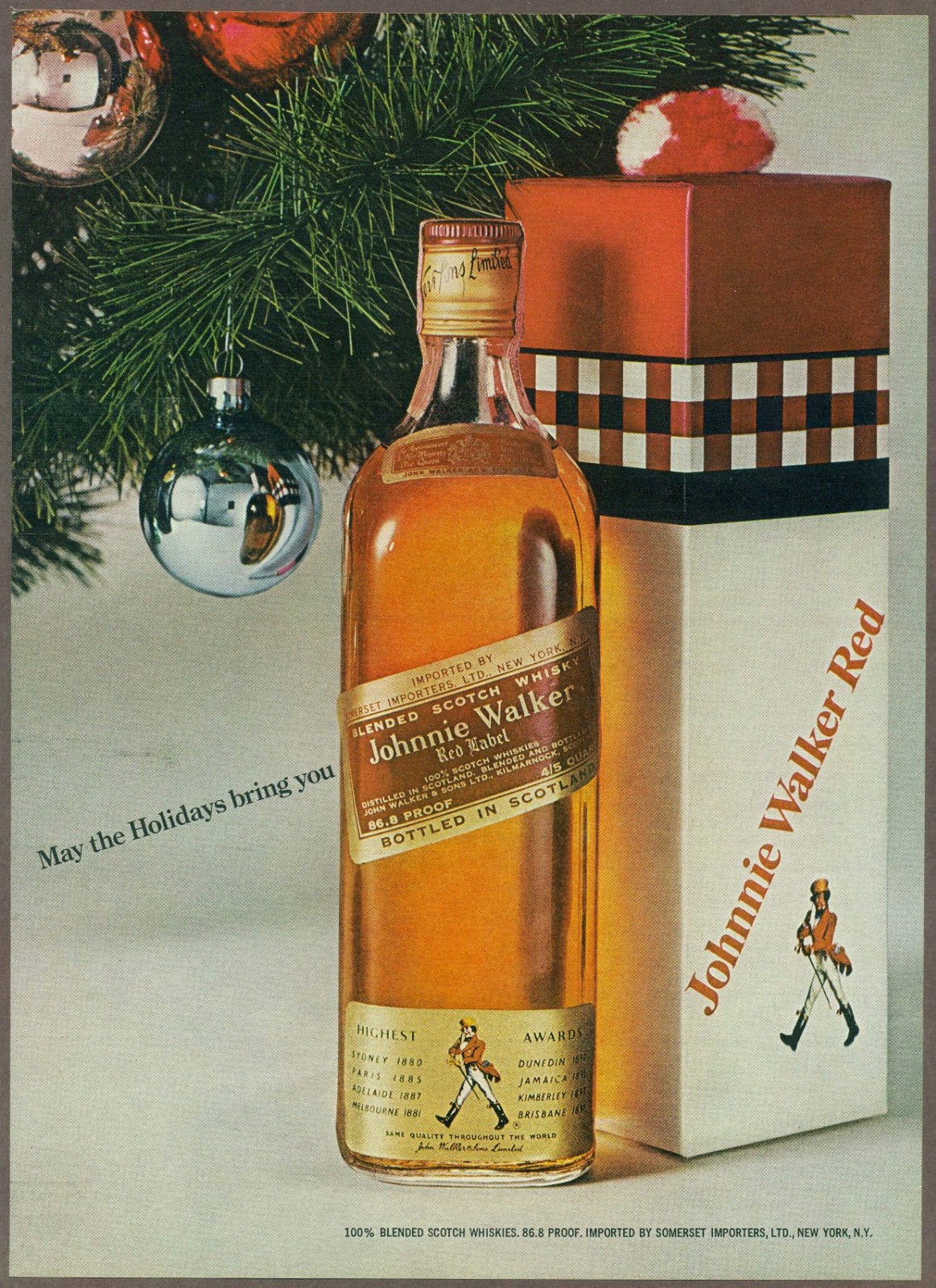
So this bottle has a tax strip, uses avoirdupois (4/5th of a pint), and has no UPC code - so were' talking about a bottle that's from the late 1970s or earlier.  You'd think a big clue would be the strength.  Current Johnnie Walker Red is 40% abv. (80 proof)  This is listed as 86.8 proof.  Another potentially likely sounding clue is the importer: the front label clearly states "Imported by Somerset Importers LTD., New York, N.Y." This shows it's a US import and thus I know that 86.6 proof is US proof.  However, a review of the advertising shows this on a multitude of labels with essentially identical style, importer, and 86.8 proof from 1967 through 1988.  Ads from 1966 and earlier show the importer as "Canada Dry Corporation" not Somerset Importers LTD.  Even earlier ads have different label details and start having cork closure.  By 1992 we have the redesigned label and icon with the "phantom" walking man and a reduced proof of 40%.  That's right, the proof wasn't reduced from 86.8 (43.4%) to 40% until 1992.  

1966 ad.  The same except Canada Dry Corporation is the importer.

1972 Holiday ad.
So where does this leave us with dating this bottle?  It's somewhere after 1966 at the earliest and the late 70s at the latest (because of the lack of a UPC code) - and it's tough to be precise.  So, bottom line, this is a late 1960s through late 1970s bottle of Red Label.  I'm struck by the 1972 and 1974 holiday ads - which show the identical bottle (but 4/5 quart bottle).  I have a feeling, aided by the provenance, that this is from the late 1960s to early 1970s - but it's a hunch. 
1974 Holiday ad.
1979 "Hotline" ad - check out the awesome phone.
But, really, so what?  Red Label is Red Label, right?  Turns out that isn't so:

Johnnie Walker Red Label (late 1960s - late 1970s dusty) 86.8 proof.


Color: full gold

Nose:  A shocking revelation:  it's good.  Really quite good.  Highland honeycomb, floral heather, some fruity esters, and a distant complicating tang of coastal air, and a rich foundation of gentle smoky background peat.  It's a rich and lovely Scotch nose - quite vivid.  This has nothing in common with the current Red Label's nose.  In fact it cleanly blows away most of the current Johnny Walker line and most regular blends.

Palate:  Heather honey, with the meadow florals showing through in the opening.  There is a grain note in the opening too - but it's good grain whisky flavor, with notes of coconut and a bit of bubblegum.  It adds freshness and complication to the Highland heather floral honey entrance.  There are also hints of mint and pineapple.  The mid palate blooms with spice overlaying a strong malt richness.  The peat shows up here too in the spice and it waxes into a gentle and very well balanced waft of smoke as the midpalate fades into the turn.  The finish is gentle, without bitterness at first, and moderately long.  There is gentle oak and an array of sweet herbals and lingering gentle peat smoke.   With repeated sipping a bit of bitterness and grain whisky milk tang builds up on the palate - prompting me to take drinks of water to clear it.  

Make no mistake.  This is delicious and I could drink it all day long.  It's rich and yet soft and easy drinking - compulsively, dangerously, easy to drink.  At no point does this call out the imperative to be mixed into a cocktail.  On the contrary it is a delight to sip neat.  The grain whisky component is readily detected - but it plays along in a really nice way with the malt.  I can feel the blenders art here and it's good.  The star of the show is the rich honeyed floral nose and the presence of those flavors in the opening.  The mid palate and finish, while fine, don't play at that level.  But heck, this was (and is) the entry level expression.  I'm really looking forward to tasting my old samples of Johnnie Walker Black!  This is a shocking level of tastiness given where Red Label's flavor signature is at the moment.

****

I'm sure the 86.8 proof helps a bit over the 80 proof that started in the 90s - but it can't explain all or even the lions's share of the differences.  I'll reserve my conclusions for the full vertical of Johnnie Walker Red from the 1930s to today coming up in the weeks or months ahead.  But it's well nigh impossible not to think of Oliver Klimek's post
Has Whisky Become Better, Worse or Just Different? 
Klimek addresses the declining complexity of malt whisky and relates it to increasingly mechanized and homogenized manufacturing methods.  This old Johnny Walker Red is in a vastly different league then the current stuff - or a majority of blends up well over $50-$75 now.  This was ordinary luxury Scotch of the time.  Whisky was simply more complex and tasty in that era.  Or does bottle maturation play a role?  This will be an ongoing debate.  But bottom line - delicious.  I wonder when that stopped?

Further reading / viewing, and corroboration


Oliver Klimek did a Red Label vertical covering this period and comes to many of the same conclusions:
http://www.dramming.com/2012/07/03/comparing-two-old-with-the-current-johnnie-walker-red-label/

Ralfy Mitchell performs this exact same tasting and comparison with more wit, verve, and humor than I could dream of - with the high wire act of a live performance.  He comes with the same conclusions flavor-wise, but attributes the changes to the use of glut stocks and to extended marrying time in the bottle:
https://www.youtube.com/watch?v=UNw7muIbQX0 

Tuesday, October 15, 2013

A shot across the bow of The Whisky Sponge

The blogosphere has been all abuzz for months with the antics of a mysterious anonymous presence known as The Whisky Sponge.  This satirist writes with razor sharp wit and a dark palette (not palate - although maybe that too).  The Sponge's target is the whisky world - particularly the puffed up, self important, bombastic, money grubbing, success oriented, and just dissipated parts.  No personage is too esteemed, or (apparently) too trivial for The Sponge's depredations.   Time and again these posts are repeatedly laugh out loud funny.  Raucously hilarious, in fact.  In the dark and often murderous and cannibalistic details of The Sponge's brilliant satire the comparisons with Swift are unavoidable.  This stuff is so good that it almost veers into the terrain of literature - except manages to stay on the side of trashy fun.


In the blogosphere and social media channels of the Scotch whisky world this new comedy blog has hit with the impact of an atomic bomb.  People speculate endlessly about the identity of this phantom.  They also joyously post and discuss when their rivals are skewered - and twice as vigorously when they or their friends are roasted (and that's what is going on here, if you haven't picked up on that already, oh swift one).  Pity The Sponge's primary targets, a few listed at random here out of the many many options: poor Blair Bowman (pierced as "Blow Hairman"), Victor Bagging Brierley (mangled brilliantly as "Victoria Shagging Barfly")  Ralfy Mitchell - always presented as himself, Ian Buxton (who is abused as the hardly disguised "Liam Buxton").  Yes - these are all live links to various hilarious Sponge posts.  This is just the tip of the iceberg.  There are dozens of named references that are probably too inside for me to get - Yankee that I am.  

Pity poor Jon Beach
There have been close to half a dozen fawning links to Sponge posts in the closed Facebook group for whisky bloggers alone.  After coming close to posting a plea for people to stop doing that, I was forced to it myself when The Sponge attacked my beloved #WhiskyFabric (a concept created by awesome Canadian whisky blogger Johanne McInnis - @whiskylassie) as captured in a Rob Gard interview - and the topic of a previous post here.  The sponge also viciously attacks all of whisky blogging as well.  This was too much for me.  Last week I posted on the FB Whisky Bloggers group:

They are trying to stop the culling of Whisky Bloggers...
"I have grown weary of the ceaseless posting of Whisky Sponge blog posts to this group (and to every other group and page I frequent across the wide Internets). I tire, too, of the ceaseless fawning praise of The Whisky Sponge - even while, granted, I'm among the most egregious offenders. However, the latest Sponge post specifically skewers whisky bloggers and had me literally laughing out loud at least half a dozen times while reading it. It (the Sponge) ends by skewering the concept of the #WhiskyFabric itself. I practically wet myself. It is necessary to post a link to it here: http://whiskysponge.com/2013/10/08/whisky-bloggers-to-be-culled-confirm-scottish-government/ Now, any time, someone satirically suggests mass murder it's almost impossible not to make a comparison with Swift. And, indeed, this is positively Swiftean. But after I stopped laughing I became angry and now vow vengeance. I suggest we all begin using natural sponge in the shower. Time to kill some of those buggers off..."

Such a move was, perhaps, tactically unwise. The Sponge clearly has eyes and ears in every whisky quadrant. It was, thus, hardly surprising when I found that The Whisky Sponge abused me publicly in its latest post. The offending part comes at the end as Mr. Sandler (and I wonder what HE did to earn the wrath of the vicious Sponge?) says the following:

“I’m completely excited. You guys will love what I’ve cooked up for you all. I’m going to get started right away with my first feature, it’s called Wanking For Whisky, basically I travel round the whisky festivals of the world with a bottle of Bowmore Bouquet and a camera goading impoverished whisky lovers to perform extreme and demeaning sex acts with the promise of the Bowmore. The funniest bit is that the bottle is just full of Drumguish. I’ve already arranged a meeting with some guy called Joshua at Whisky Live New York. He seems really keen, you should see some of the pictures he already sent me, I never even knew Bell’s Decanters were so versatile.”

http://whiskysponge.com/2013/10/15/adam-sandler-appointed-new-editor-of-whisky-magazine/

This time it's personal.

I should be outraged - and INDEED I AM. But also, oddly, tickled pink that the VICIOUS EFFING SPONGE even knows I'm alive! I WILL HAVE VENGEANCE. But for the life of me I have no idea how. I certainly can't engage in satire. That would be like stepping into the ring with Mike Tyson.

FYI - for those who didn't catch the Bowmore Bouquet reference, here is Serge Valentin's tasting notes for the monster 1966 Bowmore Samaroli bottling (which earned a staggering 97!):
http://www.whiskyfun.com/archivefebruary06-1.html#140206

And, of course, even here The **EFFING** Sponge is mocking me - because I have publicly expressed desire for a taste of 1964 Bowmore for my Birthday next year (when I turn 50) - as 1964 is my birth year. The Sponge mocks me with the highest rating being not for the vaunted Bowmore Black, White, Gold, Fino, or crazy $14,000 crystal decanter one... but for the EFFING 1966 Samaroli (which might as well be a unicorn anyway - and isn't a 1964)!   And, is it possible that The Sponge knows my secret weakness for Bell's - and even deeper weakness for hyper-mature Inchgower (the primary component of Bell's)?  Many of my recent dramming partners know this - but I've never written about it on this blog.  Is its network of spies that deep?  What can I do?

I come to you, dear readers.  Please suggest an avenue for me to grapple with this erudite and satirical Titan.  Honor demands it.  Leave your suggestions in the comments section below.  Please...

------

Update:  Rob Gard suggests that the Sponge's allegation is perhaps deserved given my expression in Greenie D. McGee (@greenietravels)'s photo of me pouring Smooth Ambler at Whisky Fest:


Monday, September 30, 2013

Why Rye... Exploring The Rebirth Of An American Spirit - Its Rise, Fall, And Revival From Prohibition Through Resurgence.

It's going to be a barn burner of a rye tasting on Friday, November 1st at the fabulous Morgan Library & Museum's Dining Room.  I've been researching the fascinating history of rye whiskey in America and I'm going to share stories and anecdotes and a full and extensive flight of delicious rye whiskies as well as a deconstructed-make-your-own rye Manhattan cocktail.  I guarantee there won't be a dry eye (or throat) in the house - and it will be quite a trick emerging from such a smorgasbord sober. 

Rye is the original whiskey of America.  Brought by central European settlers from Germany, France, Holland, and the like, rye was a hardy grain that grew well in the climate of the Northeast and central Atlantic States.  It's what George Washington was distilling at Mt. Vernon in the 18th century.  It was the whiskey that dominated the tastes and the 18th and 19th century markets of Massachusetts, New York, Maryland, Pennsylvania, Ohio, Indiana, and Illinois.  Sweet and herbal with a mouth filling spicy and bitters kick - rye is the most fully flavored distilled spirit by a country mile.  Its unique flavor signature was the quintessential American whiskey flavor and the mainstay of early mixed potables from Rock and Rye through the Rye Old Fashioned and Rye Manhattan (the original forms of these venerable drinks).

Rye was the most popular whiskey in America before Prohibition
Rye's fortunes changed for the worse with Prohibition.  Like the rest of the American spirits industry, rye production was wiped out.  While some rye was among the salvaged whiskies sold as "medicinal spirits" during Prohibition, the mash bills and specific production methods, as well as distilleries themselves, were lost.  After Repeal, production of Rye did resume in a few States - particularly Pennsylvania, Maryland,  and Kentucky - but the culture had changed.  Repeal's days of everyone drinking younger whisky may have had something to do with it, but palates shifted to prefer lighter spirits.  Bourbon was just as sweet, but had much less herbal bitters and spice.  Canadian was even smoother and lighter and Canadian's whisky's ascendance and huge dominance during the 50s and 60s helped spell rye's demise as a popular whiskey.  Rye's decline became precipitous during the rise of white spirts and by the 1970s rye whiskey had virtually disappeared from the American cultural landscape.  It had become seen as old man's whiskey.  Old fashioned.  Unhip.  Bourbon took its place in most cocktails - and Canadian whisky took its place in the rest.  Canadian is often called "rye" - and usually contains some.  But most Canadian whiskies are blends where rye plays a minority role.  However, some Canadian ryes will play a role in our tasting (bonus selections!)

Whiskey production ceased entirely in rye's old strong holds of Pennsylvania and Maryland in the period of whiskey's post-Mad Men era's fall from grace.  Only a few brands of rye hung on in limited availability, produced only in Kentucky and Indiana and forgotten by most consumers.  But, like whiskey in general in the past 15 years or so, rye is has re-surged, like a phoenix rising from the ashes.  Broadly, as a culture, America was embracing rich flavors again and rejecting the "wonderbread" aesthetic in American food and drink.  As American palates turned from light, thin, beers like Bud to rich and bitter imported and craft beers, the palate preferences in the whiskey world were bound to reignite for rye.  All the same flavor elements that make rich beer delight the senses are at play in rye - and then some.  The number of rye whiskies available has exploded and rye has resumed its rightful place neat in the snifters of Americans and in the heart of American whiskey cocktails.  It's something to celebrate and enjoy.

Rye whisky has a special place in the history of New York - and a special significance for J.P. Morgan who loved the Manhattan.  How special it is to discuss this history and enjoy these flavors in Jack Morgan's dining room.

On nycwhisky.com the listing for the event appears as follows:


A discussion of the history of rye whiskey in the United States - it's rise, and fall and subsequent phoenix-like rebirth. Particular focus will be placed on its role in the history of New York and the Manhattan cocktail - related to the scholarship of presenter Joshua Feldman, blogger of www.cooperedtot.com. The discussion will take the form of historic images, as well as an extensive tasting:
  • Rittenhouse 100
  • Angel's Envy Rye
  • Dad's Hat Pennsylvania Rye
  • Tuthilltown Spirits Hudson Manhattan Rye
  • Old Potrero
  • Willet Single Barrel Estate Rye
  • Thomas H. Handy Rye
...and some unannounced specials as well.
Also includes the deconstructed ingredients of the Manhattan cocktail for assembly and experimentation, and a small plate sampling accompaniment.
$85 if reserved by October 12, $95 beginning October 13th.
For reservations or inquiries call 212-685-0008 x589

http://nycwhisky.com/event/why-rye-exploring-rebirth-american-spirit-morgan-dining-room 


Saturday, September 28, 2013

Master of Malt Glenturret 1977 34 Year Old: Tangello Cream and a Puzzling Lack of Rarity.


There were at least six casks of Glenturret distilled in 1977 bottled in 2012 at 34 years old by four different independent bottlers.  I find that remarkable.  The consensus was that there was a "pallet" - whatever that is.  I've noticed this kind of thing before.  For example all of a sudden there are 3 different meteorite apocalypse movies in one year.  The next year there are multiple volcano apocalypse movies - in the same year.  Zeitgeist?  More likely competition or cooperation among rivals.  That doesn't explain a whole bunch of whisky of identical vintage - somehow being bottled at the same time.  The story we are told is that casks are aged and periodically tasted until someone very knowledgeable about whisky determines that it's ready.  It sounds like a pretty approximate decision: is it getting over oaked?  Can it be pushed further?  What are the odds that 34 years in, at least 4 different whisky professionals spontaneously decide to bottle their separate independent casks at the same time?  Yet that's supposedly what happened.

Four separate bottlings alone were reviewed by Reuben of Whiskynotes: Maltbarn (48.4%), Malts of Scotland (47.4%), Whisky Agency (46.7%), as well as the Master of Malt bottling (47.9%):http://www.whiskynotes.be/category/glenturret/
(spoiler alert - he likes them all and gives them all 90s and 91s).

There were also two casks of 1977 Glenturret bottled in the same years by Berry Brother's Rudd (Cask #1 at 46% and cask #2 at 47.6%):

http://www.masterofmalt.com/whiskies/glenturret/glenturret-34-year-old-cask-1-berry-bros-and-rudd-whisky/

Cask #2 of the BBR version was reviewed by Oliver Klimek:
 http://www.dramming.com/2013/05/29/glenturret-34-yo-berry-bros/
(he gave it an 86 - but he's notoriously tough).

Berry Brothers also bottled another cask of 1977 Glenturret the following year as a 35 year old at 46%:
http://www.thewhiskyexchange.com/P-20981.aspx

I presume that "pallet" means that a single independent bottler owns and ages a bunch of barrels of the same vintage and then, rather than produce 6 different single barrel offerings, chooses to sell a number of them to other independent bottlers.  If you have any specific information about this practice, please let me know.

Glenturret, by the way, is the distillery expression at the heart of The Famous Grouse.  Because of this, the Edrington Group runs The Grouse Experience there.  Glenturret is well known as a sweet and lively Highland dram with some acid bite that typically reads of peaches, apricots, or oranges combined with a creamy quality.  Single malt expressions are offered by Gordon and MacPhail - particularly a MacPhail's brown label 11 year old which I've had the good fortune to pour and taste many times (review to follow).

Glenturret is particularly famous for its distillery cat Towser.  I'll let the epitaph on her monument do the talking:


TOWSER
Glenturret Distillery, Crieff, Scotland 21 April 1963 - 20 March 1987
"Towser the famous cat who lived in the still house Glenturret Distillery for almost 24 years. She caught 28,899 mice in her lifetime. World Mousing Champion. Guinness Book of Records"


That's a very good kitty!  As for the 1977 vintage Glenturret whisky: after 34 years in oak, a lot of maturation effects should be in evidence.  The one that really excites me in very mature whisky is esterification.  Acids and alcohols combine to form chemical compounds called esters which give additional fruity notes.  Consumption of acids lowers the pH of maturing whisky as well.  Angel's share evaporation further concentrates the sugars and flavor compounds that remain.  Oak influence and chemicals from the oak, including flavorful lactones, tannins and lignans infuse the whisky.  With hyper mature whisky you get all these maturation effects in greater abundance.  The question - as always - is balance.  Is this Master of Malt bottling a good kitty?  It's hardly news that it is.

Glenturret 34 year old 47.9% abv.


Master of Malt Single Cask bottle #3 of 247.  Distilled 28 October, 1977.  Bottled May 2012.  Refill Sherry Hogshead.  Non chill filtered.

Color:  Full Gold

Nose:  Rich estery malt: honey comb, ripe melon, paraffin wax, ambergris, tangerine, bourbon-like peach compote, mineral dust, and, deep within, some musky sex smells.  Basically - an orgy in a candle shop.

Palate:  Intensely sweet and fruity opening with honey drenched over-ripe apricots, tangellos and mangosteen.  Then a big broad mouth filling expansion with malt cakes in cream, tart citrus rind, overripe melon, paraffin, ambergris, and roobios tea.  The turn to the finish brings old oak tannic bitterness - but just a hint.  It's surprisingly light on oak for such as old dram.  The finish is malty and gentle and of moderate length - perhaps surprising it isn't longer given how intense the earlier phases were.

Whiskies like this tend to be swimmers.  A half a teaspoon of water enhances the spiciness - but but doesn't take the sweetness higher until substantial time is allowed for integration.  When it happens it integrates the added spiciness with the creamy citrus estery wax honey show.  It's pretty stunning. But, the achilles heel is the tartness can trend into bitterness in the finish.  You must experiment with water with this whisky - but it's not a grand slam winner over neat.  It's a bit deceptive in this regard.

It's a magnificent whisky overall - although you could nitpick that it's a little bit tart, the finish is a tad short, and it doesn't fully open with water.  But that doesn't detract enough from its considerable strengths to make me take any stars away.

*****
     
Enjoy these old glut whiskies while you can.  The hot market is sucking them down quickly.  This is the topic of a rare diversion from tasting notes on Reuben's whiskynotes - a very thought provoking article you should check out concerning the end of the era of affordable hyper mature glut whisky:
http://www.whiskynotes.be/2013/whisky-news/whisky-is-dying/


Tuesday, September 24, 2013

Smooth Ambler Yearling Bourbon - An Infant of Power and Grace.

Smooth Ambler is an exciting, relatively new whiskey project in the heart of West Virginia.  Unlike a lot of craft distillers these days, John Little, Master Distiller, wants to make good bourbon in the classic style.  This is almost a rarity in the Wild Wild West of craft spirits where everyone is trying to do something wildly inventive, iconoclastic, and "break the mold" in one domain or another.  For many craft distillers this mean rapid maturation in small barrels, and sometimes even additional tricks to enhance rapid maturation ranging from high heat, low frequency sound, wood chips and stave chunks to enhance surface area or even mechanical pressure to force the whisky through the wood.  There's also a diverse creativity in mash bills and experimentation with what should go into the mash.  Smooth Ambler doesn't do any of this.  They make traditional spirits in the traditional way.  And they do it well.  The biggest novelty here is that they are doing it in the mountains of West Virginia.

Now a big reason that so many other craft distillers are all about rapid maturation is that they want to start selling whiskey sooner.  Smooth Ambler, like many other craft distillers, also sells a variety of white (unaged) spirits, specifically Greenbriar Gin and Whitewater Vodka (and a barrel aged gin as well).  But whiskey is the primary angle.  Instead of selling young whiskey that has been rapidly "matured", like so many others, Smooth Ambler went the route of bottling casks of bourbon and rye selected ("Curated") from other distilleries to tide them over until their own distilled bourbon was ready.  Many other craft distillers sell bourbon or rye they got from another distillery too (and many of them do not actually distill anything of their own either) - and there has been a bunch of controversy about dishonesty among what Chuck Cowdery has labelled "NDP" Non Distiller Producers because many of them play games with the labeling laws and hide the fact that they are selling someone else's juice.  Chuck asked:

"why do business with someone who makes you play stupid guessing games about the basic question of who made their product?"
http://chuckcowdery.blogspot.com/2013/05/the-rational-way-to-regard-ndp-whiskeys.html

Smooth Amber doesn't do this either.  About a year ago I wrote about Smooth Ambler's "curated" bottlings of bourbons and ryes from Lawrenceburg Distillers of Indiana, now MGP.  They have taken pains to separately brand and label their "curated" whiskeys - labelled "Old Scout" and "Very Old Scout".  They are completely, refreshingly, honest and up front about acknowledging what and where.  In that post I pointed out that Smooth Ambler did the whole brokered bourbon thing the right way - and for the right reasons (i.e. to help finance the development of a native West Virginia true straight bourbon whiskey.)  I said that buying Smooth Ambler was essentially a "patriotic act".   I stand by that assessment just as much today as I did a year ago.

John Little - nice guy - but lethal to fish
John Little, himself, is extremely appealing, by the way.  Craftsman, redneck, intellectual, and what the Yiddish call "Mensch".  Little is a complete person: family man, thinker, passionate, full of integrity.  I enjoy every interaction I have with him.  And I've had quite a few thanks to social media.  John is a redneck who loves to shoot (and teaches his kids to shoot), fish, and build stuff.  He also likes to argue politics.  Being at the nexus of a number of communities (i.e. whisky epicures, drinkers, and his West Virginia small town community) these debates tend to bring together people from across the usual cultural and political divides.  Little is Solomonic in these things.  He sees the good in every position.  In the polarized world of American politics people who can do this are a rarity.  I must confess I have come to like him quite a bit.

But what about Smooth Ambler's native West Virginia bourbon whiskey?  Over the past year or so they have released a product called "Yearling" which is a young taste of their bourbon.  This is analogous to many other new distillery's "work in progress" bottlings like Kilkerran's "Work in Progress"; Ardbeg" "Young" and "Still Young", Kilchoman's "Inaugural", and Mackmyra's "Preludium".  Yearling is Smooth Ambler's "Preludium"

It's made with a wheated mash bill (corn, wheat and barley) and the new batches (batch 11 is the current one) are aged in full size new oak barrels.  Older batches reflect Smooth Ambler's evolution.  Early batches were aged in  small kiln dried barrels and a mash bill with more wheat and less corn .  As they went along they tuned the mash bill, upping the corn, and changed the barrel management to exclusively large sized barrels.  (Specifics of the mash bill follow in Little's comments at the end of this post).   The bottle I picked up and carried around for months and months is one of the old ones.  It's under two years old - too young to be called "Straight Bourbon".  Young wheaters aren't supposed to be particularly tasty - but the proof is in the glass.

Smooth Ambler Yearling Bourbon Whiskey 46% abv.  

375ml bottle.  Aged 1 Year and 10 Months.  Batch 4, Bottled 5/28/12 by TJH.

Color: light amber and dark gold with russet glints.

Nose:  Gentle bourbon aromas of stewed stone fruits, citrus, and candy.  Lightly floral with elements of violets and mint, with a vegetal and nutty quality like unroasted peanuts.  Underneath is a lovely exotic oak aromas that come off like patchouli or sandalwood incense.   The nose is lovely.  It takes 20-30 minutes to really bloom in the glass but when it does it gets bigger and sweeter than you'd think it could.

Palate:  Sweet and gently spicy.  The opening is sweet with treacle, peach, solvent, and corn syrup and spicy with red pepper flakes.  The expansion follows quickly with a prickly warm earthy musky quality I find reminiscent of Beam: loamy and farmy - like digging in the earthen floor of an old barn.  The whole mid-palate has an elegant lean lithe quality that reads "sophisticated spirit" to me.  There's some bready yeasty notes in the late expansion.  This is the area where I most notice the youth.  At the turn to the finish there's a bitter herbal turn that curbs the sweetness of the opening.  There are notes of new leather and classic herbal bitters here.  The finish is gentle with oak and char and earthy glow.  The herbal bitter aspect lasts longer than you'd expect for such a young whisky.

 The mouth feel is gentle and light - but flavor dense and never thin.  Despite the sweet opening the whole balance is almost dry.  This is lovely, nuanced, elegant bourbon already.  At 46% there's head room to experiment with water.  Water adds to the musk on the nose, but notches down the attractive incense aspects.  A few drops amps up the heat and spice on the palate, slightly enriches the mouth feel, but also adds to the bitters on the finish.  I prefer it neat - without water.

Final verdict:  delicious.

****

It's fine bourbon now and it shows enormous promise for the future.  Wheated bourbons, in particular, tend to age well.  This is a fine distillate.  With John Little's shepherding, there is no reason to expect anything less than great things from Smooth Ambler's own bourbons in the future.  

I discussed these points explicitly with John Little.  He described the evolution of Yearling's mash bill and barrel management as follows:

"Yearling started off as 60% corn, 20% wheat, and 20% malted barley. It was all originally barreled in small casks (5-15 gallons). It was kiln dried, I believe. I think it adds to the one real negative in small casks...popsicle stick or sawdust notes. Now the recipe is 73% corn, 15% wheat, 12% malted barley....all in big barrels. So, the first stuff we release will be the old recipe and we will transition into the new recipe...but all will be from big barrels."

My bottle here is the early mash bill small barrel stuff.  That means that later batches of Yearling should be even better.  I'm going to seek out a later sample and do a head to head.  As for when the flagship Smooth Ambler native bourbon will be coming out, Little says:  

"I think it's good now but we are going to wait until 2015 for the release of our "flagship". It will be named something else, but we can't quite nailed the name yet. Suggestions?"

I'll be thinking of names.  If you have any suggestions put them in the comments below and I'll be sure to pass them along.

Monday, September 23, 2013

Monkey Business


Monkey Shoulder is a blended malt (a mixture of malt whiskies from different distilleries, not containing grain whisky) that has been on the market for almost a decade (since 2005).  It sells for a very reasonable price - around $30.  Yet, somehow it had eluded me until recently.  Events aligned to make Monkey Shoulder a part of a number of evenings over this summer.  It all started a few months ago when I attended a Tasting Table barbecue with NYC food and whisky blogger Susannah Skiver Barton (@whattastesgood) of whattastesgood.net.  She blogged about the event at:
http://whattastesgood.net/2013/07/29/cueing-up-summer/

One of the featured cocktails at the event was made with Monkey Shoulder (the "Summmer Jam".  See Susannah's post for the recipe).  Attending the event was a voluble and fascinating young Englishman named Freddie May (@oloroso) who reps Monkey Shoulder (among other interesting whiskies and spirits) for William Grant & Sons.  We had a fascinating conversation about whisky: maturation, mashing, barrel management and the William Grant operations.  Stuff like that.  My whisky geek monkey bone was tweaked.

Susannah Skiver Barton toasts a Summer Jam with Freddie May
I subsequently sought out Freddy May to see him do a tasting of the Tuthill Hudson line at The Astoria Whiskey Society (the subject of a future post).  Also at the barbecue was a young man named Nicholas Rotondi, who works at PR firm Exposure.  Nicholas has been a part of a lot of fun evenings lately (which is another story entirely).  Nicholas' role in this story was to express some surprise that I hadn't tasted Monkey Shoulder straight.  He kindly sent over a bottle for review (thanks Nicholas).  As in the manner of the Zeitgeist, I found myself encountering Monkey Shoulder again and again in the weeks that followed.  As it happens it's in my glass right now - and it's a value for the money champion with a few interesting wrinkles to its tale.

Nicholas Rotondi of Exposure: party meister
Monkey Shoulder is a blended malt composed primarily of whisky made at a small distillery near Balvenie (and operated by the William Grant & Sons - the same parent company) called Kininvie.  Kininvie, built on July 4th 1990 is on of the newer distilleries in Scotland - and Monkey Shoulder is one of the few ways to taste it (there are only a handful of single malt editions).  Most of its output initially went into Clan MacGregor.  Kininvie is only a few hundred meters away from Balvenie, and it doesn't have its own mash tuns.  It gets its mash piped from Balvenie.  Kininvie was mothballed in 2011 but then re-opened in 2012.  Now Monkey Shoulder is primarily Kininvie, but it also has malt whiskies from Balvenie and Glenfiddich as well.  It's a NAS vatting - but the age of the whiskies is around 8-9 years of age.  The "Batch 27" on the label apparently refers to each batch being vatted of 27 individual casks of whisky.  The casks used are exclusively ex-bourbon - and it shows in the color and the flavors which are honeyed and malty - without any sherry influence.  At $30 to $35, Monkey Shoulder is priced comparably with mid-range luxury blends like Chival Regal and is a few bucks less than  Johnny Walker Black Label.

Monkey Shoulder Batch 27 43% abv.

Color:  Full Gold

Nose:  Honey, malt, heather, floral bloom, wax, apple, green melon, hint of anise.  There's also a bit of distant musky almost meaty animal smell behind those sweet fruits.  All of these elements are gentle and light - yet sweet and satisfying.  It's a very pretty nose.  For the price it's stunning.

The palate after a sufficient amount of airing (20 minutes) is malt sweet on entry, with vanilla pods and florals.  Honey and honeycomb wax big - with an attractive aspect of Speyside classic apple pear and melon fruits.  Warm and malty on the expansion with some white pepper.  43% isn't the norm at this price and it brings some richness and a bit of intensity that I greatly appreciate.  The finish is gentle and relatively short.  But this doesn't come off as too young.  The spirit heat is well integrated into the malty richness.  Sweetness and fruits with a relative absence of oak tannins or bite are the hallmarks of youth here.  The palate isn't huge, but the sins are of omission rather than commission.  This comes off as a quality highland malt with a classic Speyside profile.  You can taste the Glenfiddich and the Balvenie in it in the green fruits, honey, and sweet balance.  It's a fine malt to relax with, at a price that you can use heedlessly. I've had the opportunity to dram it in a variety of circumstances and its gentle sweetness is immediately appealing with people new to malt whisky.  Yet there is enough going on to satisfy experienced malt fans (as long as they don't have their peat freak or thinking caps on).  Gentle, sweet, fruity and appealing.  Easily recommended.

****