Showing posts with label Blended Scotch. Show all posts

Friday, October 18, 2013

A Dusty Red Label From Back When Red Label was Awesome

Johnnie Walker Red Label, today, is a bottom of the line Diageo blend that is made for mixing into cocktails.  I reviewed it last year and didn't like it straight at all.  But Red Label exists in deep time - born of a marketing name change (from "Special Old Highland") back in 1909 - the year the iconic striding man logo was developed.  This is also the year the Lincoln penny replaced the Indian head cent design.  I have managed to get my hands on a number of samples of Johnnie Walker Red Label which occupy a range of periods from the 1930s through today.  But this isn't that post.  I started the tasting dead in the middle with a bottle that dates from the late 1960s to the late 1970s (I'm not certain which).  It surprised and delighted me - shocked me really.  Thus the stand-alone review.

Dating a dusty Johnny Walker Red.  


In gross terms, the first pass at dating  anything not obviously antique involves looking for these features:
1) Is there a tax strip?  They were discontinued in 1985.  
2) Is the volume listed in metric (liters) (1980 or later) or avoirdupois (pints and quarts)(means prior to 1980)
3) Is there a UPC Code?  They came into use, generally, in the late 1970s.
There are more - particularly for a slightly more recent era.  A great place to start is Steve Urey's post 
Dusty Thursday: Dating your Dusty

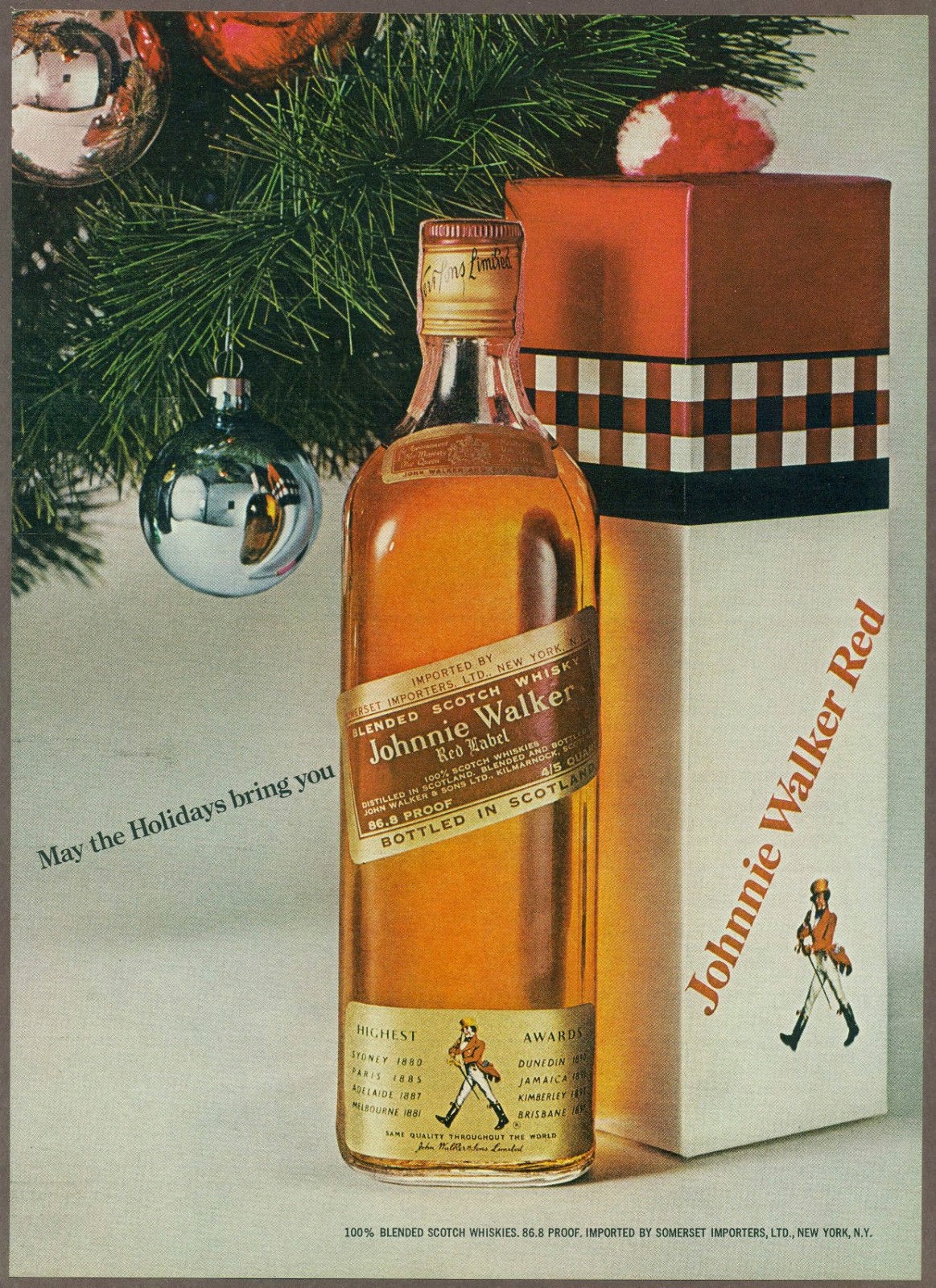
So this bottle has a tax strip, uses avoirdupois (4/5th of a pint), and has no UPC code - so were' talking about a bottle that's from the late 1970s or earlier.  You'd think a big clue would be the strength.  Current Johnnie Walker Red is 40% abv. (80 proof)  This is listed as 86.8 proof.  Another potentially likely sounding clue is the importer: the front label clearly states "Imported by Somerset Importers LTD., New York, N.Y." This shows it's a US import and thus I know that 86.6 proof is US proof.  However, a review of the advertising shows this on a multitude of labels with essentially identical style, importer, and 86.8 proof from 1967 through 1988.  Ads from 1966 and earlier show the importer as "Canada Dry Corporation" not Somerset Importers LTD.  Even earlier ads have different label details and start having cork closure.  By 1992 we have the redesigned label and icon with the "phantom" walking man and a reduced proof of 40%.  That's right, the proof wasn't reduced from 86.8 (43.4%) to 40% until 1992.  

1966 ad.  The same except Canada Dry Corporation is the importer.

1972 Holiday ad.
So where does this leave us with dating this bottle?  It's somewhere after 1966 at the earliest and the late 70s at the latest (because of the lack of a UPC code) - and it's tough to be precise.  So, bottom line, this is a late 1960s through late 1970s bottle of Red Label.  I'm struck by the 1972 and 1974 holiday ads - which show the identical bottle (but 4/5 quart bottle).  I have a feeling, aided by the provenance, that this is from the late 1960s to early 1970s - but it's a hunch. 
1974 Holiday ad.
1979 "Hotline" ad - check out the awesome phone.
But, really, so what?  Red Label is Red Label, right?  Turns out that isn't so:

Johnnie Walker Red Label (late 1960s - late 1970s dusty) 86.8 proof.


Color: full gold

Nose:  A shocking revelation:  it's good.  Really quite good.  Highland honeycomb, floral heather, some fruity esters, and a distant complicating tang of coastal air, and a rich foundation of gentle smoky background peat.  It's a rich and lovely Scotch nose - quite vivid.  This has nothing in common with the current Red Label's nose.  In fact it cleanly blows away most of the current Johnny Walker line and most regular blends.

Palate:  Heather honey, with the meadow florals showing through in the opening.  There is a grain note in the opening too - but it's good grain whisky flavor, with notes of coconut and a bit of bubblegum.  It adds freshness and complication to the Highland heather floral honey entrance.  There are also hints of mint and pineapple.  The mid palate blooms with spice overlaying a strong malt richness.  The peat shows up here too in the spice and it waxes into a gentle and very well balanced waft of smoke as the midpalate fades into the turn.  The finish is gentle, without bitterness at first, and moderately long.  There is gentle oak and an array of sweet herbals and lingering gentle peat smoke.   With repeated sipping a bit of bitterness and grain whisky milk tang builds up on the palate - prompting me to take drinks of water to clear it.  

Make no mistake.  This is delicious and I could drink it all day long.  It's rich and yet soft and easy drinking - compulsively, dangerously, easy to drink.  At no point does this call out the imperative to be mixed into a cocktail.  On the contrary it is a delight to sip neat.  The grain whisky component is readily detected - but it plays along in a really nice way with the malt.  I can feel the blenders art here and it's good.  The star of the show is the rich honeyed floral nose and the presence of those flavors in the opening.  The mid palate and finish, while fine, don't play at that level.  But heck, this was (and is) the entry level expression.  I'm really looking forward to tasting my old samples of Johnnie Walker Black!  This is a shocking level of tastiness given where Red Label's flavor signature is at the moment.

****

I'm sure the 86.8 proof helps a bit over the 80 proof that started in the 90s - but it can't explain all or even the lions's share of the differences.  I'll reserve my conclusions for the full vertical of Johnnie Walker Red from the 1930s to today coming up in the weeks or months ahead.  But it's well nigh impossible not to think of Oliver Klimek's post
Has Whisky Become Better, Worse or Just Different? 
Klimek addresses the declining complexity of malt whisky and relates it to increasingly mechanized and homogenized manufacturing methods.  This old Johnny Walker Red is in a vastly different league then the current stuff - or a majority of blends up well over $50-$75 now.  This was ordinary luxury Scotch of the time.  Whisky was simply more complex and tasty in that era.  Or does bottle maturation play a role?  This will be an ongoing debate.  But bottom line - delicious.  I wonder when that stopped?

Further reading / viewing, and corroboration


Oliver Klimek did a Red Label vertical covering this period and comes to many of the same conclusions:
http://www.dramming.com/2012/07/03/comparing-two-old-with-the-current-johnnie-walker-red-label/

Ralfy Mitchell performs this exact same tasting and comparison with more wit, verve, and humor than I could dream of - with the high wire act of a live performance.  He comes with the same conclusions flavor-wise, but attributes the changes to the use of glut stocks and to extended marrying time in the bottle:
https://www.youtube.com/watch?v=UNw7muIbQX0 

Wednesday, January 16, 2013

Dewars 12 vs Johnnie Walker Black - Beauty or Poise


Dewar's 12 is one of the "101 Whiskies You Must Try Before You Die" according to Ian Buxton - and it turns out to have something compelling to offer. But I didn't, until recently. Why? I'm guilty of "entry-level preconception". It goes something like this: ten years ago I'm on a long flight. The airline cart only has a couple of whiskies on offer and Dewar's White Label is the one I pick. I spend the next hour trying to dig out some malt satisfaction drinking it neat - and fail and bitterly write the entire Dewar's line off. The Dewar's brand became conflated with the shortcomings of the entry level offering which is really just meant for mixing. If I had had Johnnie Walker Red Label that evening instead I might have written off the whole Johnnie Walker family too, I guess.

Buxton makes the point in "101 Whiskies" that Dewar's has upped its game under current management.  I took his word for it.  I had already decided to give Dewar's 12 a whirl and had tasted a dram. I found its nose beguiling. Later that day I attended a lovely dinner party at my friend Gurinder's house. As the evening wore down a bottle of Aberfeldy 12 came out. Lo and behold, here was that same beguiling nose, with an added richness to boot. Honey and heather with some lovely soft pineapple-apricot fruity nature. The concordance between the Aberfeldy and the Dewar's 12 was striking. In fact - that's the main "problem". Over on straightbourbon.com there was a thread a couple of years ago titled "Johnny Walker Black or Dewar's 12 yr.". ABV quipped: "I'm pretty happy with both but the Dewar's makes me want to go drink Aberfeldy while the JWB doesn't". Aberfeldy usually goes for around $45 here (NYC) and Dewar's 12 is usually $35. At Shopper's Vineyard now, in the post holiday sale mode, Aberfeldy is $37 and Dewar's 12 is $30. That slim price difference easily justifies the slightly richer Aberfeldy 12 over the Dewar's 12. But both are very good. And there are plenty of times when Dewar's 12 is handy and the rare Aberfeldy 12 isn't. And the question at hand is, if the choice at the bar is Dewar's 12 or Johnny Walker Black - a very likely scenario in this big cold world - what's the choice?

Dewar's 12 (left) Johnnie Walker Black (right)

Dewar's 12 40% abv.

Color: Full Gold

Nose: honey, paraffin, heather, and a whiff of some estery fruity florals: green pear, white melon, baby's breath. It's a light but lovely aroma. It's strikingly like Aberfeldy 12 - but a tad less rich.

Honeyed, sweet, and beguilingly malty on entry, Dewar's 12 strides boldly. The mid-palate adds warm and tasty notes of baked oat cakes with butter and clover honey with a slathering of marmalade that adds candied citrus notes and the waxing verge of citrus pith vegetal bitter. Light, warm, floral and frankly full on decent. The grainy note that marks this a blend shows up at the turn to the finish. It's at the moment where the sweet waxes into wood or bitter notes in many drams. Here, it's malty melding into a younger grain note. The finish that follows is brief, gentle, and warmly malty. After the excellent nose and entry it's not a gourmet experience - but it's not offensive either. This blend succeeds in satisfying my malt whisky monkey bone and is a potent weapon in the arsenal.

*** and a high 3 stars indeed.


Johnnie Walker Black Label 40% abv.


Color: full gold, a hair darker. Doesn't mean much as both products are colored with E150 caramel coloring.

Nose: Gentle floral esters, white melon, toffee, and vanilla perfume with a bit of citrus acid and a pickle note from faint iodine and a whiff of putty peat. Later there are some wood notes and a little hint of mint.

The palate entry is sweet and creamy with malt, toffee and, heather. The mid palate brings a gentle spirit heat but also a solid cereal grain note and bit of peat smoke. The transition to the finish brings in oak vanilla notes and a sense of the wood. Very well integrated, the blend is seamless and doesn't betray an underlying grainy flavor at all.

***

Head to head, it's a little bit of a conundrum. The Dewars 12 has more wayward spirit heat and more of the unwelcome flavors of not fully matured grain whisky peeking out at the end of the mid-palate and into the finish. Johnnie Walker Black Label enjoys a smoother, better integrated, and more convincingly blended presentation. However, the Dewars has a much lovelier, more richly fragrant nose. It has the sweeter entry and the superior flavor density through the mid-palate. The Dewars' bit of untidiness in the turn and the finish doesn't erase the exhuberant power and sweet thrill of what comes before. On the whole, Dewar's 12, in the current incarnation, is a richer and more involving whisky drinking experience - and I find that, for me, this gives it the edge. It's not a clean cut or across the board win in the least. JWBL is a composed and elegantly black dressed lady with comportment and breeding. Dewars 12 is a sprightly blonde with bouncing curls wearing a beautiful if slightly messy white crochet. Which you'd rather be with is highly dependent on mood. Dewars should be commended for crafting a blend that captures the soul of Aberfeldy. Johnnie Black for crafting a blend so seamless it's not easily apparent precisely which of it's many signature is foremost at all.


Johnnie Walker Black remains a touchstone of value for me. I frequently compare it to other blends and entry level single malts and it usually wins. Here are links to other posts on this blog on the topic:

Johnnie Walker Black Label Versus Chivas Regal
Johnnie Walker Black and Johnnie Walker Red review compared head to head.
Great King St. Artists Blend is a solid effort. Is it a Johnnie Walker Black and Chivas killer?
Glenrothes Select Reserve compared with Johnnie Walker Black Label


Friday, August 3, 2012

Highland Queen 1964: An Antique Failure Fails Interestingly

In my quest to taste older whiskies with the complexity that Oliver Klimek discussed in his thought provoking article: "Has Whisky Become Better, Worse or Just Different" I came across the following listing on whiskysamples for an interesting blend bottled in January of 1964:

Thanks to the Belgian customs (never thought I would have to say this) we know this blended whisky was bottled on 20/1/1964 by Macdonald&Muir Ltd., Leith, Scotland.
What the label says: "the basis of this whisky is the matured product of two of the finest malt distilleries in the Scottish Highlands, Glen Moray-Glenlivet and Glenmorangie of which we are the proprietors."

http://whiskysamples.flyingcart.com/index.php?p=detail&pid=618&cat_id=15 

This sounded like a potentially worthy specimen which might display some of the complexity that old whiskies made with in pre-automation days are supposed to display.  Old fashioned "Golden Promise" barley would have been used instead of modern varieties. Wooden washbacks, floor maltings, oven kilns rather than drum, direct fired stills - all those sources of micro variations within a batch that may have resulted in more complex flavors.

A fly in the ointment is that Highland Queen seems limited to this single issue.  (There are plenty of references on the web to this issue - and none to any other).  Why?  Was it a dog product that just didn't taste good, so no further batches were produced?

Update: I'm wrong.  Highland Queen is an old traditional blended Scotch that is still produced.  

"First produced by Roderick MacDonald around 1893 while with Alexander Muir of Lieth. / Highland Queen Blended Scotch Whisky was named in honor of Lieth's connection with Mary Queen of Scots.  Highland Queen consists of 30 - 35 percent malt prodominantly Glen Moray."
http://www.scotchwhisky.net/blended/highland_queen.htm

I see a NAS 40% abv. version of Highland Queen available for sale in Australia ($35) right now.   I also see some 1930s Highland Queen ads on Ebay.


Highland Queen 1964 43%


Color: light gold
Nose: Honey, hay, distant sherry with citrus apricot jam and musk noted, talcum dust and a slight musty mineral note that I'm coming to associate with old whiskies - perhaps a flavor signature of bottle maturation.

Initially sweet with malt and grain sugars, the entry and expansion are disappointingly thin after the nice nose. You can taste some young grain whisky burn. However, tasting beyond the young grain there are some august notes of old style sherried malts with a bit of peat. The finish is medium short with little tannin but some wisps of oak, smoke, and malt. There is some excellent malt here, but buried beneath a young and undistinguished grain whisky.

A few drops of water adds a faint floral note and a bit more apricot on the nose. However it does more on the palate, raising some sweetness and fruity notes that fill in the flat flavor profile. It's no world beater - but the flavors that are present are interesting as old Spey malt flavors - but in diluted form. That degree of flavor dilution may be why this brand only lasted a year.  (Or, as it actually turns out - lasted over a century and still going - as is the actual case).

I can recommend this for a person who wants a whiff of the antique flavor profile - but only in that context.

***

More background to Highland Queen on Gavin Smith & Tom Cannavan's Whisky-Pages blog:

Highland Queen, 12 Year Old (Scotland)
The old-established blended Scotch whisky of Highland Queen, once a staple of the Glenmorangie business, is now part of the Bordeaux-based concern of Picard family (Terroir Distillers), which also owns Tullibardine distillery. A 12-year-old variant of the blend has recently been released to augment the ‘standard’ expression with no age statement. The nose is full and rich, with icing sugar sprinkled on pineapple, spice and black pepper. Relatively full-bodied, with spice, malt and hazelnuts on the palate. The medium-length finish features ginger and fruit and nut milk chocolate. Tullibardine Distillery Visitor Centre, Pharlanne Delicatessen, 13 Bridge Street, Kelso TD5 7HT and at www.pharlanne.co.uk 40.0% ABV, 70cl, £25.00, Pharlanne, distillery website.
 http://www.whisky-pages.com/notes/distillery.php?id=queen


Friday, March 23, 2012

Great King St. Artists Blend is a solid effort. Is it a Johnny Walker Black and Chivas killer?

Great King St.'s bottle is Edwardian elegance.
When Compass Box turned ten they announced their intention to launch a new line of blended Scotch whiskies for the mainstream market. The initial product in this new "Great King St." line is the Artists Blend. This inexpensive blended whisky is meant to appeal to first timers, people who don't normally drink Scotch, drinkers of mainstream blends, and anyone looking for an inexpensive easy drinking dram that has a bit more character than the mainstream usual blends (y'know, Johnny Walker, Chivas, Dewars, Passport, Ballantines, Teachers, Grants, Grouse, etc...). I'll weigh in, not only with tasting notes, but also with head to head tasting match ups with market leading blends Johnny Walker Black Label and Chivas Regal 12.

Here's what the Great King St. Artist's Blend (GKSAB from here on in) is made of, according to the Great King St. page on the Compass Box web site:

Whisky Spirit Character Amount (%)
Lowland Grain Whisky Fruity/perfumed 51.4%
Northern Highland Single Malt Malty, Fruity 23.2%
Northern Highland Single Malt Grassy/Perfumed 17.7%
Speyside Single Malt Meaty 7.7%

Cask breakdown:
Wood Type Flavour Impact Amount
First Fill American Oak Barrel Vanilla 62.3%
New French Oak Finish (New-Headed Barrel)
Grilled Marshmallow, toastiness, roasted coffee 27.7%
First Fill Sherry Butt Wine, dried fruits 10.0%

So, GKSAB is almost half malt, and mainly aged in oak but over a quarter aged in the spicy oak cross sessle oak barrels discussed in my previous post. There's also 10% sherry butt - a new thing for Compass Box. Let's see if we taste all this careful blending and barrel management:

abv: 43% Price at Shopper's Vineyard $37. At Union Square Liquors $43.

Color: yellow gold

Nose: Green apple, lemon curd parfait, cake batter or raw pie shell dough, a yogurt or yeast note, and a hint of sherry.  There's a bit of rawness in the uncooked bakery stuff that I don't love - but the lemony aspect is really nice.

A lovely light gold color.
Entry is sweet with soft baked fruits (apples / pears) but then a firm bright note pops up at the midpalate. Sprit heat, but also a bit of Spice Tree clove and nutmeg - but faint; more like just the tingle with little of the aromatics. There is also a note I recall from Hedonism: an acid almost like citrus, but without the tang which evolves into a touch of coconut and candy. It all rides on a firm grain body and a fairly rich mouth feel - almost creamy. At the turn to the finish there is the lemon parfait note again. It arrives with a suggestion of sherry sweetness that communicates "Scotch" to me. The finish is moderately long. It has an oaky quality, but fades to a slightly bitter finish that doesn't fit well with the rest of the presentation. It's a complex flavor profile, but a soft and gentle presentation overall.  My subjective impression is good.  It's interesting and pleasant to drink.  The complexity is clearly emerging for all that barrel management and blending.  There is oak, there is some spice from the quercus petraea spice oak.  There is the whiff of sherry.  There's a lot going on for a light and sweet dram.  This could hold your interest. 

GKSAB (left) JWBL (right)
So, how does GKSAB fare against Johnny Walker Black Label (JWBL) head to head? First of all, I'll admit that I'm rooting for Compass Box. It's a young iconoclastic artisanal company that has a clear way with grain whisky (look at their Hedonism offering). Johnny Walker is a staid old guard that has sold this flavor profile for a century (could it be coasting?) and makes a fairly nasty lower blend (Red Label).  Red Label shows me that Diageo doesn't have that way with grain whisky.  Costs are close:  GKSAB is $37 and JWBL is $34 at Shopper's Vineyard.  This is close enough to not be a factor, but Johnny is a little cheaper.

Color: GKSAB pale gold. JWBL rich dark gold - granted JWBL uses caramel color and GKSAB specifically states that it uses no colorings and is not chill filtered.
Nose: GKSAB: Lemon yogurt parfait and buttery cake batter and faint sherry. JWBL: Malt toffee, hint of peat, clear sherry note.

Flavor: GKSAB is distinctive and has complexity, but the slight thinness in the body and slight bitter note on the finish do not compare well head to head with JWBL which has a slightly thicker mouth feel and a firmer malt body through the midpalate and a more lingering wooded and graceful finish.  JWBL feels denser and tastes like it has a higher proportion of malt.  (I'm not saying that it actually has a higher percentage of malt - just that it tastes like it does).  It has a sophisticated balance that comes off as more mature.  Part of this might be the peat and bit of smoke in the JWBL flavor profile.  GKSAB feels a bit younger and thinner and more grainy.  So, JWBL wins hands down on price, density, and on hitting the archetypical "Scotch" flavor profile. GKSAB succeeds in being soft, sweet, original, and different. The difference doesn't serve as a better introduction to the segment in my opinion.  I have no problem recommending both - but Johnny Walker Black retains its place as the mainstream default pick in my opinion.  This reminds me of a survey of the ketchup market I read a few years back.  Interesting new artesanal ketchups didn't beat boring old Heinz because Heinz nailed the center of the ketchup flavor profile everyone expects and loves.  JWBL just nails the archetype of the Highland Scotch flavor profile.  GKSAB is something totally new.  It's really not a straightforward comparison at all.
GKSAB (left) Chivas 12 (right)

How about head to head against Chivas Regal 12? Here GKSAB is the clear winner. Chivas is slightly richer in color, but has the thinner nose and less richness on the palate.  Chivas' mild sweet nose is too simple by comparison with GKSAB, there is less going on.  The cake batter note in Chivas puts the flavor profile in the same light sweet doughy region as GKSAB, but with less flavor density, complexity, and heft.  GKSAB has far more interest and complexity, as well as better flavor density, more grain body, and a longer, more interesting finish.

So, in the context of the both Johnny Walker and Chivas we see Great King St. slot squarely into the pack - but clearly very close to leading.  But the uniqueness of its flavor profile and it's elegant poise makes it a compelling pick.  The lightness and softness of Great King St. is part of the family trait of Compass Box - but it works better with the floral lightness and body-tautness of, say, Asyla than it does here.  I applaud the Artist's Blend for the many things it does right - but I want more heft in the middle and a bit more oak in the finish.  Still, I can't help feeling that these are quibbles.  Great King St. Artist's blend is on my short list of recommended blended Scotches for new Scotch drinkers.
"Artist's Blend is soft and full on the palate"

***

---------------------------
Update 4/5/12:  Two weeks later I find I'm enjoying Artist's Blend even more with time.  The brightness and firmness hold up to repeated drinking.  It's a new flavor profile - but with familiarity comes affection.  Great King St. Artist's Blend is working for me.

Thursday, March 8, 2012

Chivas Regal 12 versus Johnnie Walker Black - head to head.

How many times have you ended up in a bar or a house or an airline seat where your choice in scotch comes down to "Johnnie Walker Black or Chivas Regal 12"? These are the two leaders in the "premium mainstream blended scotch whiskey" space. The choice could be much worse. There are many lesser blends loaded with grain alcohol that don't sip like real scotch like these two do. I won't name names (but some are called Dewars, Cutty Sark, J&B, Passport, Grants, and some name preceded by the word "Clan"). Anyway this essential choice has happened to me plenty. For a long time I habitually went with Chivas for no particular reason. I guess I thought all that gold foil and heraldry on the label looked more posh. Tonight (after a whole day for my palate to return) I'll be putting Chivas Regal 12 head to head against Johnnie Walker Black with 50ml miniatures sourced from a an airline beverage cart.


Chivas 12 40% abv.


Color: pale gold
Nose: Muted and gentle - but possessing appetizing and pleasing notes of cake batter, toffee, some heather and distant sherry.

Entry is light and sweet with true scotch tastes of honeyed malt. There is moderate spirit heat at midpalate but some good cereal malt backbone and structure. There is the brief suggestion of some red fruits at midpalate too - but only for a moment. At the turn to the finish you can taste some oak and some vanilla floral oak notes.
The finish is moderately short but nice and sweet with lingering burnt sugar and gentle distant oak.

Noticeably absent is the sour dairy/ vinyl / undercooked onion notes of too much Coffey still grain alcohol. The blenders at Chivas have made a nice amiable, very smooth, simulacrum of an idealized composite Speyside or Highland malt.

***

Of course so do the makers of Johnnie Walker Black:

Johnnie Walker Black Label 12 40% abv.


Color: a darker shade of pale gold than Chivas with a richer and more glittering appearance. Granted this darker color may be the result of added caramel color.

Nose: gentle and smooth, but more assertively rich with toffee, vanilla, some sherry notes, grain sugars, some floral and wood notes and a little hint of mint. Not a huge nose, but more assertive and involving than Chivas' to a small degree.

Entry is sweet and creamy with malt, honey, heather, and sweet cream. There is a thicker mouthfeel than Chivas. Midpalate brings a gentle spirit heat but also a solid cereal grain note and bit of peat smoke. The transition to the finish brings in oak vanilla notes and a sense of the wood. The finish is moderately short too, but with a real sense of wood character. There's more structure and duration to the finish of JW Black - just as there was more up front and in the middle.

***

Drinking both side by side, Chivas feels a little lighter and thinner with a bit more spirit heat. Somehow, after a sip of Johnnie Walker Black - when I take a sip of Chivas I can clearly detect the slight fishy texture, heat, and trace of the flavor of grain alcohol that I didn't notice when drinking Chivas on it's own first. Johnnie Walker Black is the clear hands down winner of the face off. Chivas comes off as a light, drinkable blend. Johnnie Walker Black comes off as almost a full malt by comparison.

To be fair, Chivas 12 goes for around $30 a 750ml bottle around here and Johnnie Walker black goes $34 - a premium of over 10%. However, there is no doubt in my mind that JWB justifies the modest premium.

Other articles comparing Johnnie Walker Black with other whiskies:
Johnnie Walker Black and Johnny Walker Red review compared head to head.
Johnnie Walker Black vs Dewar's 12
Great King St. Artists Blend is a solid effort. Is it a Johnnie Walker Black and Chivas killer?
Glenrothes Select Reserve compared with Johnnie Walker Black Label

Monday, March 5, 2012

Back to basics: Johnnie Walker Black and Red compared head to head.

Johnnie Walker blended scotches lead the world. Roughly $10-$15 separates the Red and Black expressions. Is the difference in flavor worth the money? I put up a couple of miniatures to give them a formal head to head to help calibrate my palate.


Johnnie Walker Red 40% abv.

Color: pale gold
Nose: Sour damp hay. Medicinal astringency. Some cottage cheese sour dairy, mixed with the smell of linens. There's also a raw beans aroma I associate with grain alcohol.

Entry begins sweet but with an immediate sour note of off dairy followed by some thin cereal sweetness and a hit of spirit heat. Midpalate brings malt sweetness and some minty quality I usually associate with Irish whiskey. There is a vinyl band-aid note that is connected to the opening sourness. It's a kiss of young peated whisky.   The finish is short. There's more spirit heat than I would expect at 40%. On the whole, more unpleasant than pleasant but not undrinkable. Not a whiskey experience I would repeat willingly. It mixes fine - but that's faint praise in my book. I prefer to drink scotch neat.

**

Johnnie Walker Black 12 40% abv.


Color: Darker pale gold
Nose: the real smells of malt whiskey: toffee, vanilla, grain sugars, some floral and wood notes. Not a huge nose. Rather, it's gentle, polite, and pleasing. It smells like Scotch.

Entry is sweet and creamy with malt, honey, heather, and sweet cream. Midpalate brings a gentle spirit heat but also a solid cereal grain note and a hint of peat. The transition to the finish brings in floral oak vanilla notes and a sense of the wood. The finish is moderately short, but with a real sense of wood character. I can taste the oak. It's a gentle but convincing expression of the Scottish Highland whiskey flavor profile.

***

In my area Johnnie Walker Red is $20 a bottle and Johnnie Walker Black is $34. That's a substantial difference but the Red is no bargain. $20 also buys some decent bourbon, such as Buffalo Trace. A couple of dollars more takes you to Elijah Craig 12. There's no comparison there. There are inexpensive scotch blends that I'd prefer too, such as Arran Robert Burns, Teacher's Highland Cream, White Horse or Famous Grouse. Red simply doesn't fly, in my opinion.

Johnnie Walker Black at $34 is not a bargain either, but it's a reasonable selection. Black has enough real aged malt whiskey that it really tastes like a 12 year old Highland malt whiskey. It has a gentle soothing creamy sweet character, but it also has a real wood and malt character. It plays straight over home plate - trying to approximate a mythically centered Speyside malt. The result is more polite and unobtrusive than any single malt I know - but it has the flavor profile of many 12 year old single malts. It's a solid effort and a fine pick for someone who wants a gentle utterly safe and predictable malt whiskey experience. I'm not so much of a snob that I'd look down my nose at such a choice. It has its place and JW Black fits that role just fine.

That being said, I personally would prefer any of a number of other selections at that $35 price point. Among blends at this price, JW Black is strong. Douglas XO is the only comparably priced blended offering that might edge it. Competitors like Chivas 12 don't beat it. However there are strong single malt competitors at this price - but not all are a lock. For example, right now Bruichladdich Rocks is discounted at that level, as is Glenmorangie 10. Both are miles ahead of JW Black. Aberfeldy 12 and Glenlivet 12 are also at this price point (or very close), but those are less of a clear victory. I might take JW Black over Glenlivet 12, but not the Aberfeldy. Glen Garioch Founder's Reserve (the non-age statement version) is just under $38 and that's a step up from JW Black, too. Ardbeg 10 is just over $40 and it's a whole different world and then $40 is a different price bracket altogether - one that includes Macallan Fine Oak 10 - also a step up. My point here is that Johnny Walker Black plays above cheap blends and plays strong among solid blends and entry level single malts. It has a flavor profile that hits squarely in the center of what most people think of when they think of Scotch; with no flavor element significantly out of place. It's not exceptional in any particular way, but neither is it deficient. It's a clear contender, if not a striking value at its price point. It's certainly not embarrassed by the competition.


Other articles comparing Johnnie Walker Black with other whiskies:
Chivas Regal 12 versus Johnnie Walker Black compared head to head review.
Johnnie Walker Black vs Dewar's 12
Great King St. Artists Blend is a solid effort. Is it a Johnnie Walker Black and Chivas killer?
Glenrothes Select Reserve compared with Johnnie Walker Black Label