Showing posts with label Tastings. Show all posts

Sunday, August 17, 2014

Hibiki 17 and 21 Japanese Blended Whisky's US Launch And The Nature of Beauty

Hibiki 17 and 21, Suntory's blended whisky in the sweet spot age statements, will hit the US market this fall.  The announcement came in May, at a launch event in New York which was interesting in a number of ways.  For me, the whiskies (and the event) provoked an internal debate about the nature of beauty.  While it's subjective - and "in the eye of the beholder", there are some real philosophical issues.  Beauty is about ideas such as "harmony", "regularity", and "balance".  These are exactly the aims that whisky blenders strive for when making blends.  There is a tension between the individual and the harmonic whole in the notion of beauty - and it shows in a wide variety of domains.  It comes back to whiskey because Suntory chose to do something interesting in introducing the mature Hibiki 17 and 21 year old blends to the American market: they did a tasting with the major components tasted separately and then, at the end, together as the blended expressions.  G-LO over at It's Just The Booze Dancing... put it thus: "a Deconstructed tasting of Hibiki":
The structured tasting treats each of the components as an individual instrument in an orchestra.  Then you finish with the ensemble.  Suntory spoke a narrative of obsessive perfectionism in the crafting the many components and, indeed, the individual whiskies, from the grain, to the ex-bourbon, sherry cask, and Japanese oak all were stellar.  Indeed, they overshadowed the ultimate blends in some ways.  And this got me to thinking - as I have many times before, about the divide between the individual and the collective and the issue of averaging when it comes to beauty.

For example, in Bach's Violin "Double" Concerto BWV 1043:  I Vivace and III Allegro particularly - the 1960s version with  Itzach Perlman and Isaac Stern and Zubin Mehta and the NY Philharmonic - all these elements are laid bare.  
(you can hear the first movement, Vivace here:  https://www.youtube.com/watch?v=vesrqFeq9rU )
(and the third movement, Allegro, here:  https://www.youtube.com/watch?v=x6gOeE5QTXk )
Bach's piece, among the most brilliant and beautiful pieces of music ever written in my opinion, features a tension, fire, and relentless drive in an aching minor key.  The melody shifts back and forth among the orchestra, and two dueling violins.  In this case we have the youthful brilliance of Itzach Perlman ascendant taking on the old master, Isaac Stern.  Some times they play together and other times taking turns with the same melodic phrases, each one challenging the other to match the virtuosity, timbre, and verve just laid out.  Beauty happens in the massed strings.  The solos are not timbrally as rich, but they are more exciting, delineated, and clear.  Each is a tightrope act.  It's the solos I remember and why I put this track on over and over again.  The sonics of the recording are pretty flat, but the energy these two geniuses bring to celebrating (and out-doing) each other produces the finest performance of this amazing piece.  Is it more powerful and beautiful when they play together or when they are alone?  It's subjective, but I find the moments when they are alone to be more affecting.  But it's the contrast of the back and forth that really makes it that way.

This put me in mind of the topic of averaging and the study of how humans perceive beauty in human faces. I wrote about how this relates to whisky several years ago in a guest writer post on Rachel MacNeill's  WhiskyForGirls.com that was about how carefully tasting whisky can transport you, intellectually and emotionally, called "Whisky is a Time Traveler":

"Blends can be delicious but the definite sense of terroir is lost. For example, when I drink Johnny Walker Black Label I enjoy the sweet heathery Highland opening, the firm malt foundation, and then the whiff of peat smoke and oak in the finish. But the lightness and glossed sameness of each encounter I sense the blender’s art in barrel averaging and expression blending as a way of making beauty exactly like the way a number of faces computer averaged looks very pretty – but not like any one human’s actual face."

"These averaged faces are attractive, but they are not real. Real faces have imperfections that reflect their actuality, their history, their individuality. These faces are more attractive than most people, but somehow cannot match the great beauties who have real character. The same thing goes with whisky. Barrel averaging and blending produce a smoothed impression, more perfect and beautiful than the average barrel, but without the depth of character and individual fidelity that you can find in a great cask.
"
http://www.whiskyforgirls.com/?p=607

Lisa DeBruine and Ben Jones, who run the Face Research Lab at the University of Glasgow Institute of Neuroscience and Psychology run a web site as part of their research into face averaging and perceptions of beauty.  In the historical summary area they write:

"In the 1800s, Sir Francis Galton created composite images of faces by projecting face photographs of many different individuals onto a single piece of photographic film. This was done in an effort to visualise the facial characteristics that were common to a particular group of people (e.g. to represent the typical face of criminals or soldiers). When Galton showed these images to his colleagues, however, they unanimously agreed that these composite faces tended to be more attractive than the individual face photographs from which they were manufactured (i.e. the composites tended to be more attractive than their constituent faces)."
http://faceresearch.org/students/averageness

The great thing about this site is that you get to try it out for yourself - here:
Here's an example.  I selected the 3 faces on the left, below and then averaged them and got the face on the right.  It's rather stunning.  
These three faces combine to yield this...
...averaged face.


The individual faces are each distinct, unique and individual.  They include features that are deviations from the norm.  The averaged face pulls all these deviations towards the mean - a "regression to the mean" which produces more average proportions, angles, and sizes, to the features.  Our human interpretation of this is "beauty".  By picking flawed faces it highlights the improvements.  If you tossed Grace Kelley's face in there, or any other face you love (Meryl Streep), you might consider the end result a step down, however.  But take the point: beauty is harmony and averaged to the mean is harmony.

Her's the interface where can select many faces to average, exploring the process.
This is, in a visceral and immediately comprehensible visual way, what's going on with barrel averaging and good blending.  Individuals - "warts and all" become beautiful when they regress towards the mean in large batch averaging and blending of whisky.  This was the genius of 19th century Scotch blenders like John Walker, John Dewar Sr., and Archibald Ballantine, who took individual malts that were inconsistent and sometimes unpleasant and produced blends which created a happy medium that possessed, somehow, more beauty than the average component.

(right): Sarah B. of  http://beautifultangiblethings.com
Sarah B. and Allison Patel watch the presentation by Suntory chief blender Seiichi Koshimizu
The Hibiki 17 and 21 launch event in New York in May was designed to emphasize the beauty of the blend, not from the point of view of averaging out the flaws - but from an obsessive artisanship that is about making each of the components perfect.  Elegant simplicity in the layouts and graphic elements which included references to trees (with the connotations of the seasons - fall being the launch date) and visual reference to the simplicity and art of classical Japanese calligraphy.  Suntory's Chief Blender Seiichi Koshimizu spoke eloquently about the crafting that goes into the component whiskies that make up the Hibiki blends.  These components formed the body of the tasting.  On the tables were 6 selections:  Chita Grain Pure Whisky, Yamazaki American White Oak Malt Whisky, Sherry Cask Malt Whisky, Mizunara Cask Malt Whisky, followed by Hibiki 17 and Hibiki 21.  It wasn't clear if the Yamazaki White Oak, Sherry, and Mizunara were the OB bottlings of these expressions sold in Europe and the Far East, as reviewed by Alwynne Gwilt in October of 2012 on her blog misswhisky.com:
http://misswhisky.com/2012/10/11/trying-the-stylish-yamazaki-four-woods/
Alwynne provides fantastic tasting notes and some insights into those expressions - which jibe very well with what we drank.  It's also possible that they provided examples of what went into Hibiki - which would have been older.  Update: Thomas Øhrbom of http://www.whiskysaga.com/ just provided a photo of a menu at the Yamazaki Distillery bar which showed that Suntory does sell the Hibiki 17 ingredients (fully 17 years old and over-proof) as pours there.  I will use the age and proof statements from that menu in the post below.  One thing is for certain - these Yamazaki wood examples were superb - and they were clearly a higher proof than the Hibiki blends which followed them.  

The following tasting notes are a composite of notes taken at the event and follow-up tasting sessions at home using samples I took from the event.  I'm providing composite star and points ratings to underscore fine differences in how I rated these excellent whiskies. 
Sarah B.(left)  and Allison Patel of Brenne (right) get into the Chita grain.

Chita Grain - 17 years old 55% abv

The intensity of flavor definitely indicates a bit higher proof than 43%.  Tasted head to head with Nikka Coffey Grain (45%) and Greenore 15 (43%) (the subject of an upcoming post) the Chita was definitely more intense and richly flavored.  And while all 3 were delicious, the Chita took the grouping hands down.  A really special and very tasty set of flavors.
G-LO of Booze Dancing
Color: gold
Nose: sunflower, honey, dust, vanilla, creamy custard, and some distant notes of red bean and sawn oak..
Palate:  lush sweet vanilla cream opening with creme broulle custard.  Light and elegant mouth feel.  Butter and creme broulle with some herbal aspects of sunflower and gorse.  The sweetness becomes incense-intense on expansion, waxing in buttery Scotch-malt highland flavors with a hint of salt.  The expansion continues into rich malty flavors and white oak.  The finish is moderately long and lightly herbal.  Just beautiful grain whisky - stunning and intense and as fully flavored as any grain whiskies under 30 years I've tried.

91 *****

Yamazaki American White Oak - presumably 17 yo 54% abv 

Color: gold
Nose: floral vanilla, coconut, creamy tropical fruits (papaya, and mandarin orange)
Palate: honey and floral vanilla on the opening - which was big, sweet and explosive.  Honey, brown sugar, stone fruits and rich malt on the mid palate.  The bourbon barrel's influence is clear, but the Yamazaki distillate is in command with fruitiness, and Highland malt flavor fully in the Scotch whisky wheelhouse. The turn was full of rich oak.  The finish long and satisfying with oak tannins, herbals, and a hint of char.  Stunning.

90 *****

Yamazaki Mizunara Oak - presumably 17 yo 52% abv.

Color: dark gold with an amber tint
Nose:  Complex and sweet with floral perfumed intensity, stone fruits and cherry and a nutty (almond or pecan) quality that rode over a buttery aspect.  Hatbox oak lurked underneath.
Palate:   Big, intense, and stunning on the opening with candied citrus and rancio.  The expansion brought tropical fruits and darker complexity of tobacco, some coastal iodine notes, and a bit of char.  Spiciness and herbal bitters blossomed on the turn and the finish - which was incredibly long and amazingly satisfying with herbs and  a touch of smoke.  This was the pour of the night for me.

A drop of water took the spiciness higher, and enriched the mouth feel and sweetness.  Stunning.  The spiciness had a clove/nutmeg spice aspect, rather than peppers.

93 *****

Yamazaki Sherry Oak presumably 17 yo 49% abv.

Color: dark amber.
Nose:  sweet sandalwood, cocoa powder, mashed dates, old polished oak furniture.  Deeper, some plum fruit and magnolia florals.  
Yamazaki Sherry Oak
Palate:  The opening is unexpectedly dense and dry, with focused oak, dark and tannic, up front with bittersweet chocolate, raisins, and prune essences.  The mouthfeel is light.  The expansion brings a ton of congnac-like rancio, old sherry, and oak furniture.  The turn is bitter with tannins.  The finish is long with dark oak, bitters, rancio, and some residual spiciness.

Adding a few drops of water introduces a kiss of sweetness up front, more body to the mouth feel, and a note of malty molasses to the mid-palate and finish that is beguiling.  The finish takes on a vibrant spiciness that I have come to associate with Spanish oak.  This is downright luscious with a drop of water - strongly evocative of great Glendronachs.

92 *****

Hibiki 17 - 43% abv.

Color pale gold
Nose: floral plum blossom, magnolia, and honeysuckle.  Richer aromas of honey, honeycomb, tropical fruits, linen, light oak and mineral.
Palate:  sweet and floral on the opening, with honey, vanilla, and the characteristic Japanese musky sweetness I used to call "orchid" (until Sarah B. challenged me that most orchids don't have an aroma).  Purple fruits (plum and fig) and light hints of lighter green fruits (quince, green apple, and mango) and malt richness on the expansion.  Rising spiciness and oak on the turn.  The finish is fairly long with spiciness, oak tannins as light bitter, lingering toffee and hints of floral fruitiness.  Just lovely.

A few drops of water increases the sweetness and, particularly, the spicy notes in the mid-palate and finish but reduces the floral intensity of the nose and opening.  It's worth trying with a drop, however, as it ends up making Hibiki 17 a tad more lush and involving overall.

89 *****

Hibiki 21 - 43% 

Color: dark gold with amber tints
Nose: richly floral:  magnolia and roses, dates, honeyed cakes, tropical fruits, linen, and sharper notes of dark oak.
Palate:  big dark fruity sweet opening with plum jam, some complicated filigreed incense sherry or port dark vinous sweet, and toffee.  There is also that particularly Japanese complex sweet fruitiness which I have trouble putting a name too, but is diagnostically Japanese.  The mid-palate expansion brings clove-cinnamon spiciness, a mixture of dark fruits like plum and fig and lighter acidic fruits like green plums, green apple, pineapple and mango and clear note of sherry with cocoa.  Oak tannin shows up too in the mid-palate and the turn adds sheery-like rancio, dark oak, and herbal bitters.  The finish is long, sherry rich - nutty and cocoa - and lightly herbal as well.

92 *****

Conclusions:  The big issue with Suntory in the US is the availability of the good stuff in the US.

When Suntory took over Beam International earlier in the year I wondered aloud (i.e. on this blog) whether this would mean more availability of the top expressions here.  There was little reason for hope - given the limited quantities.  The timing of the Hibiki 17 and 21 introduction in the US indicates, to me, that it was probably in the works even before the purchase of Beam.  But it's clear the US market matters to Suntory and that's great.  Maybe part of it is that Anchor is now importing a big portion of the Nikka line (and we American's are all the richer for the competition).  Last fall brought Hakushu Heavily Peated to the US, now this Fall we get these Hibiki gems.  However this tasting left me pining for Chita Single Grain and the Yamazaki Four Woods series which are not available in the US.  They were the unintended stars of the show.  They were introduced as examples of the quality crafting that goes into Hibiki, but, tasted head to head, they rivaled, and in some areas exceeded the Hibikis.  Part of this almost certainly is because they were bottled at higher proof.  This left me pining for Hibiki at higher proof.

On The Nature of Beauty

The tasting underscores the issues between the beauty of the individual voice and power of the massed chorus introduced earlier.  Just like those moments in the Bach Double Concerto when Perlman and Stern took solos, the Yamazaki individual wood expressions were direct, powerful, and compelling.  The Hibiki blends filled in with greater complexity and balance, but less compelling interest overall.  Part of this I firmly believe is the fact that Hibiki's are lower proof.  But part of it has to do with the nature of blending itself.  It is intuitive that a combination made of fantastic components will be fantastic - and the Hibikis are.  But it says something to me that the brilliance of the individual components is not immediately additive to yield a whole greater than the sum of its parts.  In the blending to yield Hibiki something is gained and something is lost.  Gained is complexity, a cohesive beauty, and evolution across the palate.  The Hibikis are glorious.  But lost is the power and distinctive natures that made tasting the Yamazaki woods thrilling.

After the tasting the Hibiki launch event was glorious too.

The Hibiki 17/21 launch event was a party with lots of friends and Exposure's consummate production which included gourmet food bites, superb Japanese style mizuwari, highballs, and ice balls.  There was a superb demonstration of a new ice ball called the Ice Diamond (I refer you to Mark Gillespie's WhiskyCast video and interview - links below).  Incredibly impressive to me, the correct glassware was used to serve what seemed like limitless quantities of the top expression: Hibiki 21.  This top notch event spawned a number of interesting blog posts and conversations.  Here follows links and some pictures to give the flavor:

Mark Gillespie prepares to interview Seiichi Koshimizu - on WhiskyCast episode 480
Malt Maniac, Mark Gillespie, produced several posts from this event on his top podcast and blog WhiskyCast.com.  
The Hibiki 17 & 21 launch notification:
An interview with Seiichi Koshimizu, chief blender for Suntory:  
A WhiskeyCast HD video of  Hidetsugu Ueno of Tokyo's Bar High-Five cutting ice diamonds:
and an interview with  Hidetsugu Ueno about his bar and the Tokyo whisky bar scene:

G-LO and Miracle Max
G-LO wrote up a consummate description of the entire event, including cooperatively blogged comments from most of the #WhiskyFabric in attendance including Allison Patel, Susanna Skiver Barton, Miracle Max, and Sarah B:
Sarah B. and G-LO
Sarah B - a correspondent of It's Just The Booze Dancing... blog as well as a gifted photographer took the best pictures of the event:

Mark Gillespie and G-LO enjoying Hibiki 12 ice balls.  Mark also has a Hibki 21
The author meets up with with Allison Patel (left) and Sarah B., right.
Bram Hoogendijk from Holland meets Edrington Group rep Nicola Riske
Bram and Allison meet Seiichi Koshimizu
Susanna Skiver Barton and Allison Patel enjoying Hibiki 21
Hidetsugu Ueno of Tokyo's Bar High-Five pours Hibiki 21 on a hand cut ice diamond

Saturday, July 26, 2014

Reuven Weinstein's Warm House... And The Killer Blind.

Hanging out on the Internet Bourbon forums you meet and befriend a lot of interesting people.  I love meeting these people in real life.  I've met Reuven Weinstein - a master dusty hunter out of New York - a number of times, but recently I had the great pleasure of spending the whole afternoon with him and his lovely wife Ilana (who was his public face of Facebook for a long time) at his home in Rockaway Park / Belle Harbor.   Ostensibly a house warming - the house has a real story of destruction and rebuilding.  The Weinsteins just recently moved into it.  There was a ton of delicious home made salads, hot wings, and world class smoked BBQ brisket.  Just delicious.  And there was also whiskey - lots of it.  The very best stuff.  Because Reuven is a master whiskey hunter.  The pictures and tasting notes below speak for themselves - but they aren't the reason for the post.  Not at all - but that will come later.

FYI - a different take on this smorgasbord was written up by my friend (and partner in crime) Steven Zeller, The Smoky Beast here:
http://smokybeast.blogspot.com/2014/07/rock-rock-rockaway-beach-tasting.html

Reuven is well known in the American whiskey world.  He is a prodigy - a talent at entering neighborhoods that others wouldn't bother with and somehow coming out with a trunk full of absolute treasures from the liquor stores there.  As Reuven toured us through a small portion of the fabulous whiskies he has collected I was amazed time and again by both the fabulous range - from dusty bourbons and the rarest issues to fabulous single malt - with a focus on spectacular and hard to find silent distilleries - and also by our hosts tremendous generosity.  What we tasted that day is not to be forgotten.  And it was but a peek into his fantastic collection.  Which only underscores a curious and oft remarked on fact: Reuven doesn't drink whiskey.  Nope.  He enjoys nosing it.  He produced a 1984 vintage single cask Yamazaki which he particularly enjoyed nosing.  I must concur - it had the most remarkable nose:  a complex and evolving aroma that started with dark cocoa with a hint of anthracite coal combustion (just a hint) and then moving into rich fig pudding baking in rum, and then on to a rich earthiness made farmy by a bit of animal skins.  I could nose that thing all day too.  But ultimately I want to take a sip.  I suspect Reuven will too, someday soon.  I can see the curiosity burning in him.  Meanwhile, his personal code and clean habits keeps him holding back. After Reuven and Ilana served a killer spread of sweet smoky BBQ brisket and lovely home-made sauced hot wings, with homemade slaw, potato salad, green salad and all the fixings,  I made the fatal error of pouring an award-winning Cotswald village Sloe Gin as an after dinner apertif.  Wrong stuff for that crowd!
But, before that happened a lot of whisky got tasted

When I encountered the spread of whiskey on the table my eyes lit on two things right away.  One The Parker Heritage 27 year old legendary PHC2 which I had never tried before.  And right next to it was a 1980s vintage octagonal Wild Turkey 8 year old age statement 1.75 Liter handle.  NOW WE'RE TALKING!  Parker Heritage 2nd edition 27 year old is a legendary statement product from Heaven Hill.  2008 Malt Advocate Magazine's American Whiskey of the Year.  I had tried and enjoyed a Wild Turkey 101 8 yo octagonal handle from the early 90s with Mike Jasinski a little while back.   Lately I've been going deeper with Wild Turkey, and there's a strong argument for the 8 year old WT101 of the 70s-90s as being one my favorite primary expression (i.e. not barrel proof) bourbons.


Parker Heritage 27 48%

Color:  Dark amber
Nose:  Rich rancio malt, sweet sherry nutty rancio, mead honey, deep iterated bourbon vanilla pods: sweetness.  Then tempered by buttery notes and oak incense.
Palate:  Sweet honey malt opening. Waxing into acetone-citrus with ripe cantaloupe, salted caramel with tannin spiciness on the finish.
Light texture on the mouth feel but big spicy finish.  This stuff is a lot like really old cognac with its darkly vinously sugared and oake loaded luxury.  Among the darkest, richest, most indulgent Bourbons I've ever tasted.  A really memorable pour (tasted both at the event and with a 1oz sample tasted at time of writing).

*****

Wild Turkey 101 8 1987 - Octagonal handle 50.5%

This is excellent Bourbon that I've been tasting in a number of contexts.  Here, it's a clear object lesson in the dangers of drinking something you really like immediately after an epic, world class whiskey.  Let's just say, the right time to enjoy a WT101 8yo age statement dusty is NOT immediately after tasting PHC2 27 yo.  Sweet and spicy as decently complex as WT101 was back in the day, it can't hold a candle to the glory cask selected wonder of that PCH2.  It's an unfair juxtaposition.

Color: medium coppery amber
Sweet and comparatively gentle stuff.   Nose:  warm and malty with herbal wafts and a oak sandalwood essence undercurrent.
Palate:  malty juicyfruit opening with both magic marker and candy dish notes.  The mid palate expands into brown sugar, herbal rye spice, warm honey, and sweet alfalfa turning into rye herbal spiciness and then a gentle oak tannin grip with a moderately long finish. Decent density in the mouth.  A perennial favorite, but completely shown the door in that head to head.

****


Lombard Jewels of Scotland Brora 22 50%

Distilled 1982, Bottled 2004, 22 years old.

Color: Gold
Nose:  Heather, honey, waxy
Palate:  Intense honey, turkish delight (powdered sugar, fruity, nutty)., paraffin, heather florals, meadow grass.  Not peaty or farmy.  Lightly tannin spicy finish is the only hint of age.  A heathery honey highland beauty.  With the waxy floral notes this came off like a Clynelish.  Light and beautiful - but oddly not complex considering it's age and method of manufacture.   I could sip and enjoy this one all day.  A true "session Scotch".  This bottling is all about the sunny, floral, honeyed beautiful side of Brora.  Missing is the earthy farmy animal manure aspects, the peat, smoke, and darkness you often see with that distillery.  I greatly enjoyed it.

****
(borderline *****)

Highland Park 25 48.1% abv.

Color: light medium amber with coppery glints.

Nose: Heathery wild meadow florals open up for rich malty rancio riding on dusky animal farmy warmth and some underlying peat and sea coast.  Fig cake and old sherry and leather notes play in the middle where the rancio lives.  As it opens, safflower oil and then marigold yellow florals join the heather, sherry, coastal light peat aroma show.

Palate: Sweet and rich on opening with black raisins, stewed black figs and malt sugars tempered by a whiff of brine.  The expansion brings vinous dark sherry notes of purple fruits and leather and tobacco.  It waxes into rich dark oak a satisfying warmth of gentle well integrated coastal peat and tails into a long, sweet, spicy finish with wood and smoke wrapped around the herbal tail of the malt and the lingering sweet of sherry rancio.  This is a full bore beauty of significant complexity and fills your mouth with a tour of the wide gamut of Scotch Whisky flavors - all of them.  Floral, honeyed, sherried, peated, and coastal all combine to make this beautiful spirit.  Like the 12 and the 18 - but with the darkness and intensity cranked up with maturity.  What a beauty.  Impressively, this stood up to the competition on the table with aplomb.

*****

Hirsch Single Cask Canadian 12 53.1%


The rear label only says Candian Whiskey * Single Cask * 12 years old * Lot 98-1 Bottled by Hirsch Distilleries Lawrenceburg, KY for Priess Imports, Ramona CA and bears a sticker in Japanese for sale in the Japanese market.  Rare and interesting as the odd-man-out bottling in the brief but now legendary association of Julian Van Winkle III's bottling operation with Priess Imports which had taken over the A.H. Hirsch lot of 1974 Bourbon from Michters and had started picking up odd lots and bottling those without the "A.H.".

Steve Zeller toasts w PHC2. Anthony Colasacco, right.

Color: light gold.
Nose: honey, herbal cedar with pencil shavings and mineral flint.
Palate, sweet and lean and honey-floral on entry.  Light and clean on the expansion where herbal spice, light clean mineral, and  a bit of grapefruit fruit and also pith astringency take over.  It tastes like a good Canadian blend of a corn base and rye flavoring whiskey.  I wonder what it actually is and which of Canada's distilleries it came from.  My guess would be Alberta distillery.  It has some of those Alberta Premium whiskey flavors.  Very refined for what it is.  Nicely balanced.

****

This somewhat legendary odd-ball bottling was a housewarming gift of Anthony Colosacco who is best known for his utterly fantastic whiskey bar in Mt, Kisco:  Pour Mt. Kisco.  It's the kind of bar where you can get a flight of Pappy Van Winkle Family Reserve - or all 3 Rittenhouse 21, 23, and 25.
http://www.pourmtkisco.com/


Pappy was well represented on the table with a bottle of Pappy Van Winkle Family Reserve 15 from 2006 and also a 2006 or prior (pre-laser stamped) bottle of Van Winkle 12 Lot B that Ari Susskind had been involved in locating.  Great guys and a great whiskey.  Soft and gentle Stitzel-Weller wheater flavors: mellow cherry root beer sandalwood incensed oaky loveliness.

Ari Susskind (left) Reuven Weinstein (right)


As the party was winding down, our host brought out nicely full glencairns with a mystery blind.  The aroma and flavor were clearly in the lightly sherried highland Scottish malt category.  Steve and I bothed initially guessed a  Macallan dusty.  I had to pull a chair aside and really focus.  My quick notes read:

Color:  amber
Nose, floral incense, hard candy, fig cake, sherry, leather

Palate. Intense (50+% abv) Honeyed, minted fig melon candy black plum with some apple skin waxes into big oak and spicy heat.  Hint of clean highland peat or just big oak tannins.  Maybe some active Spanish or French oak going on?  Inchgower?

That intense perfumed floral candy aspect of front, combined with a some of that unripe apple tartness put me in the mind of Inchgower - but also An Cnoc, Balblair, and Tomatin.  Yet this particular whisky clearly wasn't any of those.  I was purely stumped.  Later that evening Reuven texted the reveal:  It was

Convalmore 36 - 1977 Diageo office 2013 realease 58% abv.

(notes above) *****
A retail listing of this whisky at TWE (where the picture is linked from):
http://www.thewhiskyexchange.com/P-22036.aspx

Convalmore is one of the legendary silent stills of Scotland, founded in 1893 and closed in the glut days of 1985.  The story is well told on Malt Madness:
http://www.maltmadness.com/whisky/convalmore.html

When I got home I had to put it up against  this 10 cl sample of Connoisseur's Choice Convalmore 17 40% Gordon & MacPhail 1981-1998 (bottled by Van Der Boog, Holland - and brought to a recent tasting by my friend Bram Hoogendijk - thanks Bram!)


Convalmore 17 40% Gordon & MacPhail Connoisseur's Choice 1981-1998

Color: Gold
Nose:  Honey and floral heather with a hint of white white tartness, chalk mineral, and yellow grass in the Sun.
Palate: Sweet and gently honeyed on the opening with an immediate tart crisp apple skin quality.  Floral and tart fruit on the expansion with a dry perfume aspect on top of a rich barley-malt chassis.  The turn is all perfume and young sawn dried oak planks.  Beautiful - and very much in the Inchgower/AnCnoc wheelhouse - yet totally unique.  (Serge Valentin noted a touch of peat on the way to giving it a 76).
****

An amazing opportunity to taste a rare and special bottling of the rare Convalmore distillate in its very mature state.  In conversations on-line I speculated about the spicy heat on the back end of the 36 year old 1977 Diageo bottling.  Was it peat or spicy oak?  Rubin Luyten of Whiskynotes.be thought it might be a bit of peat (his excellent review is here):

Angus MacRaild (Angus MacWhisky) - expert on ancient Scotch par excellence e.g.:
http://www.whisky-online.com/blog/ - thought it was the wood:

" I'd say it is most likely from the wood given that it's a mix of european and american oak aged for over 36 years. At that sort of age you can definitely get a certain amount of phenolic extraction from the wood which can come through as medicinal/spicy/smoky/menthol in varying degrees. I doubt that Convalmore had any regular or meaningful peating level during the mid-late 70s. The ones I've tried from that time reveal it to have a spicy/herbaceous quality which I feel is very much part of the house style and derives more from the distillate. Anyway, I'm very much in agreement about the 36yo, it's an absolutely stonking dram!"

Stonking dram indeed.  I can't believe it was just handed out as a blind tasting as the post dessert apertif.  That's class.  Thanks, Reuven, for a wonderful time and a fabulous education!


Monday, December 2, 2013

Blurred Lines: Having Fun Pouring Whisky and Skirting The Edge of the Ethics of Whisky Blogging

Pouring Smooth Ambler at Whisky Fest NYC October, 2013 -
Photo courtesy of Greenie McGee (in my pocket) (@greenietravels)
I've been taking risks lately.  These include biking through urban Newark, NJ late at night to get home from a distant train station and biking in traffic in New York City.  I've hit the pavement a few times (luckily without injury so far).  I've been taking risks in the whisky domain too - and I'm not talking about drinking a lot.  I'm talking about toying with the limits of accepted ethics for whisky bloggers.  But I'm doing so for a reason - although the primary reason is "for my own amusement".  But there's more to it too.


What I've been doing is pouring whisky (and whiskey) at events and at tastings - sometimes in the apparent role of Brand Ambassador.  I've brought home samples of the whiskies I've poured and I have every intention of writing up critical tasting notes and then posting them to this blog as if I were an impartial and honest whisky blogger.  Impartial - yet on one or more particular evenings I've stood behind a table and poured these same whiskies and schmoozed them to a the paying public.  And, in a few cases, I've received an hourly payment for doing so.  The payment was considerably less than I usually make for working and given the work and incidentals wasn't very lucrative and certainly wasn't why I did it.  In most of the rest I've received the dregs bottles.  That's nice - but it's also not why I did it.  Personally I have quite a bit of whisky and I'm way behind in my tasting and writing.  Believe it not, a bag full of half full bottles aren't a compelling reason for me to spend several hours on my aching feet after a full work day while tons of people pack in and hold their glasses out.  I did it for a complex of reasons that center around the following:

Pouring Gordon & MacPhail at the Whisky Guild "Whisky on the Hudson" cruise
Fall, 2012.  I'm nervously talking up a really awesome Mortlach cask strength to
Malt Maniac Peter Silver (right) & Dr. Brian Silverman
Photo courtesy of Greene McGee (@greenietravels)

1) I wanted to see what it feels like to be on the other side of the table.  Part of me thinks it might be kind of interesting from a journalistic perspective - like George Plimpton pretending to be a QB in the NFL in order to write an "insider's perspective piece.  

2)  I wanted to feel an "insider's" sense of belonging in the whisky community.  The industry people have a tremendous esprit de corps and sense of belonging.  I wanted to feel that too.  Indeed, since I've poured and done events, I have been accepted by industry people to a much larger extent than I was formerly.  That feels good - and it also gives me access and insight into their ways and their world.  This has been fun and gratifying.  It's also grist for the blog.  I want to party in the scene to so I can kiss and tell.  (Granted I'm way behind in telling these stories).

3) I really enjoy talking about whisky with people.  Pouring at shows has been a blast because I get to teach people about whisky and share some of the passion from an implied position of authority (because I was the one doing the pouring).

But the burning question I must address here and now is whether this stuff compromises my ethics as blogger.  Will this lead me to write some puff ball reviews of the whiskies sold by the people in my #whiskyfabric?

The issue of the ethics of whisky blogging has been a hot topic lately.  On October 2, 2010, Oliver Klimek of Dramming wrote a manifesto called:  

The Ethics of Whisky Blogging

In brief - the commandments were:
1. I will not accept free offers that require or expect me to bend my opinion.
2. My future writing will not be influenced by free offers of the past or advertising money
3. I will not ask for free offers
4. I will tell you when I write about something I received for free
5. I will plug my own blog only if I have something worthwhile to contribute
6. I will not ask for links to my blog


I read this post early on, was influenced by it, and have attempted to honor its tenets in all my actions.  Nothing in this list prevents me from pouring whisky as a pretend Brand Ambassador.  But when I put the question bluntly to Oliver Klimek he was clear and unequivocal in his reply:

" I guess we all agree that bloggers should not be industry whores. But how close is too close? It seems ["Preacher'] thinks that any visible connection to the industry already compromises the writer. I would not go that far, the real issue is how you deal with it in your writing. How honest you are and how strong you are to also express criticism about products of someone you are close to. But there is also the public perception. People may think you are corrupted just because you are actively endorsing a brand. It is a very fine line. And my personal opinion is that For a blogger it may be better to keep a visible distance to that line to avoid any misonterpretations. For example I would never pour for a company on a public event."

But Oliver is a Malt Maniac.  He's also a judge at the Malt Maniac awards.  He can't afford to be too cozy.  I'm not under those same constraints.   But I am under some very real constraints and this was brought home to me forcefully in a comment made by a friend of mine, Tim Read, blogger of Scotch & Ice Cream, in the comments section below an important and potentially influential post about whisky blogger ethics written by a different friend - the blogger of My Annoying Opinions, who prefers to remain anonymous, and who I call publicly by the nickname "Preacher" (because his Twitter Avatar used to be a black and white picture of a country preacher before it became his awesome free-hand line drawing of a hand-holding-the-glencairn.)  Here is the meat of Preacher's argument:

"Lifestyle journalists can’t question the industry very much because the publications they write for (mostly on a contract basis) are deeply reliant on the industry for advertising, materials etc.. Whisky journalism therefore functions mostly as a celebration of the whisky industry and everyone’s happy with the quality and quantity of reciprocal backscratching (or wanking, if you prefer).

But this is precisely where I think bloggers have the opportunity to open up room for critique that the industry–the distillery owners/marketers and the major publications–cannot or will not give us; to write about issues, and from perspectives, that don’t align with those of the industry. I’m not suggesting that this is what bloggers should write about all the time–I myself spend all my time writing fussy tasting notes that a handful of people read; but keeping the theoretical space open seems important. This independence and potential critical perspective is what it seems to me gets lost very quickly when bloggers so happily jump in the pool with the professionals; and indeed many bloggers seem happy to be co-opted in this way, it seems proof of their success that the industry acknowledges and “rewards” them with access."

http://www.myannoyingopinions.com/2013/10/23/annoying-whisky-bloggers/#comment-3850


In this context, my recent spate of pretend Brand Ambassador gigs, and cosying up to industry folks makes me guilty of this specific form of whisky blogging ethics treason.  (The following brilliant image is taken from Shane Helmick's brilliant review of Cromwell's Royal Box Scotch Whisky - which is guilty of the sacrilege of being a Scotch Whisky in a box)  I've borrowed it here to represent my heresy):

SACRILEGE - Blurred Lines association
on Shane Helmick's "How to Drink Whisky" blog.
http://www.howtodrinkwhisky.com/cromwells-royal-de-luxe-scotch-whisky-40/
The text of Preacher's post is potent - but perhaps even more potent to me was Tim Read's comment that reads, in part:

Josh Feldman (left),
Ellie (of nycwhisky.com)
and John Little, Master Distiller
Photo courtesy of Greenie McGee -
WhiskyFest NYC 2013
"There’s a problem I as a reader and consumer have though, and I’ll call you to a pair of specifics. You said: “But as I’ve said elsewhere, when I suit up for an amateur Brand Ambassador gig, I’m thinking of it being like being a pretend quarterback ala Plimpton’s Paper Tiger, than being a blogger who has crossed the line into overt brand advocacy.”
Here’s the problem I as a consumer have with suspending my disbelief. I know you have a basic contract you have to sign and you’re acting as a representative for the company. No one’s going to want the brand ambassador who, as he’s pouring the mainline NAS release, says to the recipient, “This is a mess and it’s a real shame the distillery has made this their primary entry-level whisky.” Presumably, given your professed desire to stay involved in this promotional capacity, you’re going to broadly make nice. I don’t personally have a problem with it – IF THE RELATIONSHIP IS KNOWN TO THE READER. You gave Smooth Ambler’s year-old bourbon high marks, and then a few weeks later, there’s a photo of you in an Ambler shirt pouring at an event. Boy, I wish I’d known that you were cultivating or had a relationship with these guys."

To which I replied:

"I wrote the Smooth Ambler blog post several weeks prior to agreeing to pour for Smooth Ambler. I fully disclose my warm personal relationship with John Little in the Smooth Ambler blog post. At the time I wrote the post that’s as far as it went. If I had a pre-existing relationship with Smooth Ambler I would have divulged it. Later on, I asked John Little if needed help at Whisky Fest. He agreed to put me on the list. I poured Smooth Ambler and took a dregs bottle of Old Scout 10. Other than that dregs bottle and admission to Whisky Fest (which I saw little of, between pouring and having my sister in town) I was otherwise not compensated. When I review the Old Scout 10 I’ll divulge the source of my sample."

I won't tell you that didn't sting a little.  But it was important for me to hear and to rebut.  I reiterate: I've never signed any contracts or made any assertions or agreements that I'd give anything a good review in exchange for anything.  I haven't - and I never will.  That said, the fact that Tim jumped to those conclusions is proof of Oliver's warning that "People may think you are corrupted just because you are actively endorsing a brand."  Oliver was right, and Preacher was right too.  The warning and the issue in general is clearly valid.  My response is to try to counter with clarity and some statements of good intentions:

1) I'm going to abide by Oliver's Klimek's 6 points of whisky blogging ethics.

2) I'm going to stand up here and now and promise to myself and to you that I'm going to tell the unvarnished truth about any and every whisky I blog about.  I will not soft ball whiskies I don't like just because I have a relationship with the importer, distiller, or ambassador.
Pouring Purple Valley Imports at The Casker's Showcase, November 2013 -
Photo with my own camera by the Casker's event staff photographer
 (while I held his camera)

3) I'm going to review my dregs bottles and I'm going to be completely honest where the whisky came from - just as I have been very honest about the source of all the whiskies I've reviewed so far.  If I've been given a sample or if I swapped for it I say so.  If I don't bother to say where I got it - it's because I bought it in a store.
4) If and when I pour whisky at a show and you happen to walk up to me, I'll tell you the truth about the whiskies I pour.  Ask anyone who has come up to me at a show and had me pour them whisky.  I tell the truth about what I'm pouring.  There have been some whiskies that aren't as good as the others and I've said so.  However, the rare times I pour, I pour whisky that I'm interested in because I think it's good or I think it has some redeeming feature that makes it worth trying.

Photo courtesy of Wes @wmoe1
4) If I have a relationship with the importer, distiller, or a brand ambassador, I will be honest and forthcoming about that fact.  Look back over my reviews and you will see that this has always been the case.

5) I will not let personal relationships interfere with my telling the truth about whisky.  I'm going to post a lot of reviews in the coming months and years and I'm going to describe what's in the glass to the best of my ability in each case - no matter what my relationship to the person(s) who brought the whisky into being.

6) And, finally, I won't let any of the aforementioned get in the way of me doing whatever the !@#$ I want to do.  And if I want to hang with whisky people and maybe even pour their stuff that's what I'm going to do.  If I start judging for the Malt Maniacs awards I may reconsider this position.

So, what's it like pouring whisky at a big event?  It's loud, frenetic, often repetitive - telling the same story about what you're pouring over and over again, and involves hours standing in a way that makes your feet tired.  It's also a wonderful opportunity to geek out with a huge cross section of the whisky community.  I get to meet and discuss whisky with bloggers and passionate insiders, and also beginners and partiers and sometimes obnoxious inebriated people.   It's a fascinating experience being on the other side of the table.  It makes you feel a kinship with the whisky that you don't normally experience.   Now, the challenge will be seeing if that feeling of kinship affects my ability to write about these whiskies impartially.  I say "no".  Check back and find out.   And don't be afraid to call me on it if I seem to be straying into "bogus".


Sunday, November 10, 2013

A Day With A Master Dusty Hunter ... driven by a pretty green liqueur and the Question of Bottle Maturation

Chartreuse, Bourbon, and Rye dusties.
Old dusties bring out the geeky and ornery as well as stupid and brave (all quintessentially American traits).   Part of the story might be best described by Steve Zeller's joke:

"How many whiskey snobs does it take to change a light bulb?  One hundred.  One to put in the new bulb, and ninety-nine to tell you why the old one was better."  

But what if the old ones really ARE better?  Not all of them.  Not all the time.  But some of them - a whole lot of them actually - and really, veritably better.  The question, as always, is WHY?  Production method changes?  Bottle maturation?  In the American whiskey world the story is complicated by the fact that the brands are shuffled around among corporations like playing cards at a poker game (which may be an apt analogy) and end up being made by one distillery after another - sometimes with respect for things like recipe and mash bill and at other times not.  In this situation it's very valid to say "Wow, I really liked Eagle Rare (for example) when it was made at the Old Prentice Distillery in Lawrenceburg Kentucky, but I'm not such a fan of the new stuff made at Buffalo Trace Distillery in Frankfort Kentucky.  Other than sharing a brand name there's very little actually in common between them.

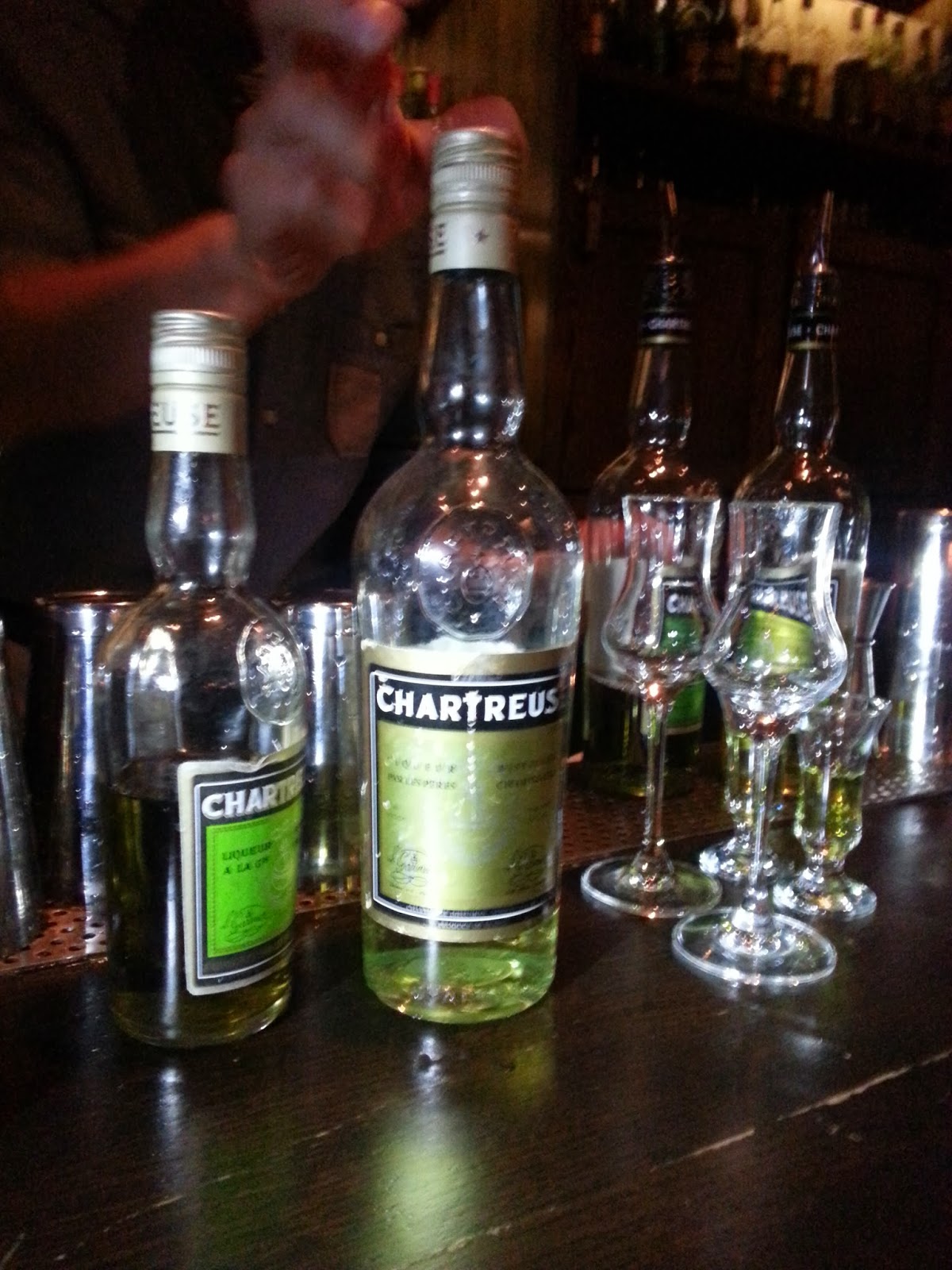
These facts drive dusty hunters into terrible neighborhoods to seek out the worst forgotten liquor stores to find hidden gems in the dust.  But old neglected liquor stores have a lot more than Bourbon lying around.  There's also other stuff - like Scotch & Chartreuse.  Chartreuse?   Chartreuse, the effete, French, and undeniably feminine after dinner liqueur that makes an excellent glass rinse when making high end Manhattan cocktails?  Yet Bourbon and Chartreuse all became wrapped up together this last week for me.  The tale involves dusties, ambition, and exploration and ends up in the living room of a new friend:  a man with whiskey knowledge, enthusiasm, and the kind of welcoming friendliness and whisky camaraderie that earns the twitter hash tag #WhiskyFabric in my book.

It starts with the tasting for the Sunday October 13th Bonhams whisky sale.  I was lured by a rumor that Joe Hyman might be pouring a bottle of Prohibition era Monongahela rye whiskey from Ruffdale PA brand Dillinger that was distilled 1913 and bottled in 1923.  FYI: Sam Dillinger's story and an amazing travelogue blog post describing a visit to the site today is amazing reading on EllenJay.com:  http://www.ellenjaye.com/hist_mono4ryewhiskey.htm#samdillinger

The rumor turned out to be true and that remarkable whisky deserves its own post - here I need only say that it is remarkable, delicious, historic and very interesting rye whisky both from a collector's and a whisky loving drinker's perspective.  But amazingly - in the face of this very compelling sip, I found my attentions yanked way to an unexpected flavor that I had never tasted before and wouldn't have expected to love: yellow Chartreuse.  Among the amazing things Joe Hyman was having the pretty Bonhams' women pour that day was a 1940s bottle of Yellow Chartreuse.  As later auction results showed - this is a pretty precious bottle.  But I wasn't thinking about that at the time.  All I knew was that I was bewitched by the rich dynamic liqueur that brought big notes of honey, exotic herbs, and an elegant balance that wasn't cloyingly sweet, but came close - packed with a dense, sophisticated, and delicious complexity.  I couldn't help myself, I kept going back for more.  I mean more of the 1940s Chartreuse, rather than the 1913 rye.  OK, I went back for more of both of them - but I tasted as much of the Chartreuse.  And let me tell you there were quite a few other compelling whiskies on that table, too, to distract a gentleman for even looking at a yellow liqueur from France.

I came to taste this: Dillinger Mongahela rye


Fell in love with this: 1940s Yellow Chartreuse


I tried to forget her.  She wasn't "my type".  For one thing, she isn't barrel aged (except that modern VEP editions that are allowed to mature for 8 years in oak.  For another - it's an herbal liqueur for goodness sake!  But I couldn't get it out of my mind.  A few weeks later Mike Jasinski put up some lovely pics of some old dusty chartreuse that he had found hunting for dusty Bourbon.  I got interested and ended up creating a whole pinterest board to help date the dusties.  


I ended up bracketing the ages of Mike's bottles between 1965 and the late 1970s.  We struck up a conversation and proposed a trade.  But I knew I really wanted to taste Chartreuse from this era and compare it to the current stuff before going ahead with this madcap idea.  I described the situation to whisky/food blogger Susanna Skiver Barton and she suggested I visit an East Village bar called "Pouring Ribbons"  
1970s green & yellow Chartreuse at Pouring Ribbons
Jourdan Gomez executes precise pours.


Pouring Ribbons turns out to be perfectly suited for this exploration.  They have the full line of current production Chartreuse and an extensive selection of dusties by the ounce and half ounce.  They serve the good stuff in pro-level liqueur glasses.  The cheaper stuff come in shot flutes.  I brought Perfect Dram glasses (1/4 size glencairn shaped glasses).  All the Chartreuse was delicious, but the 1970s stuff was on a vastly different level than the current stuff.  All the areas where the current stuff runs a little hot or comes close to strident on the herbal flavors become honeyed, rounded, relaxed, and somehow better delineated - with tremendous flavor amplitude between the warm and honeyed backdrop an the powerful herb and fruit flavors that rise in sharp relief:  limes, bay rum, tarragon, lavender, oregano, rosemary, and verbena.
The barrel aged VEP version.

There have been quite a few recent discussions in the whisky blogosphere about the question of how much better whisky (generally Scotch - and blended Scotch in particular) was 40 and more years ago.  The questions tend to focus on the debate whether the public or the blenders bear the primary responsibility and whether production method changes or bottle maturation are why the old stuff tastes better.  Two blog posts that exemplify this debate to me are


Well, the Carthusian monks who make Chartreuse take special pains to make a constant product.  While history forced the monks to make their product in Tarragona, Spain for a while, the main French Voiron production's herbal component has been the same for centuries and the monks take special pains to keep it constant.  This is the antithesis of the situation with whisky- where distilleries modernized tremendously and changed production methods during the 1960s-1980s period both in the Scotch and Bourbon worlds.  Barreling proofs were raised.  Mashing periods were cut.  Higher yielding grain varieties were used etc...   Enjoying a Scotch from the 1960s entails a degree of uncertainty about whether the extra magic is in the old ways, or just half a century of bottle maturation.  Some debate whether bottle maturation even exists.  Oliver Klimek gives the excellent example of Kirschwasser as a place where bottle maturation is employed and is readily detectable.  Charbay's Marko Karakasevic famously devotes a portion of maturation time in this hopped whiskies to maturation in stainless tanks.  Presumably he has his reasons.  Well, Chartreuse is an excellent case study in the relative merits of bottle maturation because of the constant production methodology.   It does, however, enjoy the benefit of the way sugar enhances maturation according to Angus of Whisky-Online.  So the conclusion that I inevitably reached based on the Chartreuse tasting is that bottle maturation is a very real and significant improver of a given spirit given multiple decades to work its magic.

As Mike Jasinski and I spoke about old Bourbon - he kept pulling bottles out of odd corners and lined them up on the entry hall chest until it was packed solid (this picture was early in the process - less than halfway).  The bottles ranged in era from the 1940s to the 1980s.  An epic group of dusties.
So I paid a visit to Mike Jasinski out at his home in Pennsylvania to make our swap and to have a little visit.  Now, I've written about the warm and supportive #WhiskyFabric.  But the very active Bourbon community involves a cadre of dedicated dusty hunters and some of them come off as very business-like.  That's not Mike.  Mike is a true whiskey lover with an obvious depth of knowledge, experience, and passion for Bourbon and rye.  Mike isn't a hoarder (although his bunker is absolutely unbelievable).  No, first and foremost Mike is a drinker and lover of the juice.  He immediately welcomed me with unreserved generosity and a convivial whisky geekiness that we share and through which we instantly bonded.  And then ensued one of the best American Whiskey tasting sessions I've ever enjoyed.  And frankly it was about as luscious a tasting overall as any whisky from any part of the world.

We started with a nip of Old Ren, a bonded bourbon from Rockford, Illinios, distilled in the Fall of 1936 and  bottled in the Spring of 1944.  It has a rich, sweet, overloaded nose full of dark toffee, over ripe squash, parrafin, old books, and baking spice like pumpkin pie.  The palate is unexpectedly dry and lean, with a huge hit of rye spice.  The finish returns to the over-ripe caramelized squash note - but now it has morphed into malted milk balls and it's persistent.  The musky slightly winey malt flavor stays and stays.  Hour later - over huge burritos, Mike said, shaking his head, all I can taste even now is that Old Ren.  It is a titanic finish.  Schizophrenic?  Strange?  Yes - totally unique and kind of incredible.  I've since written a full post on this bizarre and compellingly drinkable mystery:
http://www.cooperedtot.com/2013/11/old-ren-bonded-bourbon-antique-and.html


Then on to Old Fitgerald Bottled In Bond 1966-1972 from a ceramic decanter (The "Irish Luck" bit of silliness).  Richly amber colored and a rich pudding of classic Stitzel-Weller flavors: caramel toffee baked apple with cinnamon, baking spices, and honey, rich sandalwood oak.  As it opens in the glass there are more layers of oak perfume and a complex interplay between the sweet candy and fruit flavors on the opening and the influence of tannins in the turn and the finish.  The mouth feel is rich and thick.  The wood management is a clear contributor to what was going right at Stitzel Weller at this time.  A wonderful and delicious dram.

1966-1972 Cabin Still decanter.
Stitzel Weller at its best. 
One of the most provocative things the Mike has said on line recently is that Old Cabin Still is both the best and worst Bourbon he's ever tasted.  He attributes this to the fact that it was sourced from Stitzel Weller glut stocks and, alternately, Seagram's lower end stocks.  My impression of this brand is the yellow-label stuff from the early 1980s which my college buddies and I used to shoot.  It's not a good impression so I was very curious to taste the difference.  Mike lineup up drams of both.  The 1980s Seagram NAS stuff was terrible.  Insipid, thin mouth feel, harsh alcohol bite, and a flavor dominated by wet cardboard notes.  The 6 year old age dated 1966-1972 Ducks Unlimited decanter Old Cabin Still, however, was very much in the mode of the contemporary Old Fitzgerald decanter I had just tasted - but if anything incrementally more honeyed, with a richer mouth feel.  All the classic Stitzel-Weller wheated bourbon flavors were in play:  caramel, toffee, butter braised brown Betty, demerara sugar and rum.  Sandalwood perfume, and, on the finish, a clear note of light and sweet coffee and cream.  Too much?  Not a chance.  Brilliance.

National Distiller's Old Grand Dad 114
 from the early 1990s
Next up was a shift into high rye mash bill Bourbon with an astounding duo of classic Old Grand Dad dusties distilled at the old National Distillers Old Grand Dad Distillery DSP-KY-14 (which is used solely for bottling by Beam these days): an 8 year old bottled in bond 100 proof from the late 1980s and an early 1990s bottling of the 114.  I've heard great things about the old Old Grand Dads but hadn't ever tasted them.   Rich, honeyed, with a complex and rich palate that melds herbal floral rye with bourbon caramel sweetness and blessed by a rich mouth feel.  The 114 was superb but the Bottled In Bond actually edged it with a more vivid presentation of the flavors and a bit more rye spice kick.

Not content to rest there, Mike brought out the imitation Old Grand Dads.  Check out Barton's Colonel Lee's label side by side with OGD.  Notice a resemblence?
Old Grand Dad BIB 8 year old versus 114 versus Barton's homage: Colonel Lee
Colonel Lee, represented here by a half pint with a tax strip and a "79" date mark in the bottom of the bottle was astounding.  Clearly a high rye mash bill, this had the same rich sweetness (caramel, honey, leather and tobacco) and iterated fully delineated rye flavor profile but with a bit richer mouth feel; more honey; and more vanilla.  We discussed the irony that Colonel Lee was a cheap knock off with bottom shelf pricing and, yet, in the right era with the right bottle maturation it emerges as an incredibly delicious pour - very close to the dram of the night because of the shocking surprise.
Ezra Brooks 7 yo 1979 from Medley
Next Mike produced a 1979 (by bottle mark) sealed tax stampled Ezra Brooks 7 from Medley distillery as another example of a high rye mash bill bourbon intended to play in Old Grand Dad's sandbox.  On the nose the wood quality was clearly inferior to me: with some "kiln dried" notes that I associate with craft whiskey small barrels.  But as it opened the nose evolved into a musky musty place and the palate became astounding: with tremendous flavor amplitude that exploded in the mouth with the many of the same flavor notes:  delineated rye spice, rich bourbon sweetness - but overlayed by a darker aspect with more leather, old barn, bottom of the pot caramel, and char.
Wild Turkey 8 year old - circa early 1990s
The turkey molded into the octagonal jug.


No discussion of high rye mash bill bourbon can be complete without including Austin Nichols' Wild Turkey 101 - which we tasted and which then led to a discussion and tasting of ITS imitators:  Eagle Rare and Fighting Cock.  The pour of Wild Turkey 8 was from an octagonal jug handled 1.75 L bottle from the early 1990s with magnificent molded panels depicting the Turkey.  This was my first taste of 8 year old age statement standard OB Wild Turkey and it was a revelation.  Really really big.  Oak char, herbal rye sweetness, big musky bourbon with tons of toffee, corn, peach compote, and a big fragrant sandalwood oak finish.  Despite all the steep competition that came before, Wild Turkey 101 stands tall and absolutely earns its reputation and popularity.


The original 8 year old age statement
Fighting Cock.
Yes, it's all that.
Fighting Cock is one of those underrated Heaven Hill 6 year old bourbons that is seen more, it seems, in shooter bars than in whisky snob environs.  It currently rocks 103 proof.  But in its original incarnation it was an 8 year old 101 proof - just like the Wild Turkey it was clearly meant to imitate.  Here, in its original form as a 1990s dusty it shows all those delicious flavor of "whit if Heaven Hill did a high rye mash bill" - a bit lighter and sweeter palate than WT101 - with more citrus and a cleaner brighter rye spice and less musky musty notes and darker caramel aspects.  Mike actually prefers it.

Probably the most famous imitation of the Turkey is Eagle Rare - which exists in a bicameral existence in Buffalo Trace's line up as a very inexpensive 10 year old, sold at a sleepy 90 proof, with a reputation for sweetness, softness, and simplicity, and an ambitious 17 year old that is part of the Buffalo Trace Antique Collection.  But Eagle Rare has a long history - that begins with a Sam Bronfman marketing decision at Seagrams and master distiller Charlie Beam creating a WT101 killer in 1975 at Seagram's Old Prentice Distillery in Lawrenceburg, Kentucky.  As the sepia photograph neck tag makes clear, Old Prentice is what we now know as the Four Roses distillery.  Sazerac aquired the brand in 1989, thus the labels with New Orleans - and that's how it ended up in Buffalo Trace (which is part of Sazerac).
Original Seagrams Version of Eagle Rare:
 Old Prentice, Lawrenceburg KY.
...better known as Four Roses Distillery

Left to right: Eagle Rare made at Four Roses, Ancient Age (Buffalo Trace), and New Orleans
We were drinking the Lawrenceburg, KY bottling (late 70s through late 80s).  It had a large molded decanter top.  This is utterly magnificent Bourbon.  Dram of the night?  The mouth feel is epic: thick, mouth coating, and rich.  The nose and flavors are loaded with malt, cognac, molasses, burnt caramel, leather,  and a huge finish of iterated genius boxwood and sandalwood oak that brings a whole barrister's world of overstuffed brown leather chairs with black brass nails and huge dark brown polished oak surfaces into your olfactory system.   I have to stop writing for a moment.  I've become speechless...  So this big thick malt candy loaded flavor signature is giving me deja vu.  It's Old Ren!  Where the evening began.  This stuff tastes like Old Ren - but better.  Better balance and bigger mouth feel.  Old Ren has the bigger finish, though - and distances itself by being utterly weird.

Old Overholt 4 yo rye - made in Pennsylvania
My interest in rye dictated a taste of Pennsylavia Old Overholt 4.  Suffice it to say it's a whole different animal than the current Jim Beam Old Overholt.  This, too, needs to be its own post.  Old PA Old Overholt drinks much more like Rittenhouse 100 - which really managed to make a convincing replica of that old PA style of red rye.

Willett 25 yo single barrel rye 50% abv. v.s. Hirsch 25 yo rye 46%
How do you end a tasting like that?  How about a head to head between two legendary recent bottlings of hyper mature rye that are rumored to be juice of the same distillery?  Willett Family Estate Bottled Single Barrel Rye 25 year old Barrel 1767, 50% abv. versus Hirsch Selection Kentucky Straight Rye 25 46% abv.  These beauties are dark walnut in the glass.  Freshly poured, their palates seem quite distinct: with the Hirsch going to darkly mulled wine: grapey and loaded with cloves; spiked with St. Joseph's baby aspirin.  The Willet tending more towards a baked apple loaded with the same spiced as the mulled wine.  As they open up with extensive time in the glass, the noses converge.  These are both really big flavor signatures - but weird.  The rye is showing signs of noble rot with the good things that implies (like rancio, density, and character) but also some of the bad things:  weird, intense, loaded with oak, hard to drink.  While the Hirsch lost the baby aspirin and settled down into a big dark presentation dominated by dark purple fruits and cloves... (wait, that's not it...) CLOVES!!!.  The Willetts edged it by doing a strong essence of the hard red candy on a candy apple combined with cinnamon, baked apple loaded with allspice, cloves, nutmeg and cinnamon.  Titanic tastes with epic long finishes.  Both unique and fascinating examples of the vanishing glut era.

The finishing pair was apropos as well because it help highlight the differences between barrel and bottle maturation that run like a central thread through the conversation.  The object lesson of the Chartreuse was the undeniable fact of bottle maturation - and its way of relaxing the flavor elements and allowing them to balance better with each other, all while bringing in a sweeter and more vivid presentation of the flavor elements.  I kept getting that feeling with the many examples of young (4-8 year old) Bourbon we were tasting that had sat around in the glass for 20-50 years.  Barrel maturation is, of course, a vastly different animal: concentrating flavors, adding wood influence.  Tonight, was all about how long bottle matured younger whiskies can be amazing.

And I haven't tasted any of the 40-50 year old dusty Chartreuse bottles from Mr. Jasinski's collection yet...