Showing posts with label Stitzel Weller. Show all posts

Saturday, February 21, 2015

Rebel Yell - Past and Future

Late 1960s Rebel Yell magazine ad.: 
a romantic vision of the ante-bellum South.
(thanks Herb Allen, for finding this)
Rebel Yell is a wheated mash bill Bourbon originally sold only in the South - to personify the South.  It was light and sweet and beautiful and sort of an inside secret of the South.  I want to write about the history, but I can't do better than Michael Veach's  (Posted 04-05-2004 on straightbourbon.com) - 

"Alex Farnsley worked at W.L.Weller and Sons with Julian Van Winkle in the late 1800's/early 1900's. They purchased the company about 1910 and George Weller became the President, with Van Winkle and Farnsley as Vice President and Treasurer. Farnsley also became President of the Bank of St. Helens (in what is now Shively) about the same time. Prohibition saw the retirement of Weller and the last family tie to the company."

Charlie Farnsley,
mayor of Louisville 1948-53
Congressman, KY's 3rd 1965-67
Creator of Rebel Yell
(Photo from wikipedia)
In the 1940's Charlie Farnsley became Mayor of Louisville. At the same time he started bottling a few whiskies for his own use and to give as gifts. He created the brands "Rebel Yell" and "Lost Cause". There is a label book at the U.D. Archive with a 1948 label for Rebel Yell. It is white with a cannon shooting a cannon ball. Lost Cause did not have a graphic design and was even more plain than the Rebel Yell label."

"In the 1960's to honor the cenntenial of the Civil War, Stitzel-Weller took the label to the public, but only below the Mason-Dixon line. It was a 5yo 90 proof wheated bourbon at that time."

"United Distillers decided to take the brand world wide and amde it available anywhere in the U.S. I thought this was a mistake - A better selling point in London or Paris or Sidney would have been "What can you get here that you can't get in New York City or Boston?". They also lowered the proof to 80 proof. It became part of the brand sale to Heaven Hill and Bufallo Trace in the late 1990's and was in turn sold to David Sherman."
Mike Veach


Steve Leukanech's late 70s 200ml example.
From the 1960s when it began until sometime in the 1990s Rebel Yell was a product of Stitzel-Weller distillery located in the Louisville suburb of Shively.  United Distillers closed Stitzel-Weller in 1992 and transitioned production of Rebel Yell to their new Bernheim distillery subsequently - and then sold the brand to David Sherman Corp (which subsequently became Luxco) and distillery (Berhnheim) to Heaven Hill in 1999.  I've written about Stitzel-Weller before in connection with their flagship expression Old Fitzgerald and the anchor expression Cabin Still and they have been love letters.  This is no different.  Stitzel Weller Rebel Yell is a thing of stunning beauty.  It's a lot like S-W Cabin Still, slightly lighter and sweeter than the dark tannin complexity of classic S-W Old Fitz.  It was a 6 year old age stated Bourbon for most of the 70s and early 80s - the heyday.  Full tasting notes will follow at bottom.  A number of commentators over the years have commented on the irony that a gentle and sweet Bourbon would have the fierce name "Rebel Yell" but the actual sound of the rebel yell was not the fierce, angry, deep yell you might imagine.  It was a high pitched coyote sounding cry.  There's something plaintive and haunted about it.  As evidence, I present this famous clip of Confederate veterans doing the rebel yell in 1938.  Granted they are old men - but you can see the pride they take in performing the yell.  I have little doubt they are doing it properly.  They would know.  They had been there.

1938 footage of Civil War Confederate veterans performing the Rebel Yell.

One story is that Keith Richards, legendary guitarist of the Rolling Stones, loved Rebel Yell.  According to wikipedia's article about Billy Idol's song "Rebel Yell":  

"At a televised performance of VH1 Storytellers Billy Idol said that he had attended an event where Mick Jagger, Keith Richards, andRonnie Wood of The Rolling Stones were taking swigs from a bottle of "Rebel Yell" bourbon whiskey. He was not familiar with the brand, but he liked the name and decided to write a "Rebel Yell" song."

One of the later verses goes like this:

"I'd sell my soul for you babe
For money to burn with you
I'd give you all, and have none, babe
Just, just, justa, justa to have you here by me
Because
In the midnight hour she cried- "more, more, more"
With a rebel yell she cried- "more, more, more"
In the midnight hour babe "more, more, more"
With a rebel yell "more, more, more"
Billy Idol "Rebel Yell"

It's not articulate - but it conflates the topics of delirium, lust, desire, and disregard for financial responsibility that are at the heart of rock 'n roll and of Bourbon-mania.

When Stitzel Weller's brands were being sold off by United Distillers in 1999 Rebel Yell's proof had been dropped 80 (40% abv.) and the age already reduced from 6 years old to a NAS 4 years old in the decade before.  Rebel Yell ended up with David Sherman Corporation of St. Louis (the company was renamed Luxco in 2006 in honor of former CEO of DSC, Paul Lux, who died the previous year).  Luxco contracted for it to be made by Heaven Hill.  Heaven Hill's version of the wheater wasn't the same.  How could it be?  But it's overly simplistic to simply compare the two expressions and find the new one wanting.  It's unfair to take the apex of American Bourbon making that was Stitzel-Weller in its prime and compare it with anything else - let alone something that sells for less than $20.  Luxco's Rebel Yell can often be found for in the neighborhood of $15.  Make no mistake, modern Rebel Yell isn't the masterpiece that came out of Pappy & Farnsley's distillery.  But the new stuff has a thread in common with what came before: the wheated mash bill.  Wheat adds a sweetness and a grape quality that in the new stuff comes across like marc or young cognac.

Rebel Yell - new label 80 proof (40% abv.)  NAS, but apparently 4 years old Luxco (sourced from Heaven Hill, wheat mash)

Color: gold

Nose: vanilla, sawn oak, woodshop, solvent and glue, mineral dust, cut flower sap (marigold stems).

Palate: a hot and sweet entry with flavors of dilute vanilla extract, sugar, applejack, and solvent.  Fruity and spicy on the expansion with raisin and spice.  The solvent, raisin and spice puts me in the mind of VS cognac.  There's plenty of young kiln dried oak which carries some plywood notes.  This aspect of the wood puts me in the mind of young small barrel craft bourbon.  The finish is short, but sweet with plenty of char.  Repeated sips and lots of air amp up the raisins and the vanilla.

This is a young wheater and tastes it.  My first impression was negative, but as I get further down into the bottle I'm finding it charming in its brash youth.  This drinks like Craft whiskey.  For the money you can do plenty worse.  Just don't expect this to drink like regular rye-mash inexpensive Bourbon such as Heaven Hill BiB or black (it's hotter. sharper, and fruitier).  The wheat really makes this different, and the youth makes this taste different from the more mature wheaters you know (like Weller, Larceny, or Maker's Mark).  The defining signatures that mark this difference are raisins (think marc) and a starkness to the oak that reads like small barrel Craft.  The bottle opens up over the course of weeks which takes the edge off the solvent, sharp and hot notes which detract early on.  It becomes sweet, open, and lightly fruited in a way that is not at all unpleasant.

**
(This bottle was provided by Pia of Common Ground PR for Rebel Yell / Luxco on the occasion of the release of their new bottle design)


Rebel Yell, 1970s 1/10th pint 90 proof (45% abv) 6 year old age statement Stizel-Weller labelled "Exclusively for the Deep South".

Color: Dark coppery amber

Nose:  Big black greasy vanilla pods.  Malt. Malted milk balls candy.  Sandalwood oak. Caramelized brown sugar and apple Brown Betty. Magic.

Palate: Sweet and spicy on opening.  Vanilla extract, root beer, cherry, red hots, caramelized cinnamon loaded apple upside down cake.  Then a big swing of tannin loaded oak redolent of big dark furniture in a fancy lawyer's office.  This trends into bitterness in the finish with herbal bitters, dark oak, and then a returning note of root beer candy.  At the fade out you're left with good herbal bitters - like Dr. Adam Emegirab's Orinoco Bitters.

This is all utterly characteristic Stitzel-Weller goodness straight out of the Old Fitzgerald playbook.  It's beautiful.  It's candy and spice, heat and oak richness.  It's big and dark and brown: a flavor bomb.  I can't be objective about this stuff.  It's the classic Stitzel-Weller flavor signature and it's beautiful beyond words and all the more precious for being lost and gone.

*****

(bottle is a mini originally from the incomparable collection of American whiskey minis of Rotem Ben Shitrit:  http://just-mini-bourbons.com/)

(These were tasted blind - with the assistance of Temma Ehrenfeld - with the original tasting notes dictated while blindfolded.  Suffice it to say, I was able to identify them correctly, repeatedly, blind).

Herb Allen's faux tax stamped
 88 glass marked bottle.
Where are the points of intersection between these two versions of Rebel Yell?  They are wheat mash and oak.  This is the old recipe made in a different way: younger, lower proof, with different oak (I'm guessing kiln dried as opposed to air cured).  These are profound differences.  Yet, for all that, there's a fruity sweetness that they share in common.

Is your bottle of Rebel Yell Stitzel-Weller or Heaven Hill?  Stitzel-Weller closed in 1991-92 and David Sherman Corporation bought the brand in 1999.  What if you have a bottle from within that transitional period?  Bourbon brands transitioned to different distilleries in different ways.  Stitzel-Weller had a ton of whiskey aging in it's rickhouses when it closed and the S-W expressions continued to be bottled with S-W juice for a number of years afterwards.  But by the late 90s things definitely did transition. One way to tell with Rebel Yell is to look at the UPC code (and if there's no UPC code the bottle pre-dates the 1990s which shows it's S-W juice). 88508 UPCs generally indicate Stitzel-Weller. Later bottlings have 88076 or 88352 codes which generally indicate Heaven Hill. Another way to try to gauge is to look at the color. The S-W stuff is generally much darker than the Heaven Hill stuff.  (More on this in a follow-up post to come).

Every time I think about Stitzel-Weller's closing and the trading away of its brands I can't help but feel it's a parable about America.  Ultimately Stitzel-Weller went out of business because it was a niche distiller, undiversified and holding fast to an uncompromising notion of excellence at a time when Bourbon was fading in popularity.  It was truly excellent.  The new Rebel Yell is something of a parable for American whiskey's rebirth - with whiskey bought bulk from a distiller that isn't the brand's producer.  But the whiskey itself still tells an American story, high and thin like the rebel's yell itself.

Monday, October 27, 2014

A Fascinating Transitional Bottle of Old Fitzgerald From the Dawn of the Repeal Era.

When Prohibition ended, Pappy Van Winkle, and his partners A. Ph. Stitzel and Alex Farnsley incorporated Stitzel-Weller and began building the legendary distillery by that name which has aroused such passions.  It was finished in 1935 and distillation began soon afterwards.  But in that year between the end of Prohibition on December 5th 1933 and whenever in 1935 distillation commenced, Stitzel-Weller existed as a company selling medicinal whisky distilled prior to Prohibition from their concentration warehouses where whisky from all over ended up under the watchful eye of the bondsmen.

The bottle you see at right is a window into that particular moment in history.  Pappy Van Winkle had purchased the Old Fitzgerald brand name from S. Charles Herbst.  He had originally called the brand "John E. Fitzgerald", distilled in Frankfort, KY for exclusive markets like steamships and private clubs.  It was the good stuff, named for the crooked bondsman who knew to pilfer the good stuff - a wicked inside joke.  Pappy must have loved it because he approached Herbst to buy the brand during Prohibition a number of times according to Sally Van Winkle Campbell in "But Always Fine Bourbon".  She writes that Herbst demanded $25,000, but ended up finally selling it to the persistent Pappy for $10,000.  According to the excellent timeline on the Bourbon Enthusiast forum Pappy's W.L. Weller & Sons bought the brand from Herbst for $2,000 in 1922 and then paid Herbst another $2,000 in 1925.

So, in the year 1934, following Repeal, Pappy's W. L Weller of Louisville produced this first quart bottling of Old Fitzgerald.  The whiskey inside was taken from medicinal pint bottles and rebottled into quarts.  The back label explicitly says so:

"100 Proof
Kentucky Straight Bourbon Whiskey
Distilled Spring 1917 by 
Daviess County Distillery Co., Owensboro, Ky.
Originally Bottled Fall 1933 by
A. Ph. Stitzel, Inc., Louisville, Ky.
Rebottled by
Frankfort Distilleries, Inc. Louisville, Ky."

Back Label
Daviess County Distillery Co. was purchased by George E. Medley in 1901, according to Sam Cecil's book.  His son, Thomas A. Medley took it over when he died in 1910.  Thomas kept the company alive through Prohibition and distillation was moved to the Old Rock Springs Distilling Company after Repeal.  The whiskey in this bottle is from the old Medley's production at Daviess County and as such is a real piece of history.

I had never seen anything like this.  I put my question up on a number of forums.  Chuck Cowdery thought that it might have been a special bottling for share holders of the new Stitzel-Weller venture.  Joe Hyman (the whisky auctioneer previously of Bonham's and now of Skinner's) and Scott Spaid, blogger of WhiskeyBent.net both pointed out that quart sized rebottlings of medicinal whiskey were common in the first days of repeal.  Hyman mentioned the quart bottles of Dillinger Rye that Bonhams had sold in Spring of 2013.  Spaid pointed out quart bottles with 1933 BiB strips of Old McBrayer he had recently acquired (from the same originally owner as this bottle) - and also on Whisky Paradise: 

FYI - this bottle is going up for auction Wednesday 10/29/14 at Skinner's up in Boston.  Joe Hyman, the leading auctioneer of whisky in the USA left Bonhams when Bonhams cancelled the Fall NY whisky auction and moved to Skinner - as documented here"
In the absence of Bonham's, Skinner may be the best hope for a vibrant whisky auction business in the US.  I urge everyone who used to enjoy Bonham's auctions to make the move to Skinner.

https://www.skinnerinc.com/auctions/2758B/lots/738

Detail pics below show the BiB (Bottled in Bond) tax strip, age statement label (characteristic A. Ph. Stitzel red crescent), and the light shining through the whiskey so you can see it's good and clear.

(The consignor of this bottle chooses to remain anonymous).


Sunday, July 20, 2014

A Large Scale Tasting Of Dusty Old Weller Antiques 1998-2008 Tasted Blind & Compared With The Current Stuff.

11 Years of Old Weller Antique from 1998 (left) to 2008 (right).
The invitation came a couple of months ago.  Mike Jasinski - master dusty hunter and a great lover of old bourbons - had assembled a flight of Old Weller Antique paper labels bottles from 1998 to 2008: a full 11 years that chart the brands movement from Stitzel-Weller to Buffalo Trace.  These dusty bottles have become extremely popular these days and hard to find.  In the past few years the 7 year old age statement was dropped and the bottle design was changed from a stock cylinder with an antique looking paper label to a rounded ball shaped bottle with the ink printed right on the bottle (pictures of the current bottle are at the bottom).   Mike wanted a group of whiskey people to come out and taste them all blind - reporting our findings with numerical scores on the 100 point scale.  
We, however, tasted them blind - self poured from these flasks marked only by a number.

1940 BIB
(photo from Bonham's)
The brand, "Old Weller" harkens back to Pappy Van Winkle's original employer, William LaRue Weller who started his famous whiskey company in Louisville, KY in 1849.  The legendary inventor of the wheated whiskey mash bill (where wheat is used instead of rye as the flavoring grain, above a corn base and bit of malt to add enzymes).  Stitzel-Weller sold the wheated mash bill in a number of expressions, notably Rebel Yell, Cabin Still, and Old Fitzgerald.  Sam Cecil (in The Evolution of Kentucky Whiskey) reports that "Old W.L. Weller" (along with Mammoth Cave and Cabin Still) were brands that Pappy Van Winkle bottled after W. L. Weller's death in 1899 and before partnering with A. Ph. Stitzel during Prohibition using whiskey sourced from the Stitzel Bros.distillery in Louisville and the Old Joe distillery in Anderson.  Looking over old auction records I see the Old W. L Weller Special Reserve expression at 100 proof (as a Bottled In Bond expression) in the Repeal era (see photo at left taken from the October 2013 Bonham's NY Whiskey sale).  The "Old Weller" brand name doesn't seem to appear until the gold veined paper label incarnation apparently born in the early 1970s.  The earliest ad I could find showing it is from 1979 (below):
Ad from 1979 talks about the gold veining.
The word "Antique", however, is absent.
Chuck Cowdery lauds Old Weller Antique as a great value at $16 for a 7 year old in the back of his essential book Straight Bourbon (highly recommended) without reference to the brand's history. Sally Van Winkle Campbell doesn't mention the "Old W.L. Weller" or "Old Weller Antique" brands by name in "But Always Fine Bourbon".  Although she relates a story that "the reason that the distillery came out with 107 proof was because Pap's doctor said he could only have two drinks a day!"  If that's true then the Old Weller Antique expression dates to the mid-1960s (Pappy died in 1966), which jibes pretty well with the fact that I can't find a bottle or mention until 1970 or so.
(Update.  John Lipman (of http://www.ellenjaye.com/) has a much better explanation.  I posted it here:)
http://www.cooperedtot.com/2014/07/john-lipman-explains-why-there-is-107.html

That said, the expression existed through some very solid glory years of Stitzel-Weller (S-W) and then through a transition to production at Ancient Age / Buffalo Trace.  Experience tasting the Pappy Van Winkle Family Reserve bottlings from 2009-2013 have shown me that Buffalo Trace has a good handle on the Stitzel-Weller wheated mash bill flavor component.  The first in the series we'd be tasting at Mike's house would be a 1998 Stitzel-Weller Old Weller Antique (abbreviated "OWA" henceforth) - labeled "Louisville".  The rest would be labelled "Frankfort" but, presumably there would be a transition period where Stitzel-Weller stocks would still be used until Buffalo Trace's Frankfort stocks took over.  The Old Weller brand was sold by United Distillers to Sazerac in 1999 (which renamed the Frankfort, KY Ancient Age distillery  Buffalo Trace (BT)  in that same year, 1999).

Update: I'm wrong here.  I left out the period of time the Old Weller wheater recipe was made at New Bernheim where United Distillers (later to become Diageo) had consolidated Bourbon production - leading to the closing of Stitzel-Weller.  Thanks, Mike Jasinski, for setting it straight, in the comments on this post.  Also, in the comments below, Mike adds tasting notes: "The noses are dead giveaways as to which bottle is which. 98-01 had the typical green apple SW nose it is very muted but it is there. The 02-05 have they typical cherried sweet nose that Bernheim distilled wheated bourbons have. The 06-08 bottlings are very typical of the BT wet cardboard nose."

Mike (right center) and Claire Doorden,
(left center), welcome guests
Could we pick out the S-W 1998 stuff blind?  Could we taste a clear demarcation to BT?  Because Mike asked everyone to use a 100 point numerical scale I will be using that grading system for these.  Mike could swear he could identify BT by an aroma that I was classifying as "linseed oil" but which Mike called "cardboard".  Once he used that word I couldn't help but use it myself.  Cardboard - like sniffing the inside of a brown cardboard box is a good description of the aroma.  You'll see it mentioned in my nosing notes quite a bit below.  It's not as bad as it sounds. It's earthy and woody and sits among the floral and deep sugar notes.  As you can see by the scores below, all this stuff ranges from very good to excellent.

Josh Camerote pours himself a blind.
Jo

Old Weller Antique 7 yo. 53.5% abv. 1998 Stitzel-Weller.  Blind #4

Color:  medium amber
Nose:  Honeyed, fruity, oily, mossy, flinty.  Hint of tobacco.
Palate:  Sweet, fruity honeyed.  Maple, treacle shoo fly pie.  Cherry, citrus.
My score:  87  Mike's composite score:  87.

Old Weller Antique 7 yo. 53.5% abv. 1999 Buffalo Trace.  Blind #9

Color: dark medium amber
Nose:  honey toffee, cherry, cola, juicyfruit, oil, sandalwood.
Palate:  Intense sweet sandalwood and rancio.  Chewy mouth feel and long sweet oaky finish
My score: 91  Mike's composite Score: 92

Old Weller Antique 7 yo. 53.5% abv. 2000 Buffalo Trace.  Blind #1

Color: Dark amber
Nose: maple syrup juicyfruit.  Brown sugar toffee
Palate:  honey, malty toffee.  Cornflower, apricot bark.  Cherry, root beer
My score:  92  Mike's composite score: 92

Old Weller Antique 7 yo. 53.5% abv. 2001 Buffalo Trace.  Blind #8

Color:  dark amber (darkest yet)
Nose: Beautiful nose, floral cardboard
Palate: Honey, ripe cantaloupe, Turkish delight. Candy oak perfume
My score: 89  Mike's composite score: 88

Old Weller Antique 7 yo. 53.5% abv. 2002 Buffalo Trace.  Blind #2

Color:  dark amber (a shade darker than blind #1).
Nose light dusty musty oaky malt cherry cocoa.  Trace of iodine.
Palate, sweet cherry cola, char, tannin bitterness.
My score: 87  Mike's composite score:  87


Old Weller Antique 7 yo. 53.5% abv. 2003 Buffalo Trace.  Blind #11

Color:  dark medium amber
Nose:  Cardboard, malt toffee rancio brown sugar
Palate: Candied, toffeed, sandalwood perfumed glory.
My score: 91  Mike's composite score: 91

Old Weller Antique 7 yo. 53.5% abv. 2004 Buffalo Trace.  Blind #6

Color:  dark amber like 3
Nose: floral sandalwood, cherry, cardboard
Palate: Sweet, cherry, toffee, char and oak tannin.  Longer oaky maple finish with a bitter edge.
 My score 86 (bitter finish knocked it down)  Mike's composite score:  87

Old Weller Antique 7 yo. 53.5% abv. 2005 Buffalo Trace.  Blind #3

Color: dark amber, shade darker than 2 and 1
Nose: Oily, char. A little meaty
Palate: Fruity.  Tiny bit sour
My score: 88  Mike's Composite score: 88

Old Weller Antique 7 yo. 53.5% abv. 2006 Buffalo Trace.  Blind #7

Color: dark medium amber
Nose: Cardboard cherry juicyfruit
Palate:  honey, cherry toffee juicyfruit.  Oak tannin
My score: 88  Mike's composite score: 87

Old Weller Antique 7 yo. 53.5% abv. 2007 Buffalo Trace.  Blind #10

Color: almost as dark as 8/3
Nose: Cardboard, dark, sweet toffee, char, a hint of mildew
Palate: Sweet, cherry, cocoa, dark malt, cocoa, root beer.  Fruity, dark brown and delicious.  Char & edge of bitter char on finish.
My score: 90  Mike's composite score: 89

Old Weller Antique 7 yo. 53.5% abv. 2008 Buffalo Trace.  Blind #5

Color: light medium amber
Nose: Linseed nose, honey, yellow flowers
Palate:  honey, treacle, mint notes, honeysuckle,
My score: 88  Mike's composite score 87


Conclusion:  The Stitzel-Weller in the group wasn't the highest rated and it wasn't apparent to me at the time that it was the Stitzel-Weller one.  I like to think I can see some of the tell tale signs in my tasting notes and that if I were really paying attention I might have caught it.  Coulda Woulda Shoulda.  The bottom line is that it's all delicious Bourbon - with some significant variation between a dark and malty rich variety and a lighter amber more floral and fruity variety.  These varieties don't seem to correlate with year at all.  I suspect it's about barrel variation and rickhouse location.  While my 3 top rated ones were all dark and rich, the lighter ones were excellent drinking in their own right.  And notice that the Stitzel-Weller one was one of the lightest ones.

It makes a lot of sense to compare these experiences of tasting an extensive group of dusty Old Weller Antiques against the stuff you can buy today.  It's extremely popular and lauded.  So popular, however, that it has gone on allocation (i.e. a rationed limited supply to distributes).  It can still be readily found - particularly earlier in each month.  It's the same Buffalo Trace stuff, just now without an age statement.  Does that matter?  I tasted the bottle of Old Weller Antique that I have open at the moment (purchased late 2013) the following day at home - in the open (i.e. not blind).  This was a completely different tasting.  But just one day later the flavors of the paper label OWAs were fresh in my mind.


New Old Weller Antique 107 - no age statement.  53.5% abv. Bottle purchased 2013


Color: Medium light amber
Nose:  Vanilla, floral, hints of mint and lilac.  Light linseed oil/cardboard note.
Palate:  Opening is hotter and less malty than any of the examples tasted at Mike's.  It is grassy sweet with corn and apricot-citrus and cherry fruity notes along with some acetone notes.  The mid palate turns to oak and char, but with a more bitter presentation.
My score: 82

Conclusion.  It's still a wonderful Bourbon for the money, but it has lost a measure of depth of flavor, malty richness, and candied intensity.  With youth it has gained floral, herbal, and fruity notes - but the overall balance is thinner and less lush.

Phil Simon checks Mike's treasures
Phil Simon brought treasures
of his own too. 


The after party to this event was epic.  Major events included Phil Simon bringing a bottle of the legendary Hirsch Rye 13.  This epic bottle will be the topic of it's own post soon, but for the moment here are quick tasting notes taken at the event (when my palate was, admittedly, a bit toasted):

Hirsch 13 rye 47.8 % Medley bottled for Priess by Julian Van Winkle

Color: Dark coppery amber
Nose: caramel toffee, soft lanolin, cut daisy, cilantro flower
Palate;  Gentle, effervescent, malty, caramel, brown sugar, rum rancio, herbal, cinnamon.  Complex, rich, and superb.

Mike then opened a Louisville bottling of W. L Weller Centennial
Then people started getting goofy.
Other highlights included Mike's Louisville bottling of W. L. Weller Centennial, the last of his open bottle of 1916-1922 Old Bridgeport Mongahela PA rye (the topic of an upcoming post), the excellent Diageo bottling of Rosebank 21, and an amazing 1940s Old Taylor (that also needs its own post).  What a wonderful evening!  Thanks Mike and Claire!  Looking forward to our next 2am drive to Waffle House!

Sunday, April 13, 2014

The Tragedy of Old Cabin Still


The history of American whiskey is full of stories with all the human drama of Shakespeare's plays.  There are triumphs and tragedies; tales of creation and destruction.  There are also skeletons in the closet.  This is one of those stories.  It's the story of a murder - but not the murder of a person; the murder of a historic brand of Bourbon.  Like in most murders the motive is mundane, indeed prosaic.  It is simply greed.  The general outline of the story is simple.  Old Cabin Still - a venerable brand originally from William LaRue Weller came, via Pappy Van Winkle, to Stitzel-Weller and was a respected brand for decades. Then a huge corporation, Norton Simon, that had been clumsily dabbling in Bourbon found themselves in a jam with a bunch of bad whiskey they couldn't sell so they bought Stitzel-Weller so they could gradually dump the boondoggle failure whiskey into their bottom of the line Old Cabin Still brand.  This ruined the whiskey - effectively murdering the brand.  When United Distillers dumped 70 brands to Heaven Hill in 1993 (who immediately dumped a bunch to Luxco) with Old Cabin Still listed among them, it fell away into the mists of obscurity.  Currently the brand name "Cabin Still" doesn't appear on either Heaven Hill's or Luxco's web site.  It's not distributed in my area (although it is still made and distributed in the midwest and Europe.  It's a moribund brand, while plenty of other brands with less excellence in their histories are still plugging along.  (Update - it is still made and sold - including in New York.  It's not wheater - but is a decent entry level Bourbon in it's current incarnation.  I'll do a comparison tasting in a future post).

A word about the brand's name.   Originally "Old Cabin Still" It gradually dropped the prefix "Old".  It started in the 1950s - with the word getting smaller and sometimes being replaced by "Weller's", until it fully disappeared sometime in the 1970s - apparently after the sale to Norton Simon.  I'll attempt to use the appropriate name for whatever historical period we are discussing.

Old Cabin Still was one of William Larue Weller's brands when Pappy Van Winkle joined the firm.  It wasn't one of the brands registered in 1905 and 1906, implying that it was previously registered - one of the really old brands.   Pappy clearly liked it.  He had A. Ph. Stitzel produce some as medicinal whiskey during Prohibition.  A nice bottle and photograph appear on http://www.historicbottles.com/miscellaneous.htm  They appear as follows:

"Here is a quite interesting - and quite rare and historically fascinating - early machine-made whiskey bottle with the label, original box AND is still fully sealed with around 85%+ of the original contents - all of which date prior (barely) to National Prohibition! The fully intact tax label (covering the cork stopper) notes that the whiskey was "made Spring 1915" and "bottled Fall 1919" - mere weeks before Prohibition was fully in effect in January 1920 (though most liquor was already off the market by early 1919)."

In "But Always Fine Bourbon" by Sally Van Winkle Campbell, Old Cabin Still appears one of the stable of brands produced by Stitzel-Weller Distillery at its inception in 1935.  It was the entry level expression.  The same juice as Old Fitz, but aged less.  It was marketed as the "sportsman's" choice (see the ads, above, sporty with hunting dogs).  I imagine the idea is that sportsman in the field might nip from the bottle or flask without the luxury of the long airing Old Fitzgerald needed.  Having had the opportunity to have tasted some of the Old Cabin Still made in the Pappy era very recently, I can attest it was very good indeed, but more about that later.

My first experiences with it were very different.  Personally, I came across Cabin Still in my Sophomore year of college, 1983.  My suite mate, Kenneth Kurtz, a dazzlingly intelligent man who is now the staff architect of The Brooklyn Museum, had a penchant for it.  But not, as you might expect, have a penchant for it because it was good.  Rather, because it was bad and fading.  His nickname for it was "Stab 'n Kill".  It was an Old Man's liquor - a foul rotgut, and a symbol of what had
Ken Kurtz (in a Belleville, NJ cemetery)
gone wrong in America.  You have to understand that Ken Kurtz is a connoisseur of America's decline.  He hails from Randolph, NJ and starting in 1982 when I first met him he led me on a series of excursions the likes of which have become a staple of "Weird NJ" magazine (but years before that magazine's founding).  We drove to abandoned or semi abandoned industrial facilities, insane asylums, and the like.  We drove to Allentown and Bethlehem PA to witness the rust belt first hand.  In recent years he leads walks into places like the abandoned rail lines of the Meadowlands swamps northern NJ and the rusting drawbridges of Jersey City.  We walk the vast cemeteries of Queens and the industrial decay of Maspeth creek.  There is beauty in such places - but an ironic beauty informed by the punk aesthetic.  It's about acknowledging the rust and the loss and irony.  This is Ken Kurtz's aesthetic.  So his selection of "Stab 'n Kill" for our Friday night 1980s poker 'n bourbon 'n all you can smoke sessions must be understood as an ironic selection too.  I don't remember much about the Bourbon we drank those evenings.  We were shooting it, with grimaces and mock toughness.  We were also just kids getting drunk and I don't remember much about those evenings at all, generally.  But the long term outcome was: 1) I never bought a bottle of Cabin Still ever again.  2) I stopped drinking Bourbon pretty much entirely for about 20
Jersey City
Drawbridge abstract
years.  I turned to single malt Scotch for the most part and never looked back until 2006 or so when Paul Pacult invited Wild Turkey to host a tasting at Keen's Steakhouse in NYC when my love affair with Bourbon properly began.

This all jibes with Mike Jasinski's (master dusty hunter) tasting notes for this 1972 Ducks Unlimited ceramic decanter.  When I first met him last autumn he walked me through a tasting.  I blogged about it and wrote this:  

"One of the most provocative things the Mike has said on line recently is that Old Cabin Still is both the best and worst Bourbon he's ever tasted. He attributes this to the fact that it was sourced from Stitzel-Weller glut stocks and, alternately, Seagram's lower end stocks. My impression of this brand is the yellow-label stuff from the early 1980s which my college buddies and I used to shoot. It's not a good impression so I was very curious to taste the difference. Mike lineup up drams of both. The 1980s Seagram NAS stuff was terrible. Insipid, thin mouth feel, harsh alcohol bite, and a flavor dominated by wet cardboard notes. The 6 year old age dated 1966-1972 Ducks Unlimited decanter Old Cabin Still, however, was very much in the mode of the contemporary Old Fitzgerald decanter I had just tasted - but if anything incrementally more honeyed, with a richer mouth feel. All the classic Stitzel-Weller wheated bourbon flavors were in play: caramel, toffee, butter braised brown Betty, demerara sugar and rum. Sandalwood perfume, and, on the finish, a clear note of light and sweet coffee and cream. Too much? Not a chance. Brilliance."
http://www.cooperedtot.com/2013/11/a-day-with-master-dusty-hunter-driven.html

(Notice the mistakes (probably my own) confusing "Seagrams" for "Canada Dry".  The whiskey that ended up conflated into Old Cabin Still is not Seagrams.  It's Canada Dry - a different company entirely with only the concept of "Canadian" in common.  That shows you need to take the factual content in this blog with a grain of salt.)

Ads for Canada Dry Bourbon start popping up in the mid 1960s.  Here's an example from 1967:
1967 Magazine ad for Canada Dry Bourbon - Nicholsville
The tone of the ad is one of apologetic regret for how poor the branding is.  The text reads "Fine sounding names are a tradition in the world of Bourbon.  But fine sounding names don't do anything for the taste of Bourbon.  Canada Dry has done something for the taste of Bourbon.  We made it smoother. ..." The tacit acknowledgement that the name (and the label and the bottle and everything) is completely lousy branding for Bourbon is covered by the bluster of their claims for the taste.  But having tasted it, and finding it among the most pathetic and forgettable Bourbons I've EVER tasted it's no surprise that the brand quickly disappeared.  But that left Norton Simon - the huge conglomerate that owned Canada Dry at the time, with a problem.  What to do with a bunch of Bourbon that had tax liability hanging over it?

Canada Dry was a soda company that had started in Toronto in the 1890s by druggist and chemist John J. McLaughlin.  In 1904 he created "Canada Dry Pale Ginger Ale" which began shipping to New York in 1919.  The timing was brilliant.  Prohibition meant that many drinkers were getting lower quality liquor and Americans found that most any liquor was pretty palatable when blended in with Canada Dry Ginger Ale.  Norton Winfred Simon (1907-1993), Californian food industrialist of tremendous success and market power (Hunts foods, Avis rental cars, McCall's publishing, Max Factor cosmetics, etc...) , merged his Norton Simon corporation with Canada Dry in 1964.  The bourbon appears the very next year.  I can only imagine some kind of competitiveness with Sam Bronfman (in the whiskey world in the 1960s everything comes back to Sam Bronfman so even though I don't have a shred of evidence for this I can't imagine it not being so).  The escapade was failure and soon Norton Simon is looking for a place to dump the inferior product that didn't sell.

On Straight Bourbon there is an old (2004) thread discussing the following bottle of what is labelled "Stitzel-Weller's Canada Dry Bourbon". There is a comment by noted Bourbon historian Michael Veach that speaks straight to this issue and backs up Mike Jasinski's account of Old Cabin Still being ruined by having Canada Dry Bourbon mixed in:

"Right after the [Van Winkle] family sold the [Stitzel-Weller] distillery the company [Norton Simon] also acquired a distillery in Nicholasville, Kentucky that made the Canada Dry spirits. They bottled Canada Dry Bourbon, Gin and Vodka. The whiskey from that distillery was not very good at all and they put most of it into Cabin Still, starting the downfall of that brand. - Mike Veach"

http://www.straightbourbon.com/forums/showthread.php?3139-Stitzel-Weller-Canada-Dry-Bourbon

But I received dramatic and fully independent corroboration for the tale from an employee of Stitzel-Weller who made the shift to Norton-Simon and witnessed these events first hand.  The gentleman is named Dale Hamilton.  In his own words:

"I went to work for Stitzel Weller in October - 1970 as Controller/Accounting Manager. When the company was purchased on June 28, 1972 most of the accounting functions were transferred to the New York offices of Somerset Importers. I was asked to take a position in the Finance Offices at Somerset but since I had no desire to live in New York I didn't accept the position. I was allowed to stay in Louisville and set up a purchasing department. I remained as Purchasing Manager thru the mergers with the Canada Dry Distillery Nicholasville, ky. Later when Somerset Importers took over the operations of Distillers Corporation in the U.S.A.  Sometime later I took on the duties of packaging development in addition to the purchasing.  Thru the years the company name was changed to United Distillers Production and later with the purchase of Schenley the name changed to Schenley Distillers , Inc.
...
The distillery at Nicholasville or Camp Nelson, KY was originally the Curley Distillery and later the Kentucky River Distillery.
...
Paul Burnside was the President of Somerset Importers at the time and their production operation was the Canada Dry Distillery at Nicholasville, Ky. The operation distilled bourbon and bottled gin & vodka for the Canada Dry brand..They also bottled some brandy for the Domeq brand.
As I recall Burnside had produced more bourbon for the Canada Dry Bourbon brand than was needed and he also wanted to get Somerset into the bourbon business. I was told that some of the bourbon was not of a good quality (musty) due to some warehousing problems. I was not an expert on the quality of bourbon, but I didn't care for the taste of the Canada Dry produced bourbon made with rye ,since I had been used to the Old Fitz bourbon produced with wheat.
Somerset was owned by Norton Simon at the time and money tied up in inventory didn't fit their plan. So now the Stitzel Weller Distillery could cease production for some time and the excess Canada Dry bourbon could be used in the newly purchased Cabin Still brand. The bourbon that was produced for the Cabin Still brand could now be used for some of the other Stitzel Weller brands.
...
As I recall the Canada Dry Bourbon, Gin, and Vodka labels were only sold in the control states. I don't recall exactly ,but sometime near the end of the brands in seems to me that the soft drink company, no longer connected to liquor division, the Canada Dry named was dropped and replaced with the name "Stitzel Weller" for a short time."


- Dale Hamilton (in several private e-mails.  Emphasis is my own).

 But what about this "distillery at Nicholasville or Camp Nelson, KY - originally the Curley Distillery and later the Kentucky River Distillery"? The Curley Distillery was built around 1880. Sullivan notes it as

"The Boone Knoll DistilleryRD #15, 8 th District Jessamine County, KY"
with the following photograph:
http://www.pre-pro.com/midacore/images/inserts/dist_DST233.jpg
The photograph resides at The Kentucky Historical Society where it is described as follows:
"Curley Distillery at Camp Nelson Bridge, Jessamine County, Kentucky, ca. 1905."http://www.kyhistory.com/cdm/ref/collection/PH/id/1099

Of this distillery Sam K. Cecil writes: "E.J. Curley & Company RD No. 15, Kentucky River, RD No. 45 Canada Dry.  Built in 1880." But by 1889 Curley's horses and wagons were impounded for non-payment of taxes although it managed to stay open until Prohibition when AMS bought the brands and remaining stocks.  In 1923 the distillery building was converted into a resort.  It was converted back into a distillery after Repeal, operating as "Kentucky River" RD No. 45."  It ended up sold to Norton Simon "sometime in the 1960s".  "Norton Simon continued to operate the plant as Canada Dry until the late 1970s, when they bought the Stitzel-Weller Distillery RD No. 16 in Shively, Jefferson County."  (the actual year of the purchase was 1972, thus showing that you sometimes have to take Cecil with a grain of salt).  The narrative concludes "The distillery building burned, and the warehouses were leased for a time to Seagrams to house production from their Anderson County plant.  Since then, they have leased to Bourlevard of Anderson County for their "Wild Turkey" whiskey".
http://www.amazon.com/Bourbon-The-Evolution-Kentucky-Whiskey/dp/1596527692

Chuck Cowdery summarized the history in a post on Straight Bourbon in 2000 thus:  "Built in 1880. In recent times, Norton Simon owned it in the 60s and operated it under the Canada Dry name until they bought Stitzel-Weller in 1972. The distillery building burned down. Seagram's used the warehouse for Four Roses until they built Lotus, at which time they leased them to Wild Turkey."
http://www.straightbourbon.com/forums/showthread.php?64-Fire-at-Wild-Turkey-Warehouse!

A distillery building burning down happens from time to time, of course.  Still, I'm struck by the timing.  Norton Simon using this distillery to produce a failure of a Bourbon brand.  Then buying a struggling but well respected distillery (Stitzel-Weller) and then apparently camouflaging the bad whiskey by mixing it into Cabin Still - the bottom of the line expression from Stitzel-Weller starting in 1972.  Then, the now useless distillery burns down.  How convenient!  The warehouses still stand - serving a better purpose holding better juice.

So, given all this history, it probably comes as little surprise that when I came across a case or two of old, sad, dirty, somewhat sun-faded liter bottles of Cabin Still in a scary store in a scarier part of Roseville, NJ I bought a few of the better looking ones, bottle glass stamp dated "88".  I cracked one open and tasted deeply.  "Old Stab 'n Kill" truly.  I also shared a dram of it with Ken Kurtz himself.  Then I attempted to give him one of the liters.  He politely declined.  In light of having recently tasted 1966-72 Old Cabin Still and 1970s-80s Canada Dry Bourbon with Mike Jasinski and having recently completed a survey of Old Fitzgerald from the 1960s-1990s I felt ready to put this late 1980s Cabin Still in context:


1972 and earlier bottlings say "Distilled and Bottled by Sitzel-Weller Distillery".  Afterwards the wording is changed to "Distilled For And Bottled By Cabin Still Distillery" (emphasis mine).

Cabin Still Kentucky Straight Bourbon Whiskey circa 1988 40% abv.  


Color: medium coppery amber.

Nose:  Initially a bit sickly sweet and watery, it opens with air. After about 20 minutes it is malty, and fruity (juicyfruit, and turkish delight) beneath toffee, solvent, and candy corn.  Not too bad.  I'm getting Stitzel-Weller richness in the maltiness.

Palate: off-sweet opening.  Given the fruity nose I was expecting more sweetness in the opening, but it pulls back.  In the expansion there are notes of cherry and malt that recall Stitzel-Weller as well.  But there is a watery mouth feel and lack of density and impact.  As the expansion proceeds there is a tinge of rye prickle - a kiss of Virginia blond tobacco chaw spit in a watered down glass of good S-W whiskey.  This is, after all presumably, a 4 grain vatting.  Then, at the turn there is a bitter cardboard note.  As the finish proceeds the bitterness and cardboard flavor (like a corrugated cardboard box smells) grows and grows.  The finish is disgusting with bitterness, glue, and dry brown paper.  A disaster.  Particularly bitter given the hints of malt and cherry and oak lurking around in there.  There was Stitzel-Weller juice being tossed into the cardboard bitter mess of Canada Dry bourbon even as late as 1988.  It's a crime.  It's a crying shame.   Getting rid of the finish by continually sipping  to keep those Stitzel-Weller flavors detectable in the front end of the palate is the way to go with this stuff.

Adding a drop of water greatly improves the nose which, after 10 minutes to settle down, becomes candied like a full wheater. But it ruins what little body or mouth feel this whisky had, while amping up the undesirable rye spices which don't fit with the wheater sweeter aspects.  Definitely do not add water.

Bottom line - a disaster both for what happened in the vatting and, especially, for the special juice that was squandered here.

*

(Updated to one star down from two as, in further tasting I can't stomach this stuff at all).

Sunday, February 9, 2014

Stitzel-Weller Old Fitzgerald Bonded Bourbons From Different Eras: Speaking Kindly of the Dead.

Old Fitz S-W BIBs. 1997 (left), 1959-1966 (right).
The story of Stitzel-Weller (S-W) is a story of something very beautiful that died.  It has become a symbol and a touchstone of something uniquely and particularly American which is seeming to pass away in a larger cultural sense too - which gives the story a lot of resonance.  What that thing is, exactly, is bigger than a single phrase and hard to pin down - but it's along the lines of  'a perfectionist vision of how Bourbon should be made', a Southern gentlemanly code, and a 19th century set of values that placed craftsmanship first and seemed to typify the United States of America in its period of expansion and glory.  This period, like the American obsession with craftsmanship itself, went through a nadir where it seemed to disappear, and is now being reborn.  Stitzel-Weller is a slice of a vanished America where we made the best cars, did business with a hand shake, and liked richly flavored Bourbon.

Stitzel-Weller, formed from the pre-Prohibition partnership of Pappy Julian Van Winkle's and Alex Farnsley's Weller (a wholesaler), and A. Ph.Stitzel's distillery, that was incorporated as "Stitzel-Weller in 1933.  In Prohibition, A. Ph. Stitzel was one of only six companies in the whole country with a license to distill medicinal whiskey.  It ended in 1972 when it was sold to Norton Simon Inc. in the midst of Bourbon's decline.  Norton Simon apparently purchased the great reputation of S-W for the expressed purpose of dumping a large quantity of inferior Bourbon that had been made at the Kentucky River Distillery in Jessamine County into a brand that had a market.  After the takeover they immediately began mixing this inferior whiskey with awesome S-W stocks in the base expression "Old Cabin Still" (a story with personal ramifications for me, dating back to the early 80s - but that's another post).  But even after Norton Simon's takover, the distillery continued to produce Old Fitz and the other brands at a high level of quality.   Then the distillery went though a parade of hands and ended up with United Distillers (which formed Diageo later) who finally closed it in 1992 and treated the facility as a semi abandoned asset of warehouses.  The whisky in those warehouses has continued to come out in the decades between then and now.  Older bottlings of Old Fitz (and other S-W brands) continued to be made with S-W juice for a number of years (until the late 1990s).

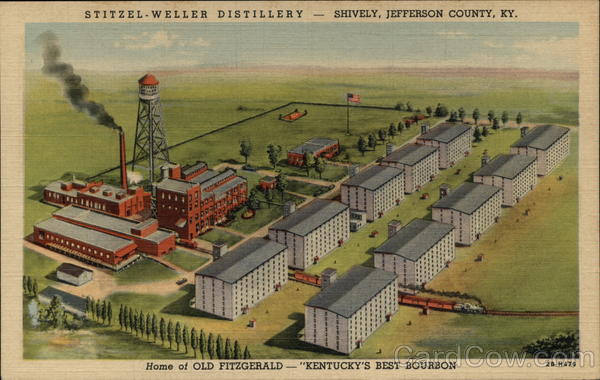
Postcard of a newly completed new post Repeal Stitzel-Weller distillery circa 1935.

But the story of Stitzel-Weller is far more than one of corporate takeovers.  It is the story of the personalities that built the business culture that ended up with a Bourbon that was reputed to be absolutely the best in the golden era of American whiskey distilling.  Chief among them is, of course, Julian P. "Pappy" Van Winkle. Pappy was the president, and while never the master distiller who actually made the whiskey, was the heart of the operation which he governed by an honest, forthright, and gentlemanly creed:

"We will sell fine Bourbon.  
At a profit if we can.  
At a loss if we must.  
But always fine Bourbon".  


After Stitzel-Weller was born as a corporation in 1933 with Repeal, they immediately began construction of a new much larger distillery in Shively, KY and it was completed in 1935.
They put Pappy's motto on a sign and posted it at the distillery's gates.  It was a clear commitment to a perfectionist level of craftsmanship.  And, as it happened, the moment passed.  Pappy died in 1965 and his son, Julian P. Van Winkle Jr. took over.  But the market was already heading South and with his sister and 49% of the board voting stock wanting to sell, he did in 1972 for the sake of family unity.  Then S-W went down the Norton-Simon rabbit hole on its path to closure.  But Julian Jr. wasn't done.  He subsequently created the "Old Rip Van Winkle" brand and contracted to buy Stitzel-Weller whisky and bottle it himself as a NDP.   His son, Julian III went into the same business and expanded it, and created the signature expressions of Pappy Van Winkle's Family Reserve 15, 20, and 23 that have become the vanguard of the tulip mania that is high-end Bourbon today.  Bottles of Pappy Family Reserve are effectively unobtainable these days and sell for many many multiples of the non-existent retail price.  Part of the mania for Pappy is its extremely high critical ratings - the buzz around which helped rekindle the widespread resurgence of ultra-high-end Bourbon in the mid-1990s.  Part of it is the tireless efforts of Julian P. Van Winkle III as a brand ambassador for his family's legacy.  Certainly part of it must be credited to the beautiful family history his sister Sally Van Winkle Campbell  wrote titled "But Always Fine Bourbon - Pappy Van Winkle and the Story of Old Fitzgerald".  In a brief but satisfyingly detailed book, Campbell tells the story of the distillery, Pappy, and the culture that thrived around a traditional and home-spun notion of a gentleman's honor code of whiskey.  It has the love and family focus of a book written by a doting granddaughter - but it also packs a good amount of detail about the business operations of Stitzel-Weller including an impressive tour of the distillery, illustrated by photographs from the United Distiller's collection (the company that ended up
The Key to Hospitality - reverse label of the 1959-1966 BIB.
with Stitzel-Weller in the end).  Many of the details in this post come from that book.  I highly recommend it.  This book certainly contributed mightily to the mystique of Pappy's whiskey.  But, honestly, the whiskey speaks for itself.  People tend to fall in love with it.  Wheated (with wheat in the mash bill instead of rye) - it's very sweet - but the sweetness is balanced by a big load of very mature quality old growth American white oak.  The wheated mash bill is a legacy of A. Ph Stitzel who made this mash bill in his old distillery before Prohibition.  It was the quality of this whiskey which had originally attracted Pappy and led him to the partnership.  It was as if Stitzel used oak spice in the place of rye spice to balance the extra load of candy apple sweetness.  That was accomplished with barrel management.  Pappy's barrels didn't look like regular barrels.  The staves were much thicker and thus the coopers had to use an extra pair of hoops so the barrels look enormously beefy and armored.  The whisky tastes enormously beefy from the oak perspective as a result.  This is a high amplitude balance; the bass of oak and the treble of sweet are turned way up high.  But more than this is the dark and rich tonal palette and thick mouth feel.  It's nutty and musky like an Olorosso sherry or a dark Cognac rancio  This bigness, balance, and heavy richness has made this Bourbon legendary.

Stitzel Weller made 4 brands:  Old Fitzgerald, Weller, Old Cabin Still and Rebel Yell.  They each had a niche.  Rebel Yell was the smoothie, with a marketing angle that targeted the South with its residual patriotism for The Confederacy.  Cabin Still was lighter and sweeter - "for sportsmen" according to Pappy.  Apparently because it didn't need as much air time to open up.  Weller was lighter as well, but also stronger.  Old Fitz was the unapologetically old fashioned full body and full flavor oak bomb at the top.  It was sold exclusively bottled in bond at 100 proof until Pappy's death when his son Julian immediately introduced an 86 proof version: Old Fitzgerald Prime.  It's significant that Sally Van Winkle Campbell chose to subtitle her history of Stitzel-Weller "The Story of Old Fitzgerald".  Old Fitzgerald wasn't just another brand in a portfolio: it's was Pappy's statement product.  Pappy had loved the brand and pursued it for years during Prohibition from its original owner S. Charles Herbst.  It had been named for a bondsman (a security guard at a bonded warehouse who enforced federal tax policy) who had such a good palate for picking good barrels to pilfer from that his name became a byword for a good barrel.  Herbst sold the brand after Prohibition shut him down.  In Campbell's book Herbst asks for $25,000 but ends up selling for $10,000.  On the Bourbon Enthusiast's excellent S-W timeline, the sale is listed as being for $4,000 in two payments in 1922 and 1925.  


(a faded date stamp is revealed to be Spring 1959 - Fall 1966 using high contrast photo filtering)

Like a lot of Bourbon enthusiasts I've encountered Sitzel-Weller's Bourbons in a variety of independent bottlings since the distillery's closure.  It has ended up in certain bottles from Willett's, Black Maple Hill, Michter's, Jefferson's Presidential Select 17 and 18, and, of course, Old Rip Van Winkle and Van Winkle Family Reserve.  Some of these bottlings are really stunning.  But the whiskey that Pappy himself considered the statement of his art was S-W's flagship brand:  Old Fitzgerald.

I've been assembling samples and bottles of Old Fitzgerald from three eras:
  1. 1950s and 60s - during the tenure of Pappy himself.  Represented here by a Very Old Fitz 1953-1961 (thanks, Mike Jasinski), and a 7 1/2 year old Old Fitz BIB 1959-1966 (full bottle found hunting)  
  2. 1965-1972 - the tenure of Julian Van Winkle Jr., represented by a 1966-1972 Old Fitz BIB "Fighting Irish" decanter (thanks, Mike Jasinski) and 
  3.  The time of closure represented by a 1997 dated Old Fitz BIB (courtesy of Joshua Scott).  
I'm also tasting a pair of Old Fitz Primes from the era of its introduction - the Julian Jr. period:  an Old Fitz Prime decanter from 1970 (Mike Jasinski) and a pair of Italian export market minis sourced from a German auction house.  Master dusty hunter Mike Jasinski was clearly a big part of this story, providing half the samples tasted.  Kudos to Mike for both being able to find these in the wild and for generously sharing them in the interest of science.


The idea is to get a sense of the flavor profile of this expression and how it evolved in the decades spanning the heyday to the final days.

Very Old Fitzgerald 8 year old 1953-1961 50% abv


Color:  Deep amber with reddish coppery tints.

Nose: Beautiful deep oak with tremendous fidelity.  Sticking your nose in a the drawer of a fine old oak desk.  Plummy round malted milk and dark chocolate, pecans, preserved cherry and dark bourbon vanilla beans.  Further back, earthy loam and char and mineral note that sometimes comes off as fresh cut grass.  This nose is heaven.  It smells of time,

Palate:  Sweet on entry with candy apple, musky malt, cherry, vanilla, and cognac rancio.  The  expansion is spicy and redolent of old dark oak.  Oak tannin bitterness rises to meet the rancio and malted milk chocolate cherry sweetness.  The turn to the finish is full of rich oak desk - fine polished furniture; herbal bitters, char and earth.  Delicious darkly oaked Bourbon.  With extra air it gets a little sour.

The extra age here takes the wood flavors to new heights, but the body isn't as malty-rich as the nearly equally aged 7 1/2 year old BIB.
(Thanks, Mike Jasinski for this sample)


Old Fitzgerald BIB, 7 year old age statement tax stamp dated Spring 1959-Fall 1966 50% abv

Color Deep amber with rich reddish coppery tints, almost like a glass of Cocoa Cola but more reddish and less brown.

Nose: Deep, plummy, round, and constantly evolving in the glass.  Malted milk balls made with dark chocolate, dark cooked toffee, well cooked citrus compote containing preserved cherry, ginger, and baking spice. Cinnamon red hots and candy apples and the dark nutty vinous quality you find in old sherry and Spanish brandy.  And, ultimately, oak: rich and deeply iterated oak.  But not the sawn oak note you get so often in Bourbon; a rich furniture oak with sandalwood perfume.  This whisky smells like time.   Over half a century in the glass, we can expect bottle maturation to have full play here.  Dark and tannic, this one took weeks to open up.  It was tight and astringent at first.  As it opens it becomes glorious.

Palate: Complex and evolving as well.  Sweet and candied and at turns honeyed, the classic wheater notes are present: candy apple, sweet corn, peach citrus, and charred oak.  But there is so much more - all in a dark palette.  Molasses, malt, chocolate, oak char, oak tannins.  This is full bore rich, dark whiskey.  The combination of sweet and dark gives this bourbon enormous flavor amplitude.   The progression of the palate works like this:  Floral treacle sweet cherry vanilla on the opening at the tip of the tongue.  A big spicy expansion full of mandarin orange, oak tannins, dark chocolate, malt, caramel, molasses and old brandy rancio take sway and never let go.  At the turn robust hyper-detailed oak with darker notes of char joins the endless and continuing rancio and big brown sweet flavors and fade off into the sunset together with the mass of the attack moving across the middle of the palate to the rear in a stately and fully mouth encompassing way.  The mouth feel is oily and thick.  This is a masterpiece.  It's a dark rich spicy pudding.  This is a Bourbon that completely embraces its brown and rich flavors.  Such Bourbon isn't made any more and it makes me want to cry.


Old Fitzgerald BIB 6 year old crockery decanter ("Irish Luck") Spring 1966- Spring 1972 50% abv.


Color: medium amber.  Just a shade lighter than the '59-'66 BIB.

Nose:  similar but a tad drier than the '59-66 BIB.  More citrus and cherry, and less vanilla floral sweetness, dark char and rancio.  It's a year and half younger and you can smell it.

Palate:  Glorious in the classic Old Fitz ways: candy apple sweet on opening with nutty rancio, malted milk, and old preserved cherry vanilla.  Darkly tannic at the turn, big oak dominates the turn and the finish.  The balance seems better here than with the 1959-66, even while the heavy malt and rancio flavors that are so distinctive are less fully emphasized.  Is this Julian's take?  The same instincts leading Julian Jr. to start making Old Fitz Prime leading him to make a slightly younger less malty-funky expression of Old Fitz?  It's clearly the same brand, same recipe and style - just turned a notch down in amplitude.  (Thanks, Mike Jasinski, for the sample).


By 1997, S-W isn't automatic.  The label here specifies that the distillery is DSP-KY-16.  That's S-W

Old Fitgerald BIB, NAS bottle date 1997 50% abv

While distilling ended for Old Fitz at S-W in 1991, Old Fitz continued being made with aging stocks of S-W juice for another half decade or so.  This NAS Old Fitz BIB appears bottled in 1997 or 98.  Given that the whisky in that bottle was laid down in 1992 at the latest, it must have been 5-6 years old, most likely.

Color: coppery medium amber

Nose: Candy apple, orange compote, orchid flowers, apricot nectar, floor varnish, and hints of pineapple and coconut.

Palate: Big and floral opening - almost perfumed.  Candy apple from the nose meets fruity cherry vanilla. Citrus and florals meet in the mid palate which brings a big dose of fragrant tannic oak.  Darker notes of char, caramel and leather rise up in concert with the oak.  There's a very nice balance to the three aspects - flowers, citrus, and dark oak and leather in the turn to the finish which isn't as long as you'd suspect, but full of the characteristic Stitzel-Weller Old Fitz rounded oaky bitters on the finish.  It's remarkable how it's the same flavor profile as the 1966 stuff, but younger, sweeter, and more dynamic.   It's pretty clear that the Old Fitz product was being bottled younger and maybe was being barreled at a higher proof - but the recipe was the same.  Tasted head to head with the 1966-1972 crock 6 year old version of Old Fitz it is a hair lighter and less malty-rancio rich, but only a hair.  Frankly, I was surprised how close they were.  I could never pick between them blind.

The 1997 date stamp.
Pappy resisted the market forces which led most whiskey makes to offer lower proof versions than Bottled In Bond 100 proof.  Here's a 1963 ad which expresses Pappy's creed on the topic:
But when Julian Van Winkle Jr. took over in 1966 the first thing that he did was introduce Old Fitz Prime:

1966 ad announcing the new Old Fitzgeral Prime expression 86.8 proof.

Old Fitz Prime (86 proof) mid 1960s mini (left) and 1970 duck decanter sample

Old Fitz Prime Duck Decanter 1970 43.4% abv.

Color: medium amber
Nose: dusky sandalwood oak, candy apple floral vanilla cherry compote.  Sweet, fruity, dusky, musky oaky, and intense.
Flavor: sweet with toffee, caramel, malted milk balls, a quality of Spanish dark brandy with dark sherry grape and rancio and a dose of floral vanilla on the opening.  Succulent dark cherry joins at the expansion, with notes of chocolate, and even light and sweet coffee.  Just beautiful.
The added bit of dilution in the Primes takes the oak tannin intensity down a notch and opens the palate with more sunny sweetness, but at the expense of a bit of richness of mouth feel.  This is an excellent and classic flavor profile.  Despite the lower proof, one of the tastiest pours of the evening.

Old Fitz Prime Italian Export market 6 year old Bonded 1/10th pint 43% abv - around 1965

For dating, note the two tone (white and gold) painted label and see #4 at:
http://www.ne.jp/asahi/miniature/smallworld/image/BourbonO.htm
The all gold color scheme of the late 50s turned into a gold and white two toned painted label mini like the ones here.  By 1968 a paper label had replaced the painted one.
Not technically a "Prime" at 43.4%, but an export version of the Bonded bottled at 43%.

Color: medium amber
Nose: very similar to the decanter: sandalwood oak, candy apple, black cherry fruit, floral vanilla.
The palate is also nearly identical: toffee sweet on opening with musky malted milk balls, dark cherry, floral vanilla, with a marked minty note as a distinguishing feature.  Lots of fragrant oak.  Really delicious.

The Primes succeed because the added water helps sweeten and mellow the dark tannin oak of the 100 proof BIB.  The trade off is the lighter mouth feel.

Old Fitz 1959-1966 BIB. Look at the color!
There is a remarkable unity in the flavors of the Old Fitzgeralds of the Sitzel-Weller distillery across the decades between the heyday and the end.  It's a heavy and old fashioned style of whisky.  Dark sweet and sherry-nutty were more common attributes among Bourbons of the early 20th century.  It was clearly inspiration for the  first year Eagle Rare 101 from Old Prentice (the malted milk and rancio).  For decades, S-W's whiskies were the only wheated mash bill whiskies around.  So the various wheaters you find now are all descendants of these S-W whiskies.  The crafting and attention to quality for which it is famed is immediately apparent.  S-W Old Fitz is a lush and heady beauty.  Candied, fruity, richly oaked.  (Some would say over oaked).

Old Fitz tastes old fashioned because that's the ideal of whiskey that Pappy had in his mind.  Pappy wasn't going to compromise on anything to do with the whisky - and that whiskey was all he was going to do.  In the end, Pappy stood for something.  He made his stand on the topic of quality Bourbon in the way he understood it - timelessly - to be.  Ultimately his fierce dedication to this inflexible definition of quality left his company too specialized on a type of whiskey that had become nonviable in the market to survive.  It's a shame.  Meanwhile, change is inevitable and isn't only about loss.  You can love a mid-century American car and note that "they don't make them like they used to" while still driving and enjoying a new car - which has certain benefits.  For example, compared to, say, Buffalo Trace's statement wheater - W.L. Weller from the Buffalo Trace Antique Collection, old Old Fitz is distinctive - but isn't unambiguously better.  This shows me that the state of the art isn't necessarily lost.  Although, clearly, something very special was indeed lost:  a culture of the grace of old time Southern gentlemen, the passion of craftsmen, and a sense of commitment to keeping a tradition of excellence - family owned.  Bottom line, Pappy's business was about family.  And that human dimension was the first thing that disappeared into the maw of the culture of corporate behemoths.

Pappy's name and the legend of his whiskey have become a mania in the Bourbon world at the current moment.  People are scrambling for the brands that have become associated with his legacy and don't seem to care when what they are actually buying is a cleverly made Buffalo Trace replica.  Old Fitz is now made by Heaven Hill and doesn't share S-W's lofty reputation among the hunters and the epicures.  (I need to taste the new Old Fitz.  It's not sold in my area - but I do get on the road from time to time.)  My purpose with this post isn't to stoke the mania for S-W further.  Auction prices are through the roof for Very Old Fitzgerald and vintage bottles of Old Fitz.  The hype ship has already fully sailed.  My purpose is to take a moment and remember Pappy's bourbon and try to understand what makes it great.  The distillery tour in "Always Fine Bourbon" tells the story:  Old Fitz was mashed a long time from carefully milled corn, barley, and wheat using a closely guarded old yeast and limestone aquifer well water (that is now no longer safe to use).  It was barreled at a low proof into high quality custom made bespoke cooperage and aged a long time for Bourbon.  It wasn't afraid of tasting rich 'n thick like "Old Man's" whiskey.  In In order to move on we have to know where we've been.  America isn't the same place it was in 1959 or 1965.  That moment in history has passed, but with some passion and some love our best days may still be in the future.

A year ago news came come out that Diageo is fitting Stitzel-Weller to restart Bourbon production there.
http://chuckcowdery.blogspot.com/2013/01/after-more-than-20-years-stitzel-weller.html 
The gist is that they are going to make Bulleit there:
http://whiskycast.com/decision-time-for-diageo-on-stitzel-weller/
BourbonTruth takes a deeper dive into the buzz of activity and the rumors and evidence for why:
http://thebourbontruth.tumblr.com/post/62732920744/whats-going-on-behind-the-gates-of-the-old

So, Stitzel-Weller will soon be making Bourbon again.  But, apparently, it won't be what we know of as Stitzel-Weller Bourbon.  It will be Diageo's replica of Four Roses' expression of Bulleit Bourbon.  And yet, Pappy's ideals are very much alive out there in the world of distilling.

Update:  As the story unfolded it became clear that production was not being restarted.  Rather, Diageo converted the old office house into the "Bulleit Frontier Whiskey Experience" - a tourist destination on the Bourbon Trail to be the spiritual home of their Bulleit whiskey expressions (Bourbon and Rye) - neither of which has any connection with the distillery in any way, as far as I know.