 http://fr1day.co.za/) I looked it up. There were a ton of ads which helped to date it because of bottle shape changes. As a cheap blended American whiskey it was an inexpensive and high profit margin product for Hiram Walker, its producer, because its was mostly grain neutral spirits which are cheap to produce and are not aged. Whisky companies tend to put a lot of image advertising into these types of products because the whisky doesn't sell itself and the profits justify the advertising costs. The ads changed a lot over the years - in a way that reflected the values of the times in a way I found fascinating. But as I dug deeper into the story it got even more interesting... (The story that is, not the actual whiskey itself. There will be tasting notes at the end of a dusty 1980s bottle of this stuff; This isn't a gourmet whiskey. It's for mixing, not drinking neat.) Imperial, as it turns out, has a contested and somewhat mysterious past.
When I looked up the ads, the earliest ones I found were from 1943, they follow thickly until 1975 when they abruptly disappear (other than supermarket price listing ads). Given the 1943 beginnings I wasn't too surprised to find the Bourbon Enthusiast forum timetable gives the following bit of information:
1941 - "Imperial" whiskey is introduced by Hiram Walker
(Brown, 200 Years of Tradition, p. 108).
http://www.bourbonenthusiast.com/forum/viewtopic.php?t=1818
But as it turns out, that's not true. Hiram Walker sued Penn-Maryland corporation in 1935 for trademark infringement over use of the brand name "Imperial" claiming to have sold whiskey under that brand name since 1887:
79 F.2d 836 (1935)
HIRAM WALKER & SONS, Inc., v.PENN-MARYLAND CORPORATION.
Circuit Court of Appeals, Second Circuit.
December 2, 1935.
"This is an appeal from an order granting a temporary injunction restraining the appellant's use of the word "Imperial" as a trade-mark for whisky. The order was based upon the infringement of a registered trade-mark for the word "Imperial" for appellee's product. The court below granted the injunction after issue was joined and upon affidavits. The appellant in selling its whisky has a brand name, "Penn-Maryland Imperial.
...
It is alleged that appellee and its predecessors have sold distilled whisky under the name "Imperial" since 1887, principally in Canada up to 1891, and since the latter year it has sold quantities in the United States. It is also alleged there were sales in large quantities and extensive advertising in the United States and that the purchasing public in the United States have come to identify the whisky to which this name is applied as that of the appellee.
...
Appellee complained to the appellant about the use of the word "Imperial," and the appellant asserted that under the circumstances it was proper for it to use the word. Indeed, Henry H. Schufeldt & Co., like appellant, a subsidiary of the National Distillers Products Corporation, used "Imperial" as a trade-mark for gin continuously from 1868 to the date of Prohibition, antedating the appellee's first use even in Canada. Appellant's affiliate also used "Imperial Crown" for cherries and olives used in making cocktails. The record only shows sales by appellee of its brand in the United States, prior to Prohibition, to be 964 cases and 37 barrels for the year ending August 31, 1891; 1 case in March, 1896; 2 cases in August, 1902; 1 case in December, 1909; and 1 case in September, 1917. No sales could be made during the Prohibition period, but 5,210 cases of appellee's brand were sold here between the date of Repeal and October, 1934, when appellant put its brand on the market, and of these 4,964 cases were sold in the state of Michigan. The appellee sets forth the total, which was very large, of the sales of its brand in Canada and elsewhere, prior to Prohibition, but submits no figures, other than those above, as to sales in the United States.
The word "Imperial" is descriptive and indicative of quality. Webster's New International Dictionary defines it as "of superior or unusual size or excellence;
http://www.leagle.com/decision/193591579F2d836_1629.xml/HIRAM%20WALKER%20&%20SONS,%20INC.%20v.%20PENN-MARYLAND%20CORPORATION
The Pre-Pro web site corroborates this in a list of brand names used before Prohibtion:
Hiram Walker Established 1858
The company used the brand names:
"Biltmore", "Canadian Club", "Canadian Club", "Gold Capsule", "Hiram Walker", "Imperial", "The Epicure", "W", and "Walker's Father Time."
http://www.pre-pro.com/midacore/view_vendor.php?vid=DTW11355
And the New York Public Library's restaurant menu project shows the Banff, Maine, Sanitarium Hotel's October 4, 1893 Wine List proudly selling Walker's Imperial just two years after the lawsuit claims Hiram Walker began importing Imperial into the USA in 1891. (Note - the prices are for whole bottles only. Wine and beer were sold by the pint and quart, but whiskey and brandy was apparently only sold by the whole bottle. If anyone knows what G. & D. is, or can illuminate what the "White Wheat" was I'd love to hear it. I suspect a local agricultural whiskey).
But I've never seen a bottle or an image of a bottle from before the 1940s. Was it a blended whiskey? A Bourbon? A rye? What was the mash bill? If anyone has any further information about the Pre-Prohibition incarnation of Hiram Walker's Imperial I'd love to hear about it.
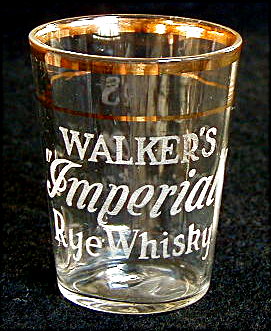
Update: John Lipman - of http://www.ellenjaye.com/ fame - just came up with a link which has the answer: a pre-pro shot glass on Pre-Pro.com which shows that pre-Prohibition incarnation of Imperial was a rye - at least for a portion, if not all, of the period. Although he points out that it might have been a "rye" in the Canadian sense (where actual rye whiskey might have just been a flavoring). In the era before the Food and Drug Act of 1906 you never knew what was in there.
http://www.pre-pro.com/midacore/view_glass.php?sid=RRP864
But from 1941 to the present, Hiram Walker's Imperial is a blended American whiskey, sold at a low price and from 1943 to 1975 I find a ton of ads that charts a progression of priorities that says something about America. It starts with WWII and wartime rationing. The first ads for Imperial are a set of allegorical stories justifying the "one bottle per customer" rationing rules for whiskey. The illustrations are animal themes which are explicitly allegorical and reference classical sources such as Aesop's fables.
 This ad (1943 Life Magazine) reads: "This is no time for gobblers"
"No one can have a lot in these times of little - or someone else will most certainly get less than he needs.
And that's why rationing of essential and vital things is a national "must" -for if all are to have what they need, a few can't have all they want.
But no such solid rules apply to less essential things - and they're the things we have to be careful not to "gobble up." A few gobbles and these, too, might be gone. No one knows this better than your liquor dealer. That is why "only one bottle to a customer" may be most conspicuous thing in his store. No one knows better than he that this is no time for gobblers.
With every distillery in America making war alcohol instead of whiskey, present stocks of whiskey must last for a longer time than anyone had foreseen. And a little for all now is the best insurance against none for anyone later." Imperial ... it's "velveted"
Blended whiskey, 86 proof, 70% grain neutral spirits. Hiram Walker & Sons Inc., Peoria, Ill.
The story is about rationing and it explicitly references the fact that distilleries aren't putting up whiskey because all production has been shifted to industrial alcohol for war production. But there's marketing too. An explicit reference to the blended nature of the whiskey is the phrase "...it's velveted" which seems to argue that the soft (weak) flavors of the blend are actually a good thing. I also get the impression that the weakness of the flavor of the blend is also being somehow justified as part of the "noble sacrifice" of wartime good citizenship. The use of animal visual anecdotes puts the issue in a classical, almost elemental frame of reference.
After the war ended, Imperial rolled out a new advertising theme: American laborers rolling barrels of whiskey in industrial environments. The tagline is: "88 years at fine whiskey-making makes this whiskey good". The small block of text at right reads: "86 proof. The straight whiskies in this product are 4 years or more old. 30% straight whiskey. 70% grain neutral spirits. Hiram Walker & Sons, Peoria, Ill."
The title of the painting in the ad above is "Whiskey Going to the Rackhouse to Age". The irony is that product is less than 1/3rd whiskey. The content is the claim that Hiram Walker knows how to make good whiskey because they've been doing it for a long time, but the fact is that they hadn't been doing it in Peoria for the entire duration of WWII. This is an exercise in branding referencing a form of wishful thinking about whiskey. But it's also something more. The image of the heroic laborer evokes a mythic representation of labor itself, within a specific context of the labor movement, the rise of communism and socialism, and the previous decades New Deal and WPA. For example, here is an image of laborers pushing barrels from a 1936-37 WPA project public works mural:
By using themes of labor in their whisky advertising they seek to associate Imperial with an ascendant American working class - and by association with the aesthetics of an American industry which had just literally conquered the world in WWII.
The worker rolling the barrel became the brand's logo, used in advertisements for a number of years in the late 40s. Look at the lower left hand corner of this 1948 Life magazine ad:

By the early 1950s the message of the age of the brand had become the focus, with a series of ads showing partying late 1890s or early 1900s partying people singing the radio jingle:

Color: light amber
Nose: grassy light floral lavender and grape. Underneath some earthy Bourbon citrus and leather. A pale and washed out nose, but the aromas that are present are fine.
Palate: Sweet and light on the opening with grape bug juice and magic marker. The midpalate brings in some leather and tobacco and earthy Bourbon flavors, but light and a bit far away. The finish is relatively short. Sometimes I get a little whiff of vodka in the finish. Put head to head with a contemporary bottling of Wilson (another venerable old blended American whiskey - a rye until Prohibition and a blended American whiskey from Repeal on. Now currently made at Barton as well.) shows great similarity and fairly similar flavors. The Wilson has more spirit heat and burn, but a tad more vividness of flavor. This Imperial is weak and a bit flabby. This might be almost 30 years of bottle maturation. Or not. Certainly not anything to write home about, or even drink neat. This is for putting into soda or a cocktail where whiskey plays a minor role.
**
Conclusions: Imperial begins with Hiram Walker's Canadian strategy to avoid Detroit's distillation restrictions and arrives in America as an import. After Repeal it is a Peoria Illinois product that fit mid-century tastes for light whiskey used in highballs and cocktails and was sold with references to America's industrial might and ascendant working classes - possibly referring to its low price. It represented, like a mirror, American notions of the macho maleness of whiskey drinking (ironic as the product is smooth and weak) and some ironic attempts at class (ironic because the product is dirt cheap) before ending up failing as a pre-sex social lubricant and disappearing to the bottom shelf. American blended whiskey failed because it's not as flavorful as real whiskey (which is GNS free) and isn't as smooth and easy mixing as the white spirits which slayed whiskey from the 70s to the 90s. Whiskey's revival is about the full flavors of real whiskey. Blended American whiskey is cut with un-aged grain neutral spirits so it has no role to play in whiskey's revival. Its sole play is a low price point.
79 F.2d 836 (1935)
HIRAM WALKER & SONS, Inc., v.PENN-MARYLAND CORPORATION.
Circuit Court of Appeals, Second Circuit.
December 2, 1935.
"This is an appeal from an order granting a temporary injunction restraining the appellant's use of the word "Imperial" as a trade-mark for whisky. The order was based upon the infringement of a registered trade-mark for the word "Imperial" for appellee's product. The court below granted the injunction after issue was joined and upon affidavits. The appellant in selling its whisky has a brand name, "Penn-Maryland Imperial.
...
It is alleged that appellee and its predecessors have sold distilled whisky under the name "Imperial" since 1887, principally in Canada up to 1891, and since the latter year it has sold quantities in the United States. It is also alleged there were sales in large quantities and extensive advertising in the United States and that the purchasing public in the United States have come to identify the whisky to which this name is applied as that of the appellee.
...
Appellee complained to the appellant about the use of the word "Imperial," and the appellant asserted that under the circumstances it was proper for it to use the word. Indeed, Henry H. Schufeldt & Co., like appellant, a subsidiary of the National Distillers Products Corporation, used "Imperial" as a trade-mark for gin continuously from 1868 to the date of Prohibition, antedating the appellee's first use even in Canada. Appellant's affiliate also used "Imperial Crown" for cherries and olives used in making cocktails. The record only shows sales by appellee of its brand in the United States, prior to Prohibition, to be 964 cases and 37 barrels for the year ending August 31, 1891; 1 case in March, 1896; 2 cases in August, 1902; 1 case in December, 1909; and 1 case in September, 1917. No sales could be made during the Prohibition period, but 5,210 cases of appellee's brand were sold here between the date of Repeal and October, 1934, when appellant put its brand on the market, and of these 4,964 cases were sold in the state of Michigan. The appellee sets forth the total, which was very large, of the sales of its brand in Canada and elsewhere, prior to Prohibition, but submits no figures, other than those above, as to sales in the United States.
The word "Imperial" is descriptive and indicative of quality. Webster's New International Dictionary defines it as "of superior or unusual size or excellence;
http://www.leagle.com/decision/193591579F2d836_1629.xml/HIRAM%20WALKER%20&%20SONS,%20INC.%20v.%20PENN-MARYLAND%20CORPORATION
The Pre-Pro web site corroborates this in a list of brand names used before Prohibtion:
Hiram Walker Established 1858
The company used the brand names:
"Biltmore", "Canadian Club", "Canadian Club", "Gold Capsule", "Hiram Walker", "Imperial", "The Epicure", "W", and "Walker's Father Time."
http://www.pre-pro.com/midacore/view_vendor.php?vid=DTW11355
 |
| Sanitarium Hotel October 4, 1893 Banff Maine Wine List From NYPL - http://menus.nypl.org/menu_pages/41892 |
And the New York Public Library's restaurant menu project shows the Banff, Maine, Sanitarium Hotel's October 4, 1893 Wine List proudly selling Walker's Imperial just two years after the lawsuit claims Hiram Walker began importing Imperial into the USA in 1891. (Note - the prices are for whole bottles only. Wine and beer were sold by the pint and quart, but whiskey and brandy was apparently only sold by the whole bottle. If anyone knows what G. & D. is, or can illuminate what the "White Wheat" was I'd love to hear it. I suspect a local agricultural whiskey).
But I've never seen a bottle or an image of a bottle from before the 1940s. Was it a blended whiskey? A Bourbon? A rye? What was the mash bill? If anyone has any further information about the Pre-Prohibition incarnation of Hiram Walker's Imperial I'd love to hear about it.
Update: John Lipman - of http://www.ellenjaye.com/ fame - just came up with a link which has the answer: a pre-pro shot glass on Pre-Pro.com which shows that pre-Prohibition incarnation of Imperial was a rye - at least for a portion, if not all, of the period. Although he points out that it might have been a "rye" in the Canadian sense (where actual rye whiskey might have just been a flavoring). In the era before the Food and Drug Act of 1906 you never knew what was in there.
http://www.pre-pro.com/midacore/view_glass.php?sid=RRP864
 |
| http://www.pre-pro.com/midacore/images/shots/RRP864.jpg |
But from 1941 to the present, Hiram Walker's Imperial is a blended American whiskey, sold at a low price and from 1943 to 1975 I find a ton of ads that charts a progression of priorities that says something about America. It starts with WWII and wartime rationing. The first ads for Imperial are a set of allegorical stories justifying the "one bottle per customer" rationing rules for whiskey. The illustrations are animal themes which are explicitly allegorical and reference classical sources such as Aesop's fables.
"No one can have a lot in these times of little - or someone else will most certainly get less than he needs.
And that's why rationing of essential and vital things is a national "must" -for if all are to have what they need, a few can't have all they want.
But no such solid rules apply to less essential things - and they're the things we have to be careful not to "gobble up." A few gobbles and these, too, might be gone. No one knows this better than your liquor dealer. That is why "only one bottle to a customer" may be most conspicuous thing in his store. No one knows better than he that this is no time for gobblers.
With every distillery in America making war alcohol instead of whiskey, present stocks of whiskey must last for a longer time than anyone had foreseen. And a little for all now is the best insurance against none for anyone later." Imperial ... it's "velveted"
Blended whiskey, 86 proof, 70% grain neutral spirits. Hiram Walker & Sons Inc., Peoria, Ill.
 |
| The Aesops fables theme was a whole series of ads |
 |
| Tortoise & Hare from Aesop's Fables |
After the war ended, Imperial rolled out a new advertising theme: American laborers rolling barrels of whiskey in industrial environments. The tagline is: "88 years at fine whiskey-making makes this whiskey good". The small block of text at right reads: "86 proof. The straight whiskies in this product are 4 years or more old. 30% straight whiskey. 70% grain neutral spirits. Hiram Walker & Sons, Peoria, Ill."
 |
| Illustration by Fred Ludekens 1946 |
 |
| Gordon Grant WPA mural, Ventura CA post office http://www.experiencingla.com/2011_04_01_archive.html |
 |
| The "Labor" theme was a whole series of ads too. (and this collage is not remotely complete) |
By the early 1950s the message of the age of the brand had become the focus, with a series of ads showing partying late 1890s or early 1900s partying people singing the radio jingle:
By the mid-1950s Imperial changed the message again to one of macho heroism with a famous series of ads that showed specific men associated with really macho activities such as boat racing, big game hunting, deep sea diving, sport fishing, and bronco busting:
The motto here is "FOR MEN AMONG MEN THERE IS A WHISKEY AMONG WHISKIES - IMPERIAL" and the tag line "Man, this is whiskey!" I can't help but think they are over compensating for the fact that Imperial is a weak flavored blend. But this is image advertising after all. The point here is that the heroism of labor isn't sexy any more. Big macho maleness is what was sexy in mid-century America.
Update: in contrast to the example I made large above, it occurs to me that most of the men depicted are rather un-macho. They are all actually a bit goofy or boyish or even a a bit feminine (like the polar hunter in the lavender fur lined coat). I wonder if there's a subliminal anti-macho message here that ties into the soft blended whiskey.
By the early 1960s the theme shifted to class. From 1962 to 1967 Imperial ran a series of ads that showed a chauffeur carrying a case of Imperial to a 1930s classic Rolls Royce Phantom. Other ads showed people bringing cases of Imperial to fancy yachts, airplanes, boats, vacation home garden parties etc...

Just as in the 1940s, the theme is a laborer moving the whiskey, but now, instead of noble empowered labor rolling the barrel as the logo, it's a servant of the rich (a chauffeur) carrying a case. (look at the lower left hand corner of the ski plane ad in the lower right hand corner of the collage above - and you can see the carrying chauffeur used as a logo of the brand). The theme of class had become totally inverted. Does this represent the growing affluence of mid-century USA or is it simply a reflection of the shifting aesthetics of an ascendant American culture focusing less on how it had become affluent than simply on the fact that it was?

By 1973 the tag line shifted to the sexual revolution. Imperial was now the "Good-Natured Whiskey" with the tag line "It mixes well." - with a clear context showing that the mixing was between the sexes. In 1975 this took its final, darker, turn with the advent of "The Imp" ad campaign.

This series of ads re-brands Imperial as "The Imp" - a kind of "ruffie" date rape drug for use in seducing women. The ad copy of "The Imp Next Door" ad reads: "Meet the Imp: Imperial. It mixes so smoothly you might never guess what it's up to. But for breaking the ice, it's up to your highest expectations. Try the Imp tonight with someone you know. Or borrow a cupful from someone you'd like to know better." The Imp campaign also introduced a new logo. It's a representation of an imp - a goblin like creature from Germanic folk-lore associated with demons. The specific image they chose - which is depicted as a medallion worn somewhere on the beauties in the ads is a satyr - a classical allegorical image of lust. But the satyr is a fun allegory.
The implication that you might use the stealthy softness of Imperial to trick a woman into getting more inebriated than she planned with the aim of seducing her is more akin to the classical demon, the incubus which is described in the Wiki as follows:
"An incubus (nominal form constructed from the Latin verb, incubo, incubare, or "to lie upon") is a demon in male form who, according to a number of mythological and legendary traditions, lies upon sleepers, especially women, in order to have sexual intercourse with them."
http://en.wikipedia.org/wiki/Incubus
I discussed this campaign within the larger context of how women were depicted in American whiskey advertising a couple of months ago:
In that post I wrote: "Overt and inappropriate sexuality was the centerpiece of the Imperial blended whiskey "Imp" ad campaign too. The tag line was the text "it brings out the imp in all of us" at the bottom of each ad in the series' block of text. But the photo, with the woman wearing a choker with a devilish imp medallion, shows that the imp is the sexually available woman herself. The clear implication is that plying the modern sexually liberated woman with whiskey will produce some kind of love slave that "he can call his own". It's an inversion of feminism's appropriation of sexual liberation into a kind of sexual slavery or ownership on the part of the male reader who, presumably was feeling a little defensive about this feminism stuff. It's worth noting that this was the last national ad campaign for Imperial - a venerable Hiram Walker brand - before it disappeared into the world of ultra-bottom shelf well whiskey where it has languished ever since."
http://www.cooperedtot.com/2014/05/women-in-american-whiskey-advertising.html
Hiram Walker's plant in Peoria, Illinois closed in 1982 and the brand was sold off to Oscar Getz's Barton, and production moved to Bardstown, KY the following year. Then, as John Lipman writes in his excellent history of Barton Brands:
"In 1993, Barton Brands which had been acquiring other brands left and right, was purchased by the Canandaigua wine company, primarily for two reasons. One was their distribution rights for Corona beer; the other was because Canandaigua had recently purchased the Paul Masson and Taylor wine companies -- both of whom were producers of distilled brandy -- and intended for them to be aged and bottled (if not originally distilled) in Bardstown. As we visit today, we can see cases of Paul Masson brandy being bottled and cased. Also Walker's Imperial."
http://www.ellenjaye.com/barton.htm
Barton finally ended up with Sazerac Company - the parent company of Buffalo Trace, A. Smith Bowman in Virginia, Glenmore, as well as Barton Brands. Imperial now exists solely as a bottom shelf well whiskey. The Whiskey-Reviewer in his epic pan writes:
"One sniff, and you might feel like Tom Joad in the Great Dust Bowl, searching for a jar of Smuckers Strawberry Jam in a duststorm, only to find there’s just one jar of the stuff, that’s been left open for a few weeks and is now about 51% dust.
A sickly, artificial sweetness (that expired Smuckers again) dominates what little taste Imperial has, with a hint of metal lurking about the edge. The finish? Imagine scarfing an ashtray spilling-over with week-old cigarette butts soaked in splash of last nights beer and, well, that’s close. Yes, there’s some vanilla, and yes, it is a surprisingly – you might say frighteningly – smooth finish, but the taint of stale, beer-doused cigarettes is what lingers, and it lingers for quite some time."
and concludes:
"The Price $7.99 for a fifth. Enough said"
http://whiskeyreviewer.com/2013/05/imperial-american-whiskey-review/
 |
| 1955 print ad. This guy killed jaguars with a spear. |
The motto here is "FOR MEN AMONG MEN THERE IS A WHISKEY AMONG WHISKIES - IMPERIAL" and the tag line "Man, this is whiskey!" I can't help but think they are over compensating for the fact that Imperial is a weak flavored blend. But this is image advertising after all. The point here is that the heroism of labor isn't sexy any more. Big macho maleness is what was sexy in mid-century America.
Update: in contrast to the example I made large above, it occurs to me that most of the men depicted are rather un-macho. They are all actually a bit goofy or boyish or even a a bit feminine (like the polar hunter in the lavender fur lined coat). I wonder if there's a subliminal anti-macho message here that ties into the soft blended whiskey.
 |
| Man, this is whiskey! was a whole series of ads in from 1954-1956. |
Just as in the 1940s, the theme is a laborer moving the whiskey, but now, instead of noble empowered labor rolling the barrel as the logo, it's a servant of the rich (a chauffeur) carrying a case. (look at the lower left hand corner of the ski plane ad in the lower right hand corner of the collage above - and you can see the carrying chauffeur used as a logo of the brand). The theme of class had become totally inverted. Does this represent the growing affluence of mid-century USA or is it simply a reflection of the shifting aesthetics of an ascendant American culture focusing less on how it had become affluent than simply on the fact that it was?
By 1973 the tag line shifted to the sexual revolution. Imperial was now the "Good-Natured Whiskey" with the tag line "It mixes well." - with a clear context showing that the mixing was between the sexes. In 1975 this took its final, darker, turn with the advent of "The Imp" ad campaign.
This series of ads re-brands Imperial as "The Imp" - a kind of "ruffie" date rape drug for use in seducing women. The ad copy of "The Imp Next Door" ad reads: "Meet the Imp: Imperial. It mixes so smoothly you might never guess what it's up to. But for breaking the ice, it's up to your highest expectations. Try the Imp tonight with someone you know. Or borrow a cupful from someone you'd like to know better." The Imp campaign also introduced a new logo. It's a representation of an imp - a goblin like creature from Germanic folk-lore associated with demons. The specific image they chose - which is depicted as a medallion worn somewhere on the beauties in the ads is a satyr - a classical allegorical image of lust. But the satyr is a fun allegory.
 |
| "The Imp" logo - a satyr. |
"An incubus (nominal form constructed from the Latin verb, incubo, incubare, or "to lie upon") is a demon in male form who, according to a number of mythological and legendary traditions, lies upon sleepers, especially women, in order to have sexual intercourse with them."
http://en.wikipedia.org/wiki/Incubus
I discussed this campaign within the larger context of how women were depicted in American whiskey advertising a couple of months ago:
In that post I wrote: "Overt and inappropriate sexuality was the centerpiece of the Imperial blended whiskey "Imp" ad campaign too. The tag line was the text "it brings out the imp in all of us" at the bottom of each ad in the series' block of text. But the photo, with the woman wearing a choker with a devilish imp medallion, shows that the imp is the sexually available woman herself. The clear implication is that plying the modern sexually liberated woman with whiskey will produce some kind of love slave that "he can call his own". It's an inversion of feminism's appropriation of sexual liberation into a kind of sexual slavery or ownership on the part of the male reader who, presumably was feeling a little defensive about this feminism stuff. It's worth noting that this was the last national ad campaign for Imperial - a venerable Hiram Walker brand - before it disappeared into the world of ultra-bottom shelf well whiskey where it has languished ever since."
http://www.cooperedtot.com/2014/05/women-in-american-whiskey-advertising.html
Hiram Walker's plant in Peoria, Illinois closed in 1982 and the brand was sold off to Oscar Getz's Barton, and production moved to Bardstown, KY the following year. Then, as John Lipman writes in his excellent history of Barton Brands:
"In 1993, Barton Brands which had been acquiring other brands left and right, was purchased by the Canandaigua wine company, primarily for two reasons. One was their distribution rights for Corona beer; the other was because Canandaigua had recently purchased the Paul Masson and Taylor wine companies -- both of whom were producers of distilled brandy -- and intended for them to be aged and bottled (if not originally distilled) in Bardstown. As we visit today, we can see cases of Paul Masson brandy being bottled and cased. Also Walker's Imperial."
http://www.ellenjaye.com/barton.htm
Barton finally ended up with Sazerac Company - the parent company of Buffalo Trace, A. Smith Bowman in Virginia, Glenmore, as well as Barton Brands. Imperial now exists solely as a bottom shelf well whiskey. The Whiskey-Reviewer in his epic pan writes:
"One sniff, and you might feel like Tom Joad in the Great Dust Bowl, searching for a jar of Smuckers Strawberry Jam in a duststorm, only to find there’s just one jar of the stuff, that’s been left open for a few weeks and is now about 51% dust.
A sickly, artificial sweetness (that expired Smuckers again) dominates what little taste Imperial has, with a hint of metal lurking about the edge. The finish? Imagine scarfing an ashtray spilling-over with week-old cigarette butts soaked in splash of last nights beer and, well, that’s close. Yes, there’s some vanilla, and yes, it is a surprisingly – you might say frighteningly – smooth finish, but the taint of stale, beer-doused cigarettes is what lingers, and it lingers for quite some time."
and concludes:
"The Price $7.99 for a fifth. Enough said"
http://whiskeyreviewer.com/2013/05/imperial-american-whiskey-review/
I found a dusty bottle on a store shelf in the ghetto of Roseville, Newark, NJ. It has a faux tax strip (after 1985), no health warning (before 1989), is a metric 375ml (post 1980), and sports a UCP code (post 1980). This constellation of attributes puts the bottle in the late 1980s - probably 1986-89.

Imperial Blended American Whiskey 40% abv. Bardstown late 1980s dusty. 70% grain neutral spirits.
Color: light amber
Nose: grassy light floral lavender and grape. Underneath some earthy Bourbon citrus and leather. A pale and washed out nose, but the aromas that are present are fine.
**
Conclusions: Imperial begins with Hiram Walker's Canadian strategy to avoid Detroit's distillation restrictions and arrives in America as an import. After Repeal it is a Peoria Illinois product that fit mid-century tastes for light whiskey used in highballs and cocktails and was sold with references to America's industrial might and ascendant working classes - possibly referring to its low price. It represented, like a mirror, American notions of the macho maleness of whiskey drinking (ironic as the product is smooth and weak) and some ironic attempts at class (ironic because the product is dirt cheap) before ending up failing as a pre-sex social lubricant and disappearing to the bottom shelf. American blended whiskey failed because it's not as flavorful as real whiskey (which is GNS free) and isn't as smooth and easy mixing as the white spirits which slayed whiskey from the 70s to the 90s. Whiskey's revival is about the full flavors of real whiskey. Blended American whiskey is cut with un-aged grain neutral spirits so it has no role to play in whiskey's revival. Its sole play is a low price point.


