Monday, March 17, 2014

Irish Revival


Irish whiskey is softer, sweeter and lighter than most Scotches, Bourbons, and other World malts.  It is a breed apart: particularly easy going, approachable, and lyrical.  It generally has a fresh and "green" aspect that conveys Ireland to me beautifully.  And like Ireland, it hides a history alternately ancient, noble, joyous, and also dark - full of pain, loss, and catastrophic death.  Ireland is the birthplace of whiskey.  Irish monks were particularly scholarly and wide ranging - helping to retain and disseminate classical learning through Islamic sources when this knowledge had all but entirely disappeared from the West - providing a vital link between the Classical and Medieval world.  Along with classical knowledge, the monks also brought Islamic advances in mathematics and sciences such as chemistry including the Alembic still in around 1000 AD.  The Alembic had been invented to intensify perfumes and tinctures in the Middle East.  Not surprisingly, the intrepid monks applied the method to barley beer (an art well practiced in Ireland as any drinker can attest), producing probably the first malt whiskies in the world in the 11th or 12th centuries.   Potcheen production became part of agricultural life, hospitality, and medical practice.  This topic is well discussed in Fred Minnick's Whiskey Women.  Ireland produced whiskey for export early as well in the industrial era - and was particularly popular in the US in the 19th century.  Whiskey production in Ireland boomed and there were dozens of distilleries thriving producing grain, blended, malt, and pure pot still style whiskey in the first decades of the 20th century.
Irish whiskey's heyday was before Prohibition. This ad is from 1897.

This 1904 sign says so very much.
But then a parade of disasters struck the Irish whiskey industry.  First Prohibition wrecked the US export market, which had been the largest market, in the teens and twenties.  The Irish War of Independence and the Irish Civil war deeply disrupted local industry, agricultural production, and trade in that same period - a vicious double whammy.  Then a series of trade disputes with England following Independence led to the loss of export markets to the British Commonwealth.  As a result, virtually all of  Ireland's whiskey distilleries went bankrupt in the decades between the 1930s and the 1950s.  Ultimately leaving just two:  Bushmill's, in the Northern Ireland, and Midleton in the Irish Republic.

Lately the global whiskey boom has floated boats in Ireland too and there has been a boom in new whiskey brands and plans for new distilleries.  First Bushmill's and Midleton were joined by Cooley Distillery - John Teeling's resurrection of a native Irish owned distilling tradition dating to the late 1980s.  Cooley proved innovative and ambitious, reviving beloved and vanished brands such as Kilbeggan (and laying the foundation of the reopening of that distillery in the past few years - with spirit from there on the way) to creating interesting iconoclastic expressions such as Connemara's Turf Mor - double distilled and peated.  Cooley was purchased by Beam International in 2012.  Other recent projects (all within the last half decade) have started distilling, with spirit on the way, including West Cork Distilleries, Dingle Distillery, Alltech Craft, and Echlinville in Northern Ireland.

Like in the US whiskey market, the explosion of interest and demand has led to a number of companies issuing independent bottlings and using the proceeds to develop their own distilleries.  Examples include Teeling's - a new distillery project planned for urban Dublin, with a brand of whiskey rolling out in the USA on April 1st with juice from Cooley to pay the way.  Tullamore Dew - owned by the Scottish whiskey company William Grant - is selling whiskey from Midleton, but is also building a distillery in Tullamore to re-establish a once proud distilling tradition there.

There has also been a boom in independent bottlers getting whiskey from the existing distilleries - and experiencing a growth in distribution.  Some of these brands include Knappogue Castle, a brand created by Castle Brands, a company founded in the 1980s by American Mark Edwin Andrews (an oil executive and former Assistant Secretary of the US Navy).  Knappogue Castle was initially known for bottling some monster casks of very old pure pot still whiskey from vanished distilleries.  More recently  Knappogue Castle is known for vintage dated independent bottlings of what is supposed to be Bushmills.  My tastings certainly bear that out.  Castle Brands has recently started selling a blend too, called Clontarf 1014.  Another, older, native Irish IB is Mitchell and Son's - which has recently started selling Green Spot and the US (and is also known for it's older Yellow Spot).

In order to get a handle on this activity I've engaged in some tastings.  Coming off of a lot of Bourbon and rye tastings lately, the first thing that really comes home is how light and gentle Irish whiskey, generally, is.  Smooth, sweet, and creamy - Irish has spirit heat but little bite.  Irish whiskey is, generally, constructed from the ground up for this constellation of attributes - triple distillation, malting in sealed kilns, the use of malted and unmalted grain, etc... This balance once led Irish whiskey to be the most popular whiskey in the world and is trending in that way again.  Lightness, smoothness, creaminess, and uncomplicated sweetness are beguiling things for a certain kind of drinking.  But they aren't "kick in the pants" flavor bombs.  This is changing too with cask strength, over-proof, and more complicated offerings in recent years, with varying degrees of success.

Today's post will look at a selection of the resurrecting distilleries and IBs - just in time for St. Patrick's Day.  Happy St. Patrick's Day!  Why do so many whiskey bloggers post about Irish whiskey on St. Patrick's Day?  Certainly it's like Christmas for Irish whiskey brands.  But Irish whiskey isn't just for St. Patrick's day, people.  They are for when you want the green minty flavors of the Emerald Isle on your tongue and shining in your heart!

Mark Gillespie of WhiskyCast
enjoys a taste of Teeling

Teeling's Blended Irish Whiskey 46% abv.

The Teeling family's created and then sold Cooley - but grandfathered into the deal an arrangement to
purchase some of the Cooley stuff in an ongoing to way to help finance plans to build a distillery in Dublin.  As a twist, they are doing an Angel's Envy style barrel management scheme where the blended whiskey from Cooley is finished in ex-Nicaraguan rum casks.   The symbol of the phoenix on the bottle represents the resurrection of Irish whiskey.  The Teeling family brought it back to Ireland with Cooley, then sold it to Beam and is now doing it again with Teeling.  Given that Cooley was the most exciting thing in Irish whiskey in a century, I'm kinda psyched to see where this project goes.

Color: pale gold
Nose: Creamy vanilla, honey, malt, and a kiss of pineapple on nose. Floral talcum powder
Palate: White fudge frosting and floral vanilla opening, shifting into malty honey with a kiss of fruit tart acid.  I get caramelized pineapple - but gentle.  This is followed by a dry light tannic finish.  There is a good intensity of flavor here and a very pleasant drinkable balance.  This one works for me.  Expected to hit the US market around $50 on 4/1/14 it seems a tad pricey for blended Irish whiskey - but the wood management twist and higher ABV help take this one to a level where it doesn't seem stupid.

****

Tullamore Dew 40%

The base expression from William Grant owned, Midleton sourced Tullamore Dew - it promises to be in the Powers Gold wheelhouse of flavors.

Color: straw
Nose: Gentle malt, grain bubble gum, floral heather
Palate is unexpectedly firm with a sweet honeyed malt opening.  The mid-palate sees a handoff to light fruity grain whiskey flavors (gum, fruity jellies) and a light mint note.  The finish is short and ends on a slightly young grain note.  The opening is the strength here.  Light, sweet, sippable, and easy.  The grainy finish is common at the price point - and easily rectified by simply sipping more.

It's nice - but high in younger grain whiskey flavors and isn't particularly distinctive IMO
**

Tullamore Dew Phoenix 55%

An exciting wrinkle: blended Irish whiskey over proof at 55% and finished in sherry casks and says non-chill filtered.  On the down side it's NAS and doesn't mention color - so thus might have e150.   The phoenix in the name - and the rising bird symbol on the bottle strikingly like Teeling's - refers to Tullamore's recovery after a fire caused by a ballooning accident in 1785.  This is considered the world's first aviation disaster and is the subject of annual festival in Tullamore called The Phoenix Festival.  This is obviously a whole theme in Ireland, where resurrection from disaster is a national narrative.  This version is limited at 15,615 bottles.  This one is number 13 of 15,615.
(Update: Joe Gratkowski, blogger of http://www.whiskyjoe.com/ showed me a dozen pictures of bottles of Phoenix and they all were 13/some other number). His inquiry with TD showed that 13 indicates the year.  The second number is the bottle number and apparently it isn't necessarily limited.  Thanks for the information and the help. Joe!)

Color: Gold with amber glints
Nose: Faint linseed oil, spirit, solvent, sweet white raisins.
Palate, bright and razor sharp.  Solvent, mint, oak.  Rich oak with a sherry aspect.  Then a bit of spirit heat and tannin spice.  The sense of oak cask is intensified with more air, time, and a drop of water.  The oak carries through on the finish too.  Intense, spirity, and strong,  Yet the classic Irish sweet and mint notes show clearly beneath the oak cask and sherry flavors.

The spirit heat on this is fierce.  It brings an intensity of flavor - but that doesn't mean a complexity.  There's plenty of oak here and some of the vinous sherry flavors, sweet and heat and a good volume of oak flavors.  On the whole this is a solid Irish sipping whiskey but comes off as a bit pointed and sharp.  More time would help take it into epic.  As it is, it's pretty darn decent.

****


Knappogue Castle 12 Single Malt 40%

Color: palest gold.
Nose: spring grass, malt, anise seed, fresh mead.
Palate:  Creamy sweet grassy mash.  The expansion hits with the green and minty note that screams "Bushmills" at me loud and clear.  This is a lot like the Bushmill's 10 single malt expression.  There is spirit heat and some gentle oak on the turn to the finish, which is exceedingly gentle and brief.  A delicate, acceptable Irish single malt, but without a distinctive angle.  It shares the strengths, and in my opinion, the weaknesses of Bushmill's Single Malt 10, with whose price point it shares, but brings a freshness and a bit more fruitiness to the flavor signature.  I'd take this over Bushmill's 10, but I definitely prefer the others in the line.

***


Knappogue Castle 14 Single Malt 46%


Color: Gold
Nose:  Grassy sweet aroma of heather, white frosting, some distant dried yellow flowers.

Palate: a sunny golden malt sweetness opens.  It's a beautiful moment.  Then the expansion waxes with the note of mint and the green flavors of Bushmills.  There is some greater density of flavors here than the 12.   Some citrus notes and wine gums.  Two years more in the wood, plus a finishing turn in sherry cask - and bottling at 46% all work in its favor. The turn to the finish is warming, with more oaky bitters flavors.  The finish is a longer too - but still fairly brief.  Yet it's a pleasant finish with tannin bitters fading amid lingering mint and wine gum sweets.  This is a pleasant and drinkable example of a Irish single malt:

***


Knappogue Castle 16 Single Malt Sherry Finish 40%

14 years in bourbon barrels, 21 months in sherry casks.  4500 bottles total.

Color: light amber.

Nose:  Grassy fresh, but joined by a bit of vanilla, citrus, fig, and notes of oak and sherry cask.  It's a light and pleasant nose - with distinctly more going on.

Palate:  The opening is more gentle than the 14 (40% as opposed to 46%) but the sherry finish actually shows up.  Sweet with some vinous raisins and fig on the opening.  The minty green shows on the expansion.  The turn to the finish shows oak spice and tannin spiciness which warms with clove-like heat.  But the shelved down intensity of 40% leaves me wanting more.

***

Knappogue Castle 17 Single Malt (1994-2011) Sherry Finish 40%

15 years in bourbon barrels, 21 months in sherry casks.  Bottle 4278 of 4500

Color:  light amber.

Nose:  Again, grassy and fresh with gentle hints of vanilla, raisins, lemon, and fig.  It's a soft and gentle nose.  In direct head to head nosing with the other Knappogue Castles it is distinctly darker and oakier than the others - but only in a relative way.

Palate: sweet and distinctly figgy on the opening.  The expansion gives a greater sense of sherry cask - but the minty green aspect of Bushmills is still readily evident.  No surprise, given that most of the maturation takes place in ex-bourbon casks and the sherry finish is for the last 21 months of maturation.
The extra time gives a bit of added richness - but this is still impressively light and fresh.  The main sign of the extra maturation is more oak in the nose.

****


Clontarf 1014 Blended Irish Whiskey 40%

From the cut sheet:  "Clontarf 1014 is  triple-distilled, filtered through Atlantic Irish oak charcoal, and aged four years  in bourbon barrels: ten percent is pot  stilled single malt whiskey; the rest of  the blend is a combination of pot stilled  and column stilled grain whiskey. The  whiskey comes from Dublin."

Color: light amber.
Nose: heathery, light talcum, honey, bubble gum, and distant iodine.
Palate: sweet vanilla fudge on opening, but immediately complicated by salty sea air, firm malt, and some lovely sweet chewing gum grain whiskey notes.  Soft and easy drinking, with a short sweet finish.  This has some complications and twists pretty unusual in a $20 bottle of blended whiskey in the form of those iodine notes and sea breeze.  In a head to head between Clontarf 1014 and Tullamore Dew the similarities are more apparent than any difference.  I give Clontarf the slight edge because of the complexity of salt and a bit of iodine.  But Tullamore Dew's gentle uncomplicated take on the same set of flavors might be more pleasing to some.  Personally I'll take this any day.  Enough going on to be worth sipping and cheap enough at $20 to be used heedlessly.

***

Green Spot Pure Pot Still 40%  

A classic triple distilled pure pot still (malted and unmalted barley whiskey - an unblended whiskey) from Midleton (Jameson's).  This has a long history - a contract production for a Dublin grocer.  The brand has a long history but Green Spot only began importation into the USA a few weeks ago.  This makes it part of the expansion story for me.  FYI, my pal Steve Zeller just reviewed this on his blog The Smoky Beast and has more background on why it's called "Green Spot":
http://smokybeast.blogspot.com/2014/03/review-green-spot-single-pot-still.html

For a deeper dive into the history of this brand, check out Peter Lemon's post today on The Casks.  Peter writes history beautifully:
http://thecasks.com/2014/03/17/green-spot-irish-whiskey-circa-2010-review/

Color: dark old gold with light amber tones.
Nose: cream caramel, honey, heather, light sherry tones of fig, and leather.  Underneath is fruity sweet floral tones.  Nosing deeper, you get more sweetness and complexity. For 8 year old whiskey this is pretty rocking.
Palate: big sweet creamy opening.  White fudge, honey vanilla cream, then mint, faint sherry notes of black raisins and figs.  The expansion has the green and minty flavor signature of Jameson's - so very Irish!  There are some light grainy alcohol notes at the turn, but malt and grain and seeds dominate the finish.  This one has a buttery aspect that takes it into a different level than most blended Irish whiskies.  It's a visceral creaminess - a textural thing - to go with the creamy flavors so characteristically Irish.  This is of a piece - and yet clearly something special.   It's been released at $45.  Definitely worth a taste at that level.

****

Yellow Spot Pure Pot Still 12 year old 46%


I've seen this in some exclusive stores in the USA (Park Avenue Liquors) but this is from a 700ml European bottling shared by my friend Eric Sandford (thanks, Eric!)

Extra aging to 12 years and higher proof at 46% are the edge here.  Yet, the extra years add wood and oak tannins, spice and heat and fruity intensity.

Nose:  Cream caramel, and honey malt made mellow by rich oak and fruity wine gums.  Figs, gooseberries, and something tropical (mangoes and papayas).  Nosing deeper, I'm getting some butterscotch.  Nice.  Really nice.

Palate:  Buttery, creamy, sweet, and candied on the opening.  Lovely viscosity in the mouth.  There is a big expansion of flavors after that sweet dessert-like opening: sherried and madeira'd flavors that include tart acids and lots of tropical fruits - creamy mangos, gooseberries, thimble berries.  Underneath is clearly the minty green of Jameson's and Ireland, but the tartness and fruitiness really put on a show.  Plus there is a big oak presence.  The turn shows this oak growing, but a goji-berry sweet-tart quality hangs on.  This fruity and oaky quality yields a fairly long finish.  This is a Red Breast 15 like presentation, but more fruit forward.  Pretty stand-out stuff.  Is it $100 stuff?  Tough competition from top Scotches at the price - but this is definitely a contender in the pure pot still style at a bit under.  I would definitely seek this out.

*****

Full disclosure of sources:  My bottles: Tullamore Dew, Tullamore Dew Phoenix, Knappogue Castle 17, Green Spot.  Teeling's Sample graciously poured for me by Jack Teeling at a tasting I was invited to by the Baddish group, PR.  Knappogue Castle 12, 14, 16 and Contarf 1014 samples also provided by Laura Baddish - of the Baddish Group, PR.  Yellow Spot sample provided by my friend Eric Sanford.

Saturday, March 8, 2014

Considering Michter's.

I love Michter's.  But which Michter's?  There are two.  There is what we'll call "old Michter's" the Pennsylvania distillery in Schaefferstown that people known as Michter's - and which marketed itself as Michter's but was actually named Pennco for most of the recent past and Bomberger's Distillery before that.  That distillery has been closed since 1990.  It is most famous for one particular 1974 contract run of Bourbon made for a guy named Hirsch and aged for a heck of a long time.  This became the subject of a fantastic book called "The Best Bourbon You'll Never Taste - The True Story of A. H. Hirsch Reserve Straight Bourbon Whiskey.  Distilled in the Spring 1974.  Made and Bottled in Kentucky" by Chuck Cowdery.  This book is a miracle, which somehow tells something profound and universal about the Bourbon business, the craftsmanship, and history by focusing on one particular legendary run of juice.  I cannot recommend this book more highly - it is a sweet and compulsive read and will teach you lessons about Bourbon that any enthusiast must know.  It will also make you crave a taste of A. H. Hirsch's Bourbon - and that's a bit of problem as it is not around except at auction and then at stratospheric prices - dozens of times what it sold for even half a decade ago.

Meanwhile, there is a brand of Bourbon, whiskey, and rye sold in many stores called Michter's which is made by an unrelated company - owned by Chatham Imports, a middle-tier importer/wholesaler.  We'll call that "new Michter's".  New Michter's has extensive distribution for a company producing small quantities - and an excellent reputation for quality offerings at the high end of their line.  You frequently see particular issues highly sought after in the Bourbon enthusiast community.

A few months back I visited the home of New York American whiskey enthusiast Jared Zuckman.  While his newborn son slept next to us, Jared graciously and generously led me through a tasting which spanned such Bourbon stellar bottlings Four Roses Small Batch 125th Anniversary, Jefferson Presidential Select 18, A.H. Hirsch 16 foil top ("old Michter's"), and Michter's 20 ("new Michter's") among others.

Jared Zuckman's bottles of new and old Michter's

My quick notes from that tasting for the two Michter's are as follows:

A.H. Hirsch Reserve 16 gold foil top Straight Bourbon 45.8% abv - 91.6 proof

Dark amber color
A beautiful big rich nose of Vanilla florals, brown sugar, sandalwood oak
The palate is thinner than you'd expect given the nose.  Thinner mouth feel.  Sandalwood perfume, citrus, and toffee bourbon flavors.  In the mid-palate there is a a pervasive but gentle mustiness.  The finish all about astringent oak.

Michter's 20 Single Barrel Bourbon 57.1% abv Barrel 2368, bottle 12 of 220

Hazelnut Chestnut color
Huge nose of dark oak perfume, deep musky loam, rich molasses and dark chocolate.  With air and a drop of water, raw chocolate chip cookie dough and pancake batter notes.
Huge sweet palate with thick mouth feel. Toasted & burnt coconut,  dark roasted cocoa, maple glazed roasted pecans.

In some ways it's not a fair comparison - the Michter's 20 is a barrel proof product.  But there's no point actually denying the fact that the "new Michter's" 20 is a superior pour - for whatever that's worth.  And pretty dramatically so.  Jared would be the first to say so.  He called the Hirsch 16, "historically interesting but overrated".  He called the Michter's Single Barrel 20 "the pour of the year" for him.  I had to concur.  Obviously the A.H. Hirsch is something more than just what's in the glass.  It's a "one year type" - like the 1793 Chain Cent is a one year type - rare and unique as a type - beyond just rare as an issue - functioning as a vanished symbol of something beautiful and gone.  Pennsylvania's demise as a distilling center is all tied up with the death of rye, the death of distilling in the North-East, and the decline of American Whiskey in general in the dark days of glut.  A.H. Hirsch's batch represents the "jewels in the darkness" - which came out of the rickhouses in the 90s as forgotten treasures, like the gold of King Tut's tomb.  More on Tut and Michter's later...  But for all that, what's in the glass (i.e. what you'd taste blind) is vitally important too.  And the takeaway here is that new Michter's 20 is a stunning pour - and a true leading product.

So, what is "new Michter's" and how does it relate to "old Michter's"?  I have my take on it, but here's how Cowdery describes it in "The Best Bourbon You'll Never Taste":

http://chuckcowdery.blogspot.com/2012/09/print-edition-of-best-bourbon-youll.html
http://chuckcowdery.blogspot.com
/2012/09/print-edition-of-best-bourbon-youll.html
"What about the Michter’s bourbon, rye and other whiskeys on store shelves today? What’s that and what is its relationship to the Michter’s Distillery and A. H. Hirsch Reserve Bourbon? After Michter’s closed, the Michter’s trademark was abandoned. A few years later, a Philadelphia company called Chatham Imports re-registered the abandoned mark and began to sell a line of Michter’s bourbons and other whiskeys. None of the whiskey they sell was made at the Michter’s Distillery in Pennsylvania. They are a non-distiller producer, which means they buy bulk whiskey made by one or more of the usual suspects and bottle it under the Michter’s brand name. Because they control rights to the Michter’s name, they can and do claim what is now (as of 2012) 259 years of Michter’s history as their own, even though they have just the name and nothing else that connects them to the distillery in Schaefferstown. Ironically, the Michter’s name itself is only about 60 years old. Over the years, the distillery was known by many different names."

"In 2011 , the new Michter’s announced its intention to build a micro-distillery in downtown Louisville, and they joined the Kentucky Distillers Association. That Michter’s had nothing to do with A. H. Hirsch Reserve and has no further role in its story."

Cowdery, Charles (2012-05-02). The Best Bourbon You'll Never Taste. The True Story Of A. H. Hirsch Reserve Straight Bourbon Whiskey, Distilled In The Spring Of 1974. Made and Bottled in Kentucky.

Everything that Chuck says in that passage is factual and these facts have led some people to be angry at the new company selling whiskey with the brand name Michter's.  But, as I'll explain later on, it's not quite the whole truth.  Yet the anger in some quarters is quite real.  For an example of this angry reaction you can't do better than the anonymous blogger of http://thebourbontruth.tumblr.com/ who writes under the pseudonym "Lloyd Christmas".  He rages at Non-Distiller-Producers (NDPs) like Jefferson's and others.  but he reserves a special vitriol for new Michter's:

"The distillery closed in 1990 for good and when the abandoned name finds its way into the public domain for Mr. “Sleaze of the Year” to take it as if it’s been his forever. The new Michter’s starts releasing Michter’s Rye, Bourbon and Whiskey under a very fake, very dishonest story. Washington’s troops drank it, you say? Bullshit, I say."

"Makes up a bunch of more crap that only a con man comes up with. Obviously this sleaze has never taken — or at least never paid attention in — an ethics class while at Yale, but I bet he aced Lying 101 and Advanced Greed."

"I’ll be honest and say I don’t know if he owns barrels he sourced, aged or if he bought them ready for bottling. What I know is that Kentucky Bourbon Distillers bottled most/all of it and, I believe, supplied the barrels. Many, if not all, are being bottled by someone new, I believe in California."

"To give some credit, there were some older batches of 10 year Rye and Bourbon that were great. Incredible 25 year and first batch 20 year bourbons as well. The rest is stuff you try at a bar and are glad you didn’t get a bottle. Chatham imports is not even second rate but they beat the Michter’s name they adopted from the scrap heap as the gift that keeps on giving."


http://thebourbontruth.tumblr.com/post/41798018064/whisky-sleaze-of-the-year-and-sinking-to-the-bottom-of

Actually - "Lloyd" says some much worse things in that post.  His rants peel paint and often go way over the line.  I actually picked some of the more gentle areas to quote from.  I have issues with many of the things "Lloyd" says, but there are some legitimate beefs here.  If you go to Michter's web site the first thing you see (before giving your birthday) is the caption "Wine Enthusiast Distiller of the Year" and the following image:

Photoshopped barrel heads - see missing support cables at right and just left of center.
Michter's is, as Chuck reported, building a pair of distilleries - one in Shively, KY and another in urban downtown Louisville on the strip.  The one in Shively already has a pair of small test stills and a large 60' column still from Vendome is being fabricated and is expected to be delivered and installed this coming summer.  It will have a pot doubler - or "thumper" - as the old Michter's distillery did.  But Michter's isn't in full production yet - and that group of barrels in the photograph on the web site are a dream for the future rather than an actual group of physical barrels with that printing on the barrel ends. Michter's was, indeed named "Distiller of the Year" by Wine Enthusiast in 2012.  But those barrels in that photograph are photoshopped.  Lloyd rages that this photograph is a deliberately constructed lie - calculated to mislead people into believing that the whisky they buy is actually distilled, barreled and aged by Micther's.  That's clearly where Michter's intends to go - but they aren't there yet.

 Let's deal with "Lloyd"'s objections.  They are, to summarize:

  • Willie Pratt given the title "Master Distiller" while Michter's still isn't distilling
  • Wine Enthusiast awards Michter's "Distillery of the Year" in 2012 before their distillery operations are in production.
  • Michter's Celebration sold in a fancy box for $4000.  The idea is that is like Dalmore: elitist and ultimately based on hype.
  • new Michter's chose to base operations in Kentucky, rather than in Pennsylvania where old Michter's was located.
  • The assertion that early releases were wonderful - and had Stizel-Weller stocks, and have gone down hill as those stocks disappeared leaving current bottlings inferior to older ones.
  • new Michter's claims the mantle of centuries of history in their advertising, but are totally unrelated to old Michter's .  

Some of these points are straight up correct, and some are just wrong.

  • Willie Pratt's title is "Master Distiller" and he is already doing test distillation batches, and he is doing barrel selection and is vatting.  That's all some master distiller type stuff.  But the whiskey you buy on the shelves wasn't distilled by Willie Pratt.  So this is ambiguous at best.
  • The text accompanying Wine Enthusiast's award is a well written restatement of Michter's marketing literature.  It commits the mistake of confusing old Michter's and new the same entity.  It states that Michter's was "restarted".  This simply isn't true.  While the award text describes both of Michter's distilleries which are under development in the present tense - it also talks a lot about Michter's "making" whiskey.  This is clearly misleading.   It reminds me of the Nobel committee awarding Obama the Peace Prize - presumably in the hopes that he would be a force for world peace going forward.  Clearly new Michter's has some very well defined ambitions about being a distiller that they are sinking capital into.  But that's the future.  What you are drinking now wasn't distilled by Michter's - although some was contract distilled for them - and to their specifications including some unique mash bills.  I don't know if you can blame Michter's for the wording of the award - but it clearly confuses the truth of the matter.
  • Michter's Celebration is an exercise in fancy decanter type "ultra-premium" marketing, like you usually see high end Cognac or single malt Scotch whisky engaged in.  It's an ominous development for American whiskey - primarily from the price pressure perspective.  I don't like the decanter business, in general, in any market.  However, it was a tiny production run.  No one forced you to buy it.  It sold out quickly.  Who really cares?  If it's a matter of principal to you, then you do.  Otherwise, not so much.
  • Joe Magliocco, Michter's President makes clear that the decision to locate their new distilleries in Kentucky was a business decision based primarily on the culture and labor resources there.  It's hard to argue with that.  They didn't attempt to resurrect the old Michter's site because it's a rat's nest of liability. 
  • While Lloyd Christmas regularly asserts that Michter's is going downhill, I took part in a blind tasting held by Steven Zeller - The Smoky Beast - where we had three different bottlings of Michter's Single Barrel 10 year old Bourbon (and a Pappy Lot "B" thrown in for confusion).  I ended up picking the newest one as the best and, in fact, ranked them in inverse order of date.  In other words I liked the oldest bottling the least and the youngest the most - in order.  And that was tasting blind:  http://smokybeast.blogspot.com/2013/10/going-vertical-history-of-michters.html
  • Lloyd's complaint about new Michter's deliberately stating that they have a multi-century history in their marketing (which is not true) is absolutely correct and is certainly troubling.

Joe points at old Michter's King Tut decanters.
A little while back, New York food and whisky blogger Susanna Skiver Barton of http://whattastesgood.net/ and I spent a very nice evening with Joe Magliocco, President of Chatham Imports and Michter's and Emily Malinowski who works with him.  (She blogged about the evening here).
Over the course of the evening we discussed a few of these issues, but mostly we talked about history and drank most of the Michter's line (and then kept drinking various other things late into the evening).  The first thing that popped out at me was that Joe Magliocco has a long history with old Michter's whiskey and has a real affection for it.  He tells a story about his first job, when starting at Chatham - his father's wine and spirits import and distribution business in 1976, was to move a large number of surplus King Tut decanters which old Michter's had produced to catch the fever of "Tutmania" that accompanied the traveling exhibition of King Tut's treasures.  He still has a good collection of King Tut decanters - among his extensive collection of Michter's decanters generally.  For example I had never seen some of these Michter's decanters before:

Some unusual 1970s Michter's decanters.
Joe Magliocco and Old Michter's
American Whiskey
Magliocco shows plans for the Louisville distillery.
Joe began our conversation by putting a tax stamped 1970s-80s dusty of old Michter's whiskey on the table and cited it as a frequent pour of his father's and an inspiration for a number of the things they are doing today.  This is the odd extremely high rye and high-malt corn whiskey that was almost but not quite Bourbon (because the mash was 50% corn.  1% too low to be legally Bourbon).  Joe said that his father drank and enjoyed it.  This old, unusual, classic Michter's form of American whiskey continues to be an inspiration for new Michter's today and is found in at least two of their expressions US1 American Whiskey and the Celebration bottling.  This effort at continuity with Michter's past is admirable.  Over the course of the evening we tasted much of the Michter's line up.  I'll post tasting notes for a few of those expressions below (the ones I took samples of, and/or have bottles of), but suffice it to say, there's some excellent cask selection and some very good palates on display at new Michter's.  The whiskeys, Bourbons and ryes in the US1 line are quite good and some of the single barrel offerings are state of the art.  Furthermore, as Joe made clear, and already noted Michter's isn't just an NDP and a bottler of contract runs made elsewhere.  They are actively developing two distilleries in Kentucky.  They aren't alone in independently bottling other distillery's whisky while developing their own distillery.  There are a range of examples. from Willett's (Kentucky Bourbon Distillers), to Smooth Ambler, Old Pogue, Widow Jane, and many others.  The fact that they are developing their own whiskey production and are members of the Kentucky Distillers Association should give them a degree of legitimacy and respect.

One of new Michter's test stills in their new Shively distillery.
image from:  http://www.bloomberg.com/news/2013-04-29/
forget-scotch-rye-whiskey-comeback-packs-100-proof-punch.html 

The US-1 line up.
By the way, when we tasted that homage to old Michter's Sour Mash Whiskey, the US1 American Whiskey - I found that the new batch was considerably better than the one I had tried before.  It is butterscotchy, grassy, with nice jujubee juicy fruit flavors.  The other entry level expressions were good too. US1 bourbon was light, floral (marigold) with nice balance.  The US1 Rye (6 years old) had floral herbal spice but also a characteristic toffee note you'll find in all the Michter's ryes.  Michter's US-1 Sour Mash (little over 6 years old) is very nice with floral sweetness, but also some sophisticated notes of clay, dust, butterscotch & spice.

Michter's 10 (barrel 2340) 47.2%a abv

Color: dark amber with coppery glints.

Nose: Candy corn, blackstrap molasses, herbal rye, bourbon vanilla pods and char. Nosing deeper you get coconut, and beautiful sandalwood incense perfume. Musky, musty, earthy and spicy.

Palate: syrupy mouth feel, dark molasses sweetness, deep char, beautiful vanilla and coconut from white oak, and a lilting refrain of herbal rye spice dancing above the dark heavy brown cooked sugars and bitter char foundation.  That dark vanilla extract leads - with plenty of vegetal treacle and brightly acidic citrus preserves.  Notes of aspirin and ivy herbals speak to old rye.  The expansion is big and bold with dark toffee, caramel, and rich sandalwood oak.  The oak tannins wax on the turn - getting spicy and drying.  The finish is long, and complex with big old wet oak dominating, but also molasses, dark chocolate, black coffee, and aromatherapy oils hanging around.  It's a big, rich, darkly brown old style whiskey.  In some ways it's bigger, more darkly wooded, and more displays more dark cooked sugar Maillard reaction flavors than the 20.  But the 20 has greater complexity, bigger rounder sweetness, and more going on to tease apart.   It's oily heavy dark flavored whisky that feels like old fashioned whisky. It is very reminiscent of the style of the big Old Fitz's of the 50s (not the candy notes of a wheater, but the same dark malty feeling and balance).


Michter's Celebration 112.3 proof 

A vatting of 30 yr bourbon and 30 year old rye plus younger favorite casks
Color: medium amber
Nose: Honey, pecan, old musty oak.
Palate: Honey, citrus floral, rye spice.
Intensely floral, herbal, sunny and balanced.  There are sunflowers, lemon and candied orange peel.  Canola oil, almond oil, and orange rind.  Old rye's dark green aspirin and complex old herbal bitters flavor hang as a backdrop behind the sweet and sunny.  Added air brings out the sweetness and a bit of mineral dust.  This is big, complex, flavor dense stuff - but with a balance that is much brighter, sunnier, and less brown than the Single Barrel 20 or the 10.  The story is the vatting in of plenty of rye - both hyper mature and vibrantly young.  It's unusual, very good, and yet very much of a piece with the rest of the Michter's line.  It is, however, sold at a very silly price.


Michter's Single Barrel Bourbon 20 57.1% abv

Color Dark amber,
Nose: oak forward, qumquats, ambergris, caramel, marigolds and daisies, cooking oil
Palate:  Beautiful rich toffee and rancio roundness like old cognac, enlivened with tart acid citrus, which melds into rich sandalwood perfume and darker, mossier, old wet oak aspect.  Dark chocolate blooms at the turn which waxes into tannin spice.  This is a big bold dark brown flavor.  With extensive air, a beautiful sweet herbal flavor asserts itself - perfumed, darkly green, and complex.  This is a monster that opens with a drop of water too - becoming sweeter and more floral.  It's beautiful both neat and with a drop.

It's quite clear there there is a definite set of flavor preferences here.  There is a clear sense of aesthetic regarding  flavors across the line.  The preference is for full flavors - rich and dark and old fashioned.  There is also some excellent palates at work in barrel selection, batching, and filtering.  Why is it so good?  Joe Magliocco, not surprisingly, has some things to say on the topic.  Stuff they have contract distilled is barreled at 103 proof.  125 proof is standard.  They have barrels made using yard dried wood exposed to the elements for 18-36 months.  With their barrels they have them toasted them before being charred.  Their barrels come from Mcinnis in Cuba Missouri, Independent Stave in Lebanon Missouri and a 3rd source he cannot name.  They do a lot with filtering - which sounds like a dirty word to whisky enthusiast me - but Magliocco assures me that filtering a creative paintbrush that Willie Pratt can use to change the balance of flavors - executing creative control.  The unavoidable impression of all that is that there is some knowledge, palate, and crafting going on.  Good whiskey is seldom an accident.

Yet I find reactions like the one I got from EMT paramedic and bourbon afficionado, Ari Susskind, earlier this week at a whisky event who said that he doesn't buy Michter's because he doesn't like that they muddy up the identity of Michters.  Mr. Susskind is a leader of a whisky group, as well as someone who makes private cask selections for liquor stores in his area, not just a casual drinker - so this presents a troubling aspect.  It's not the whiskey - it's the branding story and it isn't just "Lloyd Christmas" howling in the wilderness over at BourbonTruth.  But many of the other examples I previously gave (Willet's Old Pogue, etc..) are apparently in the same boat:  old distillery brands resurrected with newly built distilleries, selling someone else's juice until their own is in full production and ready for market after barrel maturation.  You don't hear this complaint much about them?  So what's the deal?  Is it that Chatham Imports is a middle tier distributor  Shouldn't be.  There is a grand tradition of whiskey merchants becoming distillers.  Pappy Van Winkle himself was a wholesaler and distributor before he partnered with Stitzel and built a new distillery to resurrect a beloved old brand.  So what is it?

Part of it is that it's Michter's.  Chatham took the brand name because Joe Magliocco loved it legitimately and it was abandoned.  He might have bought it but the owners had literally fled the liability of the busted down site of the physical distillery.  Picking up that abandoned brand name looks like good business and Joe is certainly a good businessman.  But the story is deeply connected to a sense of Bourbon's history and new Michter's connecting piece to that history is lacking.  With Willett's, Drew Kulsveen is a 2nd generation member of the Willett family and the distillery is the same one.  With Pogue - it's the same blood of the old family name.  With Smooth Ambler it's a new brand with no baggage.  But with Michter's the ghosts are thick and Michter's marketing talk that attempts to blur the very real line between old Michter's claims to history (already a bit fanciful - even when they were in PA) and the new project.  Michter's is special because it's about the tragic death of Pennsylvania's distilling tradition - deeply connected with rye whiskey in America.  It's about A. H. Hirsch and the story of that one amazing batch that has come to symbolize the dark tomb of the Bourbon glut era in the way that King Tut's glorious golden death mask has come to symbolize the vanished glories of ancient Egypt.

Should you care?  I'm here to tell you straight up that Michter's Single Barrel 10 is one of the best Bourbons on the market you can actually find on a store shelf.  I actually picked it blind ahead of Pappy (thanks again, Steve Zeller).  You have to decide for yourself whether what's in the glass is more important to you than a marketing story that blurs the truth that old and new Michters are separate things.

Michter's 25 yo rye. Toffee, dark spice, kiss of baby aspirin. Caramel, ivy, rich

Update:  Great post from "Lloyd Christmas" @Bourbontruth about Michter's:  loaded with scholarship and detail about specific editions.  It's also loaded with a point by point rebuttal of this post.  But he tempers his tone, and loads the post with some much empirical and useful data that I'm left only feeling grateful.   I readily concede that Bourbon Truth's post has a lot more specific information that this post provides.  It's also among the best writing that he has done to date:

http://thebourbontruth.tumblr.com/post/79568476215/deceit-vs-deception-the-heroes-and-hobos-of-whiskey

Sunday, February 23, 2014

Glenmorangie Companta. The Master Comes Back To Red Wine.

Glenmorangie just came out with its fifth annual limited release.  This year it is titled "Companta" which means "Friendship", which Bill Lumsden, master blender at Glenmorangie, said refers to the ancient (1295-1560) Scottish historic alliance with France against England usually referred to as "The Auld Alliance".  The relationship with France is the central narrative with Companta as this is a red wine finishing barrel management story with wines from the Côtes du Rhône region.  Red wine finishes on single malt whiskies are tricky.  They can impart sour flavors, can overwhelm, and are hard to balance.  "I don't like red wine finishes" is an almost automatic response for some whisky enthusiasts.  But we should all keep an open mind.  This is a red wine finish with a twist - as executed by someone who really knows what they are doing.  I won't withhold the surprise, this one is yet another success.  It can't be as easy as it looks, but Lumsden's annual limited editions have all been interesting and worth drinking in one way or another and this is no exception.  I suspect this one will go over even better than last year's more purist Ealanta.

Lumsden introduces Companta
at The Brandy Library
Red wine finishes are familiar terrain for Lumsden and Glenmorangie.  In the mid-90s he started the mania for wine barrel finishing with Madeira, Port, and Sherry finished expressions. This led directly to the Sauternes finished Nectar D'Or and famous special wine finished editions from Chateaux Margeaux (a Bordeaux) and the legendary 1975 & 1978 vintage Tain L'Hermitage finished bottling made with casks from the Côtes du Rhône region. Later there was a regular OP Burgundy cask finished version and a more focused Burgundy edition that specified Côtes de Beaune cask finishing. That's a lot of history with using casks, or "Barriques", Lumsden specifies with characteristic precision and excellent brogue.

This fascination with red wine hasn't always been well received by everyone and, at a launch event for Companta at New York's Brandy Library, Lumsden alluded to the risks of tartness and possibility of the wine overpowering the delicate stone fruit and floral nature of Glenmorangie's distillate. With Companta, Lumsden has taken two dramatically contrasting wines from them same Côtes du Rhône Burgundy region.
60% of Companta is from a big tart pinot noir "Clos du Tart".  Lumsden took 1999 vinage ex-bourbon barrel aged Glenmo which was 9 years old in 2008 and then aged it for an addition 5 years in Clos du Tart for a total age of 14 years.

Clos du Tart 2004 Burgundy
Then he tempered it by using an older sweeter 1995 vintage Glenmo and finishing it in barriques that held a sweet fortified grenache graped Côtes du Rhône called "Rasteau" for an additional 8 years, totaling 18 years. At the Glenmorangie launch event we were poured each of these.  It was fascinating to taste the wine flavors that contributed to the cask finished flavors.  And the combination of these two contrasting flavors with mature Glenmorangie distillate has produced something greater than the sum of its parts.  It's hard to taste and discuss this without considering the larger issues swirling around lately: NAS bottings, and the use of fancy barrel finishes to hide younger whisky.  Obviously, in this case where the youngest whisky is 14 years old and the rest is 18 that isn't a pressing issue.  This one feels like a real exploration of the flavors for the flavor's own sake: an artisinal effort and not an exercise in covering things up.  I suspect people who don't like red wine finishes will find aspects to the tartness to the object to.  Others who decry the loss of hyper-mature extremely estery glut stock single casks might grouse about the wild showy flavors of Companta as wood management pyrotechnics in the place of the complexities of extremely mature whisky and maybe that's true.  But the wine finish game is Lumsden's innovation and it's a defining aspect of Glenmorangie so if anyone is going to be playing the wine cask finishing game it's going to be Lumsden - and he shows a deft touch here.  If anything he seems to be upping his game year over year.

Glenmorangie Companta 46% abv.


Color:  russet medium amber, with pink, copper, and gold tints.  It's brick red and pink and honey caramel color.  One of the more appetizing colors in the bottle and the glass that you'll ever see.
Companta's color is extraordinary

Nose: Creamy berry tart with darker notes of chocolate dipped raspberry on rich honey malt.  Undertones of forest floor loam, strawberry jam, and earthy sweet and elegant oak.  It's an interesting an involving nose.

Palate:  This isn't a whisky where the nose outshines the palate.  The opposite is true. At 46% there is enough intensity for sweetness and fruity acids to pop brightly on entry.  The entry is full of  milk chocolate, tart raspberry acid-sweet with notes of currant and malted milk with floral vanilla and creamy fudge.  The raspberry tartness deftly evokes the rich acid fruit of the Clos De Tart. There's a good balance between sweet and dry going on.  The creamy vanilla floral raspberry tart fruited entry opens into a taut and elegant mid palate expansion full of darker malt, dark chocolate, cocoa, and black currant fruit notes.  Thanks to the wine tasting portion of the launch event I can recognize the black currant herbal sweetness as coming from the rich port-like Rasteau (which really comes off as a Port that tastes more of currants than of grapes).  In the mid-palate expansion you can clearly taste the nectarine stone fruit flavors of the Glenmorange distillate itself.  Plus undefined additional notes of herbal brush and animal musk.  The finish is medium long with lingering fruit skin tartness, pepper heat, cocoa dust, and tannin that reads both of oak and wine.

Companta needs air to open, and takes water well.  Water increases the estery, sweet, and fruity aspects, and the milk chocolate covered raspberry note even while upping the spicy finish.

Companta is a Valentine.  A red fruit covered in chocolate - a kiss of sweet from a taut lithe body.  This might be the best one yet.  Bottom line - as soon as I saw a bottle I bought it and cracked it.

*****

(Sample provenance disclosure:  The bottle tasted for this review was purchased at Bottle King, Bloomfield, NJ with my own funds.  I had previously attended the launch event as the guest of the BA.)

FYI - the prior 4 limited Glenmorangie editions:
  • Sonnalta PX (Pedro Ximinez, 2009), 
  • Finealta (kiss of sherry and of peat 2010), 
  • Artein (Italian "Sassicaia" Super Tuscan cask finish, 15 years old, 2012), 
  • Ealanta (virgin toasted oak - 2013)


Sunday, February 9, 2014

Stitzel-Weller Old Fitzgerald Bonded Bourbons From Different Eras: Speaking Kindly of the Dead.

Old Fitz S-W BIBs. 1997 (left), 1959-1966 (right).
The story of Stitzel-Weller (S-W) is a story of something very beautiful that died.  It has become a symbol and a touchstone of something uniquely and particularly American which is seeming to pass away in a larger cultural sense too - which gives the story a lot of resonance.  What that thing is, exactly, is bigger than a single phrase and hard to pin down - but it's along the lines of  'a perfectionist vision of how Bourbon should be made', a Southern gentlemanly code, and a 19th century set of values that placed craftsmanship first and seemed to typify the United States of America in its period of expansion and glory.  This period, like the American obsession with craftsmanship itself, went through a nadir where it seemed to disappear, and is now being reborn.  Stitzel-Weller is a slice of a vanished America where we made the best cars, did business with a hand shake, and liked richly flavored Bourbon.

Stitzel-Weller, formed from the pre-Prohibition partnership of Pappy Julian Van Winkle's and Alex Farnsley's Weller (a wholesaler), and A. Ph.Stitzel's distillery, that was incorporated as "Stitzel-Weller in 1933.  In Prohibition, A. Ph. Stitzel was one of only six companies in the whole country with a license to distill medicinal whiskey.  It ended in 1972 when it was sold to Norton Simon Inc. in the midst of Bourbon's decline.  Norton Simon apparently purchased the great reputation of S-W for the expressed purpose of dumping a large quantity of inferior Bourbon that had been made at the Kentucky River Distillery in Jessamine County into a brand that had a market.  After the takeover they immediately began mixing this inferior whiskey with awesome S-W stocks in the base expression "Old Cabin Still" (a story with personal ramifications for me, dating back to the early 80s - but that's another post).  But even after Norton Simon's takover, the distillery continued to produce Old Fitz and the other brands at a high level of quality.   Then the distillery went though a parade of hands and ended up with United Distillers (which formed Diageo later) who finally closed it in 1992 and treated the facility as a semi abandoned asset of warehouses.  The whisky in those warehouses has continued to come out in the decades between then and now.  Older bottlings of Old Fitz (and other S-W brands) continued to be made with S-W juice for a number of years (until the late 1990s).

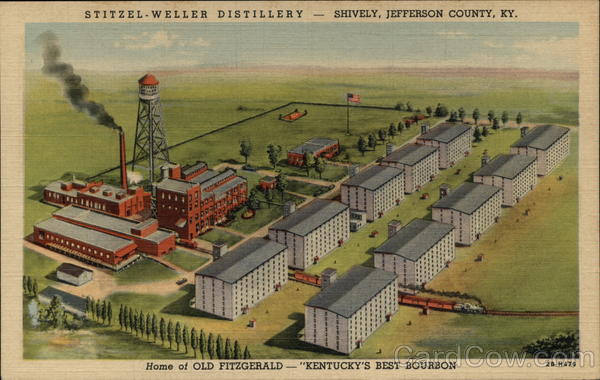
Postcard of a newly completed new post Repeal Stitzel-Weller distillery circa 1935.

But the story of Stitzel-Weller is far more than one of corporate takeovers.  It is the story of the personalities that built the business culture that ended up with a Bourbon that was reputed to be absolutely the best in the golden era of American whiskey distilling.  Chief among them is, of course, Julian P. "Pappy" Van Winkle. Pappy was the president, and while never the master distiller who actually made the whiskey, was the heart of the operation which he governed by an honest, forthright, and gentlemanly creed:

"We will sell fine Bourbon.  
At a profit if we can.  
At a loss if we must.  
But always fine Bourbon".  


After Stitzel-Weller was born as a corporation in 1933 with Repeal, they immediately began construction of a new much larger distillery in Shively, KY and it was completed in 1935.
They put Pappy's motto on a sign and posted it at the distillery's gates.  It was a clear commitment to a perfectionist level of craftsmanship.  And, as it happened, the moment passed.  Pappy died in 1965 and his son, Julian P. Van Winkle Jr. took over.  But the market was already heading South and with his sister and 49% of the board voting stock wanting to sell, he did in 1972 for the sake of family unity.  Then S-W went down the Norton-Simon rabbit hole on its path to closure.  But Julian Jr. wasn't done.  He subsequently created the "Old Rip Van Winkle" brand and contracted to buy Stitzel-Weller whisky and bottle it himself as a NDP.   His son, Julian III went into the same business and expanded it, and created the signature expressions of Pappy Van Winkle's Family Reserve 15, 20, and 23 that have become the vanguard of the tulip mania that is high-end Bourbon today.  Bottles of Pappy Family Reserve are effectively unobtainable these days and sell for many many multiples of the non-existent retail price.  Part of the mania for Pappy is its extremely high critical ratings - the buzz around which helped rekindle the widespread resurgence of ultra-high-end Bourbon in the mid-1990s.  Part of it is the tireless efforts of Julian P. Van Winkle III as a brand ambassador for his family's legacy.  Certainly part of it must be credited to the beautiful family history his sister Sally Van Winkle Campbell  wrote titled "But Always Fine Bourbon - Pappy Van Winkle and the Story of Old Fitzgerald".  In a brief but satisfyingly detailed book, Campbell tells the story of the distillery, Pappy, and the culture that thrived around a traditional and home-spun notion of a gentleman's honor code of whiskey.  It has the love and family focus of a book written by a doting granddaughter - but it also packs a good amount of detail about the business operations of Stitzel-Weller including an impressive tour of the distillery, illustrated by photographs from the United Distiller's collection (the company that ended up
The Key to Hospitality - reverse label of the 1959-1966 BIB.
with Stitzel-Weller in the end).  Many of the details in this post come from that book.  I highly recommend it.  This book certainly contributed mightily to the mystique of Pappy's whiskey.  But, honestly, the whiskey speaks for itself.  People tend to fall in love with it.  Wheated (with wheat in the mash bill instead of rye) - it's very sweet - but the sweetness is balanced by a big load of very mature quality old growth American white oak.  The wheated mash bill is a legacy of A. Ph Stitzel who made this mash bill in his old distillery before Prohibition.  It was the quality of this whiskey which had originally attracted Pappy and led him to the partnership.  It was as if Stitzel used oak spice in the place of rye spice to balance the extra load of candy apple sweetness.  That was accomplished with barrel management.  Pappy's barrels didn't look like regular barrels.  The staves were much thicker and thus the coopers had to use an extra pair of hoops so the barrels look enormously beefy and armored.  The whisky tastes enormously beefy from the oak perspective as a result.  This is a high amplitude balance; the bass of oak and the treble of sweet are turned way up high.  But more than this is the dark and rich tonal palette and thick mouth feel.  It's nutty and musky like an Olorosso sherry or a dark Cognac rancio  This bigness, balance, and heavy richness has made this Bourbon legendary.

Stitzel Weller made 4 brands:  Old Fitzgerald, Weller, Old Cabin Still and Rebel Yell.  They each had a niche.  Rebel Yell was the smoothie, with a marketing angle that targeted the South with its residual patriotism for The Confederacy.  Cabin Still was lighter and sweeter - "for sportsmen" according to Pappy.  Apparently because it didn't need as much air time to open up.  Weller was lighter as well, but also stronger.  Old Fitz was the unapologetically old fashioned full body and full flavor oak bomb at the top.  It was sold exclusively bottled in bond at 100 proof until Pappy's death when his son Julian immediately introduced an 86 proof version: Old Fitzgerald Prime.  It's significant that Sally Van Winkle Campbell chose to subtitle her history of Stitzel-Weller "The Story of Old Fitzgerald".  Old Fitzgerald wasn't just another brand in a portfolio: it's was Pappy's statement product.  Pappy had loved the brand and pursued it for years during Prohibition from its original owner S. Charles Herbst.  It had been named for a bondsman (a security guard at a bonded warehouse who enforced federal tax policy) who had such a good palate for picking good barrels to pilfer from that his name became a byword for a good barrel.  Herbst sold the brand after Prohibition shut him down.  In Campbell's book Herbst asks for $25,000 but ends up selling for $10,000.  On the Bourbon Enthusiast's excellent S-W timeline, the sale is listed as being for $4,000 in two payments in 1922 and 1925.  


(a faded date stamp is revealed to be Spring 1959 - Fall 1966 using high contrast photo filtering)

Like a lot of Bourbon enthusiasts I've encountered Sitzel-Weller's Bourbons in a variety of independent bottlings since the distillery's closure.  It has ended up in certain bottles from Willett's, Black Maple Hill, Michter's, Jefferson's Presidential Select 17 and 18, and, of course, Old Rip Van Winkle and Van Winkle Family Reserve.  Some of these bottlings are really stunning.  But the whiskey that Pappy himself considered the statement of his art was S-W's flagship brand:  Old Fitzgerald.

I've been assembling samples and bottles of Old Fitzgerald from three eras:
  1. 1950s and 60s - during the tenure of Pappy himself.  Represented here by a Very Old Fitz 1953-1961 (thanks, Mike Jasinski), and a 7 1/2 year old Old Fitz BIB 1959-1966 (full bottle found hunting)  
  2. 1965-1972 - the tenure of Julian Van Winkle Jr., represented by a 1966-1972 Old Fitz BIB "Fighting Irish" decanter (thanks, Mike Jasinski) and 
  3.  The time of closure represented by a 1997 dated Old Fitz BIB (courtesy of Joshua Scott).  
I'm also tasting a pair of Old Fitz Primes from the era of its introduction - the Julian Jr. period:  an Old Fitz Prime decanter from 1970 (Mike Jasinski) and a pair of Italian export market minis sourced from a German auction house.  Master dusty hunter Mike Jasinski was clearly a big part of this story, providing half the samples tasted.  Kudos to Mike for both being able to find these in the wild and for generously sharing them in the interest of science.


The idea is to get a sense of the flavor profile of this expression and how it evolved in the decades spanning the heyday to the final days.

Very Old Fitzgerald 8 year old 1953-1961 50% abv


Color:  Deep amber with reddish coppery tints.

Nose: Beautiful deep oak with tremendous fidelity.  Sticking your nose in a the drawer of a fine old oak desk.  Plummy round malted milk and dark chocolate, pecans, preserved cherry and dark bourbon vanilla beans.  Further back, earthy loam and char and mineral note that sometimes comes off as fresh cut grass.  This nose is heaven.  It smells of time,

Palate:  Sweet on entry with candy apple, musky malt, cherry, vanilla, and cognac rancio.  The  expansion is spicy and redolent of old dark oak.  Oak tannin bitterness rises to meet the rancio and malted milk chocolate cherry sweetness.  The turn to the finish is full of rich oak desk - fine polished furniture; herbal bitters, char and earth.  Delicious darkly oaked Bourbon.  With extra air it gets a little sour.

The extra age here takes the wood flavors to new heights, but the body isn't as malty-rich as the nearly equally aged 7 1/2 year old BIB.
(Thanks, Mike Jasinski for this sample)


Old Fitzgerald BIB, 7 year old age statement tax stamp dated Spring 1959-Fall 1966 50% abv

Color Deep amber with rich reddish coppery tints, almost like a glass of Cocoa Cola but more reddish and less brown.

Nose: Deep, plummy, round, and constantly evolving in the glass.  Malted milk balls made with dark chocolate, dark cooked toffee, well cooked citrus compote containing preserved cherry, ginger, and baking spice. Cinnamon red hots and candy apples and the dark nutty vinous quality you find in old sherry and Spanish brandy.  And, ultimately, oak: rich and deeply iterated oak.  But not the sawn oak note you get so often in Bourbon; a rich furniture oak with sandalwood perfume.  This whisky smells like time.   Over half a century in the glass, we can expect bottle maturation to have full play here.  Dark and tannic, this one took weeks to open up.  It was tight and astringent at first.  As it opens it becomes glorious.

Palate: Complex and evolving as well.  Sweet and candied and at turns honeyed, the classic wheater notes are present: candy apple, sweet corn, peach citrus, and charred oak.  But there is so much more - all in a dark palette.  Molasses, malt, chocolate, oak char, oak tannins.  This is full bore rich, dark whiskey.  The combination of sweet and dark gives this bourbon enormous flavor amplitude.   The progression of the palate works like this:  Floral treacle sweet cherry vanilla on the opening at the tip of the tongue.  A big spicy expansion full of mandarin orange, oak tannins, dark chocolate, malt, caramel, molasses and old brandy rancio take sway and never let go.  At the turn robust hyper-detailed oak with darker notes of char joins the endless and continuing rancio and big brown sweet flavors and fade off into the sunset together with the mass of the attack moving across the middle of the palate to the rear in a stately and fully mouth encompassing way.  The mouth feel is oily and thick.  This is a masterpiece.  It's a dark rich spicy pudding.  This is a Bourbon that completely embraces its brown and rich flavors.  Such Bourbon isn't made any more and it makes me want to cry.


Old Fitzgerald BIB 6 year old crockery decanter ("Irish Luck") Spring 1966- Spring 1972 50% abv.


Color: medium amber.  Just a shade lighter than the '59-'66 BIB.

Nose:  similar but a tad drier than the '59-66 BIB.  More citrus and cherry, and less vanilla floral sweetness, dark char and rancio.  It's a year and half younger and you can smell it.

Palate:  Glorious in the classic Old Fitz ways: candy apple sweet on opening with nutty rancio, malted milk, and old preserved cherry vanilla.  Darkly tannic at the turn, big oak dominates the turn and the finish.  The balance seems better here than with the 1959-66, even while the heavy malt and rancio flavors that are so distinctive are less fully emphasized.  Is this Julian's take?  The same instincts leading Julian Jr. to start making Old Fitz Prime leading him to make a slightly younger less malty-funky expression of Old Fitz?  It's clearly the same brand, same recipe and style - just turned a notch down in amplitude.  (Thanks, Mike Jasinski, for the sample).


By 1997, S-W isn't automatic.  The label here specifies that the distillery is DSP-KY-16.  That's S-W

Old Fitgerald BIB, NAS bottle date 1997 50% abv

While distilling ended for Old Fitz at S-W in 1991, Old Fitz continued being made with aging stocks of S-W juice for another half decade or so.  This NAS Old Fitz BIB appears bottled in 1997 or 98.  Given that the whisky in that bottle was laid down in 1992 at the latest, it must have been 5-6 years old, most likely.

Color: coppery medium amber

Nose: Candy apple, orange compote, orchid flowers, apricot nectar, floor varnish, and hints of pineapple and coconut.

Palate: Big and floral opening - almost perfumed.  Candy apple from the nose meets fruity cherry vanilla. Citrus and florals meet in the mid palate which brings a big dose of fragrant tannic oak.  Darker notes of char, caramel and leather rise up in concert with the oak.  There's a very nice balance to the three aspects - flowers, citrus, and dark oak and leather in the turn to the finish which isn't as long as you'd suspect, but full of the characteristic Stitzel-Weller Old Fitz rounded oaky bitters on the finish.  It's remarkable how it's the same flavor profile as the 1966 stuff, but younger, sweeter, and more dynamic.   It's pretty clear that the Old Fitz product was being bottled younger and maybe was being barreled at a higher proof - but the recipe was the same.  Tasted head to head with the 1966-1972 crock 6 year old version of Old Fitz it is a hair lighter and less malty-rancio rich, but only a hair.  Frankly, I was surprised how close they were.  I could never pick between them blind.

The 1997 date stamp.
Pappy resisted the market forces which led most whiskey makes to offer lower proof versions than Bottled In Bond 100 proof.  Here's a 1963 ad which expresses Pappy's creed on the topic:
But when Julian Van Winkle Jr. took over in 1966 the first thing that he did was introduce Old Fitz Prime:

1966 ad announcing the new Old Fitzgeral Prime expression 86.8 proof.

Old Fitz Prime (86 proof) mid 1960s mini (left) and 1970 duck decanter sample

Old Fitz Prime Duck Decanter 1970 43.4% abv.

Color: medium amber
Nose: dusky sandalwood oak, candy apple floral vanilla cherry compote.  Sweet, fruity, dusky, musky oaky, and intense.
Flavor: sweet with toffee, caramel, malted milk balls, a quality of Spanish dark brandy with dark sherry grape and rancio and a dose of floral vanilla on the opening.  Succulent dark cherry joins at the expansion, with notes of chocolate, and even light and sweet coffee.  Just beautiful.
The added bit of dilution in the Primes takes the oak tannin intensity down a notch and opens the palate with more sunny sweetness, but at the expense of a bit of richness of mouth feel.  This is an excellent and classic flavor profile.  Despite the lower proof, one of the tastiest pours of the evening.

Old Fitz Prime Italian Export market 6 year old Bonded 1/10th pint 43% abv - around 1965

For dating, note the two tone (white and gold) painted label and see #4 at:
http://www.ne.jp/asahi/miniature/smallworld/image/BourbonO.htm
The all gold color scheme of the late 50s turned into a gold and white two toned painted label mini like the ones here.  By 1968 a paper label had replaced the painted one.
Not technically a "Prime" at 43.4%, but an export version of the Bonded bottled at 43%.

Color: medium amber
Nose: very similar to the decanter: sandalwood oak, candy apple, black cherry fruit, floral vanilla.
The palate is also nearly identical: toffee sweet on opening with musky malted milk balls, dark cherry, floral vanilla, with a marked minty note as a distinguishing feature.  Lots of fragrant oak.  Really delicious.

The Primes succeed because the added water helps sweeten and mellow the dark tannin oak of the 100 proof BIB.  The trade off is the lighter mouth feel.

Old Fitz 1959-1966 BIB. Look at the color!
There is a remarkable unity in the flavors of the Old Fitzgeralds of the Sitzel-Weller distillery across the decades between the heyday and the end.  It's a heavy and old fashioned style of whisky.  Dark sweet and sherry-nutty were more common attributes among Bourbons of the early 20th century.  It was clearly inspiration for the  first year Eagle Rare 101 from Old Prentice (the malted milk and rancio).  For decades, S-W's whiskies were the only wheated mash bill whiskies around.  So the various wheaters you find now are all descendants of these S-W whiskies.  The crafting and attention to quality for which it is famed is immediately apparent.  S-W Old Fitz is a lush and heady beauty.  Candied, fruity, richly oaked.  (Some would say over oaked).

Old Fitz tastes old fashioned because that's the ideal of whiskey that Pappy had in his mind.  Pappy wasn't going to compromise on anything to do with the whisky - and that whiskey was all he was going to do.  In the end, Pappy stood for something.  He made his stand on the topic of quality Bourbon in the way he understood it - timelessly - to be.  Ultimately his fierce dedication to this inflexible definition of quality left his company too specialized on a type of whiskey that had become nonviable in the market to survive.  It's a shame.  Meanwhile, change is inevitable and isn't only about loss.  You can love a mid-century American car and note that "they don't make them like they used to" while still driving and enjoying a new car - which has certain benefits.  For example, compared to, say, Buffalo Trace's statement wheater - W.L. Weller from the Buffalo Trace Antique Collection, old Old Fitz is distinctive - but isn't unambiguously better.  This shows me that the state of the art isn't necessarily lost.  Although, clearly, something very special was indeed lost:  a culture of the grace of old time Southern gentlemen, the passion of craftsmen, and a sense of commitment to keeping a tradition of excellence - family owned.  Bottom line, Pappy's business was about family.  And that human dimension was the first thing that disappeared into the maw of the culture of corporate behemoths.

Pappy's name and the legend of his whiskey have become a mania in the Bourbon world at the current moment.  People are scrambling for the brands that have become associated with his legacy and don't seem to care when what they are actually buying is a cleverly made Buffalo Trace replica.  Old Fitz is now made by Heaven Hill and doesn't share S-W's lofty reputation among the hunters and the epicures.  (I need to taste the new Old Fitz.  It's not sold in my area - but I do get on the road from time to time.)  My purpose with this post isn't to stoke the mania for S-W further.  Auction prices are through the roof for Very Old Fitzgerald and vintage bottles of Old Fitz.  The hype ship has already fully sailed.  My purpose is to take a moment and remember Pappy's bourbon and try to understand what makes it great.  The distillery tour in "Always Fine Bourbon" tells the story:  Old Fitz was mashed a long time from carefully milled corn, barley, and wheat using a closely guarded old yeast and limestone aquifer well water (that is now no longer safe to use).  It was barreled at a low proof into high quality custom made bespoke cooperage and aged a long time for Bourbon.  It wasn't afraid of tasting rich 'n thick like "Old Man's" whiskey.  In In order to move on we have to know where we've been.  America isn't the same place it was in 1959 or 1965.  That moment in history has passed, but with some passion and some love our best days may still be in the future.

A year ago news came come out that Diageo is fitting Stitzel-Weller to restart Bourbon production there.
http://chuckcowdery.blogspot.com/2013/01/after-more-than-20-years-stitzel-weller.html 
The gist is that they are going to make Bulleit there:
http://whiskycast.com/decision-time-for-diageo-on-stitzel-weller/
BourbonTruth takes a deeper dive into the buzz of activity and the rumors and evidence for why:
http://thebourbontruth.tumblr.com/post/62732920744/whats-going-on-behind-the-gates-of-the-old

So, Stitzel-Weller will soon be making Bourbon again.  But, apparently, it won't be what we know of as Stitzel-Weller Bourbon.  It will be Diageo's replica of Four Roses' expression of Bulleit Bourbon.  And yet, Pappy's ideals are very much alive out there in the world of distilling.

Update:  As the story unfolded it became clear that production was not being restarted.  Rather, Diageo converted the old office house into the "Bulleit Frontier Whiskey Experience" - a tourist destination on the Bourbon Trail to be the spiritual home of their Bulleit whiskey expressions (Bourbon and Rye) - neither of which has any connection with the distillery in any way, as far as I know.