|
| A female spirit as the source of the juice. 1940s Guillot Triple Sec poster |
Is all of this objectification of women? You bet. The very definition of sexual objectification is reducing human beings to sexual parts. The fact that these tropes are ancient helps explain them but doesn't make it right. The use of women's bodies - and body parts - to represent aspects of alcohol, nourishing, nurturing, inebriating, or ecstatic - is metaphoric but the gendering can be ugly.
The beauty here for me is the unity of nurturing, sex, and alcohol. It goes to the root of human agricultural civilization. Humanity made a fundamental change in lifestyle in the fertile crescent of the Levant somewhere around the end of the last ice age. A devil's bargain was made whereby people exchanged the freewheeling but precarious existence of nomadic hunting and gathering for a socially regimented dutiful life of agriculture. Why would people do this? With the hindsight of history we can see the advantages of plentiful food fueling social stratification with advances in science, religion, technology, statehood and authority with professional metal workers arming professional armies. But in the moment of inception, early domesticated plants were indistinguishable from their wild ancestors. Yields were poor. Methods were rudimentary. Enabling co-technologies like rodent resistant grain storage, the plow, baked leavened bread, etc... didn't yet exist. Given up were freedom, dietary variety, and protein. What was the compelling thing that led people to trade away the wandering herds for the promise of grain? Jeffrey Kahn in NY Times' "Grey Matter" in March of 2013 explains:
"Current theory has it that grain was first domesticated for food. But since the 1950s, many scholars have found circumstantial evidence that supports the idea that some early humans grew and stored grain for beer, even before they cultivated it for bread."
http://www.nytimes.com/2013/03/17/opinion/sunday/how-beer-gave-us-civilization.html
This idea has been around for a while:
"There is ample evidence of small-scale fruit wine production during the Neolithic and possibly the Paleolithic Era (Stanislawski 1975: 429). Alcohol occurs naturally when fruits freeze and thaw repeatedly or when fruit accumulates under the right conditions, and many species of birds and primates alter their feeding behavior in order to access seasonal quantities of alcoholic fruits (Poo 1999: 124). Foraging societies often have knowledge of alcohol preparation, but are unable to produce alcohol on demand throughout the year. Indeed, many foraging and horticultural tribes around the world today produce alcohol periodically, but on a far diminished scale compared to agricultural societies."
Hence when some 11,500 years ago, humans living in the Fertile Crescent began to domesticate wheat and barely, as their ability to grow and store sizable crops increased so too did their capacity to make alcohol on a year-long basis."http://www.eaines.com/archaeology/the-archaeology-of-ancient-alcohol/
Alcohol is compelling stuff. It isn't just one of the things you can make with the staff of life. It's a gateway to something extraordinary. William James in The Variety of Religious Experience says
 "The sway of alcohol over mankind is unquestionably due to its power to stimulate the mystical faculties of human nature, usually crushed to earth by the cold facts and dry criticisms of the sober hour. Sobriety diminishes, discriminates and says no; drunkenness expands, unites, and says yes. It is in fact the great exciter of the Yes function in man. It brings its votary from the chill periphery of things to the radiant core. It makes him for the moment one with truth. Not through mere perversity do men run after it."
William James, writing at the nexus between the dawn of modern rationalism and the end of romantic spirituality captures the transcendental nature of alcohol vividly. Kahn, in the previously cited NY Times' March 2013 "Grey Matter", connects it to its essential role in the dawn of agricultural civilization:
"Five core social instincts, I have argued, gave structure and strength to our primeval herds. They kept us safely codependent with our fellow clan members, assigned us a rank in the pecking order, made sure we all did our chores, discouraged us from offending others, and removed us from this social coil when we became a drag on shared resources. Thus could our ancient forebears cooperate, prosper, multiply — and pass along their DNA to later generations.
But then, these same lifesaving social instincts didn’t readily lend themselves to exploration, artistic expression, romance, inventiveness and experimentation — the other human drives that make for a vibrant civilization. To free up those, we needed something that would suppress the rigid social codes that kept our clans safe and alive. We needed something that, on occasion, would let us break free from our biological herd imperative — or at least let us suppress our angst when we did.
We needed beer."
http://www.nytimes.com/2013/03/17/opinion/sunday/how-beer-gave-us-civilization.html

So, alcohol is two things right off the bat: the original impetus for civilization, and the escape valve for the social strictures that civilization entails. As "mother" of civilization, alcohol conflates with the grain and grape that are the staff of life and there are a series of symbols of alcohol as mother's breast and mother's milk. As escape valve, alcohol is symbolic of the ecstatic escape of orgasm. But, as William James described, it's more than simply ecstatic escape; it's the gateway to the numinous and the miraculous. I'm tempted to treat these two very different symbols independently - but I believe they interrelate as both are about conflating women's bodies with alcohol in various ways.
This isn't a new idea, by the way. The idea for this came directly from Adrienne Mayor's academic article "Libation Titillation: Wine Goblets and Women's Breasts" in Studies in Popular Culture XVI:2 April 1994. https://web.stanford.edu/dept/HPS/MayorGoblets.pdf
I came across this fascinating paper in a very modern and personal way. I'm a fan of Adrienne Mayor's books
The First Fossil Hunters: Dinosaurs, Mammoths, and Myth in Greek and Roman Timeshttp://www.amazon.com/First-Fossil-Hunters-Dinosaurs-Mammoths/dp/0691150133
and
The Poison King: The Life and Legend of Mithradates, Rome's Deadliest Enemy
But then, these same lifesaving social instincts didn’t readily lend themselves to exploration, artistic expression, romance, inventiveness and experimentation — the other human drives that make for a vibrant civilization. To free up those, we needed something that would suppress the rigid social codes that kept our clans safe and alive. We needed something that, on occasion, would let us break free from our biological herd imperative — or at least let us suppress our angst when we did.
We needed beer."
http://www.nytimes.com/2013/03/17/opinion/sunday/how-beer-gave-us-civilization.html
So, alcohol is two things right off the bat: the original impetus for civilization, and the escape valve for the social strictures that civilization entails. As "mother" of civilization, alcohol conflates with the grain and grape that are the staff of life and there are a series of symbols of alcohol as mother's breast and mother's milk. As escape valve, alcohol is symbolic of the ecstatic escape of orgasm. But, as William James described, it's more than simply ecstatic escape; it's the gateway to the numinous and the miraculous. I'm tempted to treat these two very different symbols independently - but I believe they interrelate as both are about conflating women's bodies with alcohol in various ways.
This isn't a new idea, by the way. The idea for this came directly from Adrienne Mayor's academic article "Libation Titillation: Wine Goblets and Women's Breasts" in Studies in Popular Culture XVI:2 April 1994. https://web.stanford.edu/dept/HPS/MayorGoblets.pdf
I came across this fascinating paper in a very modern and personal way. I'm a fan of Adrienne Mayor's books
The First Fossil Hunters: Dinosaurs, Mammoths, and Myth in Greek and Roman Timeshttp://www.amazon.com/First-Fossil-Hunters-Dinosaurs-Mammoths/dp/0691150133
and
The Poison King: The Life and Legend of Mithradates, Rome's Deadliest Enemy
http://www.amazon.com/Poison-King-Legend-Mithradates-Deadliest/dp/0691150265/
and I'm currently reading her fascinating new book
The Amazons: Lives and Legends of Warrior Women across the Ancient World
and I'm currently reading her fascinating new book
The Amazons: Lives and Legends of Warrior Women across the Ancient World
Finding fresh insight in ancient sources is a specialty of Adrienne Mayor's. I followed her alter ego "Mithradates Eupator" on Facebook and interacting with her there, I found myself in conversation with her a number of times and mentioned my post about the way women were depicted in American whiskey advertising:
http://www.cooperedtot.com/2014/05/women-in-american-whiskey-advertising.html
She forwarded me a link to "Libation Titillation: Wine Goblets and Women's Breasts" which opened me to the wider topic of the connection between women's sexuality and alcohol through a focused examination of the connection between the shape of glassware and women's breasts.
The idea that wine or beer is a nourishing thing flowing from female breasts has a long lineage. The usual driving metaphor is in the form of breast shaped glassware. Champagne coupe glasses look like women's breasts. There is a legend that they were created as a representation of Marie Antoinette's breasts. The story is so widely disseminated that Snopes takes the time to debunk it:
"The Champagne coupe is often claimed to have been modeled on the shape of the breast of a French aristocrat, often cited as Marie Antoinette or Madame de Pompadour."
She forwarded me a link to "Libation Titillation: Wine Goblets and Women's Breasts" which opened me to the wider topic of the connection between women's sexuality and alcohol through a focused examination of the connection between the shape of glassware and women's breasts.
Wineglass As A Woman's Breast
 |
| Image from a blog post at: http://flairliquidchef.blogspot.com/2014/05/breast-shape-became-shape-of-champagne.html |
"The Champagne coupe is often claimed to have been modeled on the shape of the breast of a French aristocrat, often cited as Marie Antoinette or Madame de Pompadour."
"FALSE"
"None of the "famed beauty's breast" tales hold up. Champagne was invented in the 17th century when a Benedictine monk discovered a way to trap bubbles of carbon dioxide in wine. As for the glass, it was designed and made in England especially for champagne around 1663, a chronology that rules out du Barry, du Pompadour, Josephine, and Marie Antoinette, all of whom were born long after the coupe came into existence. As for de Poitiers, she died a century before either the glass or the beverage was invented. And if she existed at all, Helen of Troy antedated both champagne and the champagne glass by about two millennia.
http://www.snopes.com/business/origins/champagne.asp
Indeed, the story that the champagne coupe is modeled on Marie Antoinette's breasts is common, and durable, with specific evidence in a number of dimensions.
But the story isn't that simple. Adrienne Mayor notes that Pliny the Elder describes a drinking vessel modeled from Helen of Troy's breast:
"According to Pliny the Elder, writing during the reign of Nero in the first century A.D., tourists visiting the island of Rhodes could admire an exquisite electrumcalix (chalice or wine-cup) in the local temple of Athena. This celebrated silver and gold cup was said to have been a gift from Helen herself. The vessel's real claim to fame, however, was not its precious metal or its antiquity, but the popular belief that the goblet had been fashioned to perfectly represent Helen's fabled breast (Pliny 23.81)"
"Libation Titillation: Wine Goblets and Women's Breasts" - Studies in Popular Culture XVI:2 April 1994 http://pcasacas.org.seanic11.net/SiPC/16.2/Mayor.pdf
The ancient Greeks, indeed had drinking vessels modeled on women's breasts: the "Mastos" cups.
 Claire Carusillo, in her Dec 10, 2014 post on Eater wrote:
"The connection between the breast and spirits was evident in classical Greek antiquity. For one, there's the mastos, an ancient Greek wine vessel shaped conically like a woman's breast, nipple and all, which popped up as early as the fifth century BCE. With its double handles and black-figure drawings depicting myths, it was usually incorporated into rites involving deities whose roles had to do with fertility or breastfeeding, including the worship of the thirsty god-bro Hercules himself."
 "But vessel worship wasn't always tied to fertility; sometimes it came from a place of straight-up lust. Helen of Troy has an outsized role in the history of libations: Homer credits her as the first person to suggest serving wine before a meal, and she soothed an entire troop of Trojan War-addled veterans with a signature opium cocktail in the fourth book of the Odyssey. But the woman didn't just pass out goblets; she was purportedly also the model for one. According to Pliny the Elder's Natural History, written in the first century CE, Helen lent the dimensions of her breast to a goblet on display for pilgrims at the Temple of Athena at Lindus on Rhodes."
"..Still, it's easy in our culture to keep imagining women as containers, as objects, their bodies as fountains from which men can draw strength, power, and physical fulfillment. "
http://www.eater.com/2014/12/10/7339903/breast-champagne-coupe-marie-antoinette
As for the Marie Antoinette connection, it's not a total fantasy either. Louis XVI gave her The Laiterie at Rambouillet (a dairy farm estate) in 1787 and they chose an Etruscan themed china service which included four mastos-type cups (right). There isn't any specific reason to think that they were modeled on Marie Antoinette's breasts per-se - but the fact remains that Marie Antoinette actually owned cups explicitly modeled on a woman's breast - with pearly pink nipples and all.
If Marie Antoinette had modeled a glass on her breast it would have been an explicit classical reference to Helen of Troy. Such a classical connection continues to this day. As recently as October of 2014 we were treated to a celebrated beauty making a champagne glass modeled on her breast's shape:
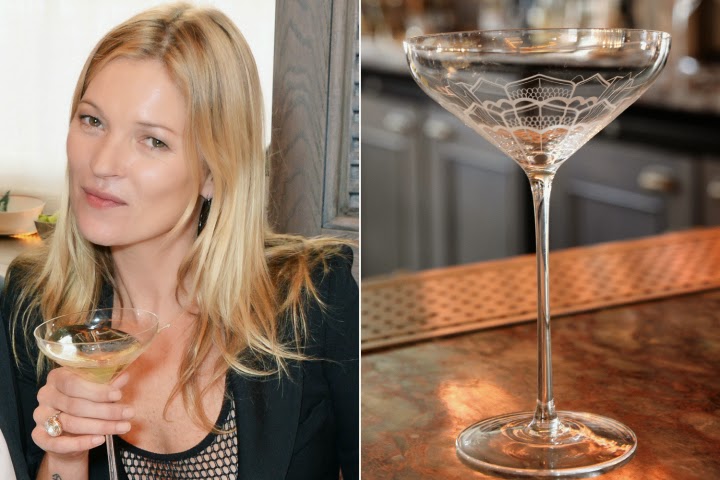 As the august New York Post reported on October 9th, 2014:
"These cups runneth over!
On Wednesday night, iconic model Kate Moss celebrated her 25 years in the fashion industry with an intimate party at posh London restaurant 34, with a guest list that included Rita Ora and Sadie Frost. But in lieu of ordinary Champagne flutes, revelers sipped bubbly from glasses molded from Moss’ left breast.
The project began in August, when Moss’ breast was first fitted for the coupe. British artist Jane McAdam Freud designed the glasses, which were inspired by Marie Antoinette — legend has it that the first Champagne coupe in the 18th century was modeled from the royal’s left bosom."http://nypost.com/2014/10/09/sip-champagne-in-a-glass-molded-from-kate-moss-breast/
The mastos cup concept is an idea that just doesn't die. Check out this publicity still of New York City stripper Baby Lake, who danced at the famed club "The Latin Quarter" in this 1951 publicity still. Her breasts are covered by grotesque masks that are sipping from mastos cups mounted on her hips. I'm tempted to speculate on the symbolism of not having the mastos cups on her actual breasts (which would be the rational thing), but I don't have a clue..
 The connection between breast and alcohol is broader and deeper than just the cup. As Adrienne Mayor noted, there are numerous visual metaphors connecting alcohol with breasts in sources ranging from antiquity to the modern day. A quick look at advertising confirms this. This Morland champagne poster circa 1930 (right) makes the metaphor explicit. The champagne is literally the milk from the breasts of a female spirit of the vine. The more recent Bailey's Irish Cream magazine ad (1990s, below) is more subtle (and given the actual cream content, perhaps more literal) but still squarely in the theme as the tag line makes clear: "The Milk of Ireland".
The terminal state for the mastos drinking vessel as breast metaphor might be found in this Halloween costume (right) which plays on the "wearable beer consumption" theme by converting the (female) wearer's breasts into beer spigots. The point is clear. As in the Morlant Champagne poster, alcohol comes from an objectified human or metaphoric breast.
Another rich vein of the conflation between breast and alcohol is the trope of the beer wench. Iconic of Munich's Octoberfest and brands such as St. Pauli Girl, the beer wench carries overflowing steins at bust level while wearing a bodice bulging gown. The bodice and decolletage is underscored, physically, by a bloom of beer steins in each hand. The connection is inescapable.
"None of the "famed beauty's breast" tales hold up. Champagne was invented in the 17th century when a Benedictine monk discovered a way to trap bubbles of carbon dioxide in wine. As for the glass, it was designed and made in England especially for champagne around 1663, a chronology that rules out du Barry, du Pompadour, Josephine, and Marie Antoinette, all of whom were born long after the coupe came into existence. As for de Poitiers, she died a century before either the glass or the beverage was invented. And if she existed at all, Helen of Troy antedated both champagne and the champagne glass by about two millennia.
http://www.snopes.com/business/origins/champagne.asp
Indeed, the story that the champagne coupe is modeled on Marie Antoinette's breasts is common, and durable, with specific evidence in a number of dimensions.
But the story isn't that simple. Adrienne Mayor notes that Pliny the Elder describes a drinking vessel modeled from Helen of Troy's breast:
"According to Pliny the Elder, writing during the reign of Nero in the first century A.D., tourists visiting the island of Rhodes could admire an exquisite electrumcalix (chalice or wine-cup) in the local temple of Athena. This celebrated silver and gold cup was said to have been a gift from Helen herself. The vessel's real claim to fame, however, was not its precious metal or its antiquity, but the popular belief that the goblet had been fashioned to perfectly represent Helen's fabled breast (Pliny 23.81)"
"Libation Titillation: Wine Goblets and Women's Breasts" - Studies in Popular Culture XVI:2 April 1994 http://pcasacas.org.seanic11.net/SiPC/16.2/Mayor.pdf
The ancient Greeks, indeed had drinking vessels modeled on women's breasts: the "Mastos" cups.
Claire Carusillo, in her Dec 10, 2014 post on Eater wrote:"The connection between the breast and spirits was evident in classical Greek antiquity. For one, there's the mastos, an ancient Greek wine vessel shaped conically like a woman's breast, nipple and all, which popped up as early as the fifth century BCE. With its double handles and black-figure drawings depicting myths, it was usually incorporated into rites involving deities whose roles had to do with fertility or breastfeeding, including the worship of the thirsty god-bro Hercules himself."
"..Still, it's easy in our culture to keep imagining women as containers, as objects, their bodies as fountains from which men can draw strength, power, and physical fulfillment. "
http://www.eater.com/2014/12/10/7339903/breast-champagne-coupe-marie-antoinette
 |
| Marie Antoinette's Sèvres “Etruscan” style breast cup c, 1788 at the Musée national de Céramique-Sèvres |
If Marie Antoinette had modeled a glass on her breast it would have been an explicit classical reference to Helen of Troy. Such a classical connection continues to this day. As recently as October of 2014 we were treated to a celebrated beauty making a champagne glass modeled on her breast's shape:
"These cups runneth over!
On Wednesday night, iconic model Kate Moss celebrated her 25 years in the fashion industry with an intimate party at posh London restaurant 34, with a guest list that included Rita Ora and Sadie Frost. But in lieu of ordinary Champagne flutes, revelers sipped bubbly from glasses molded from Moss’ left breast.
The project began in August, when Moss’ breast was first fitted for the coupe. British artist Jane McAdam Freud designed the glasses, which were inspired by Marie Antoinette — legend has it that the first Champagne coupe in the 18th century was modeled from the royal’s left bosom."http://nypost.com/2014/10/09/sip-champagne-in-a-glass-molded-from-kate-moss-breast/
 |
Baby Lake, stripper at NYC's Latin Quarter 1951 costume |
 |
| Morlant de la Marne Champagne poster - 1940s |
 |
| Bailey's Irish Cream Ad - 1990s - "The Milk Of Ireland" |
The connection between breast and alcohol is broader and deeper than just the cup. As Adrienne Mayor noted, there are numerous visual metaphors connecting alcohol with breasts in sources ranging from antiquity to the modern day. A quick look at advertising confirms this. This Morland champagne poster circa 1930 (right) makes the metaphor explicit. The champagne is literally the milk from the breasts of a female spirit of the vine. The more recent Bailey's Irish Cream magazine ad (1990s, below) is more subtle (and given the actual cream content, perhaps more literal) but still squarely in the theme as the tag line makes clear: "The Milk of Ireland".The terminal state for the mastos drinking vessel as breast metaphor might be found in this Halloween costume (right) which plays on the "wearable beer consumption" theme by converting the (female) wearer's breasts into beer spigots. The point is clear. As in the Morlant Champagne poster, alcohol comes from an objectified human or metaphoric breast.
Another rich vein of the conflation between breast and alcohol is the trope of the beer wench. Iconic of Munich's Octoberfest and brands such as St. Pauli Girl, the beer wench carries overflowing steins at bust level while wearing a bodice bulging gown. The bodice and decolletage is underscored, physically, by a bloom of beer steins in each hand. The connection is inescapable.
 |
| The St. Pauli Girl's bust line is directly in line with beer steins. |
 |
| Octoberfest waitress in action. |
 .
.And, just in case the point could be missed, this ad for Schneider (right), makes it explicit. It's a famed example of subliminal advertising, which plays with the age old conflation of breast, glass, and beer. Do I need to spell it out for you?
Alcohol as Gateway to Ecstasy
The other face of alcohol, beyond the mothering staff of life, is the metaphor of female sexuality as the euphoric release of inebriation. The roots of this conflation go back at least as far as the trope of alcohol as life giving milk. In fact, they go back demonstrably much farther. The dawn of literate civilization occurred in Sumeria over 5000 years ago. And, apparently, the conflation of the ecstasy of inebriation with that of sexual release was already established:"We know from sources such as the Code of Hammurapi that Sumerian beer was, in fact, consumed in taverns which were often run by women. These taverns were places of amusement, of prostitution, and of crime.[57] To consume alcoholic drinks such as beer fits the picture of such an environment. It also meets modern expectations of what the intoxicating effect of alcohol might be good for, since ancient beer was consumed in great amounts on the occasion of feasts. Some depictions of erotic scenes also suggest that there was a habit of drinking beer during sexual intercourse."
http://cdli.ucla.edu/pubs/cdlj/2012/cdlj2012_002.html
(emphasis my own)
 |
| Impression of a Sumerian cylinder seal from the Early Dynastic IIIa period (ca. 2600 BC; see Woolley 1934, pl. 200, no. 102 [BM 121545]). People drinking beer are depicted in the upper row with straws in a beer jar. http://cdli.ucla.edu/pubs/cdlj/2012/cdlj2012_002.html |
 |
| Ancient Babylonian plaque from The Israel Museum depicting sex while drinking beer with a straw in a beer jar in the Sumerian fashion. |
 |
| Lesbian erotic scene on a kylix cup. Note that the standing figure is holding a kylix drinking vessel. |
 |
| Wall Fresco from Pompeii - conflating erotic activity with consumption of wine. |
Woman as the Spirit in the Glass
In each one of the examples above, sex is conflated with drinking alcohol through a depiction of a drinking vessel. This conflation became more explicit in the last century with depictions of females inside alcohol drinking vessels. In her essay, Adrienne Mayor references two: artist Leo Putz 1902 painting in the Hartford Atheneum, "Woman in a Glass", and the cartoon of the stocking wearing nude at the top of the jokes section in Playboy magazine:
 |
Woman in a Glass by Leo Putz 1902:
|

"...the minature busty brunette in black stockings who often cavorts around and inside a champagne glass on the "Playboy Party Jokes" page. This synecdochical feish, in which woman-as-breast-shaped goblet, had long served as an expression of the breast / drinking vessel dynamic in both high and low culture."
"Libation Titillation: Wine Goblets and Women's Breasts" - Studies in Popular Culture XVI:2 April 1994 http://pcasacas.org.seanic11.net/SiPC/16.2/Mayor.pdf
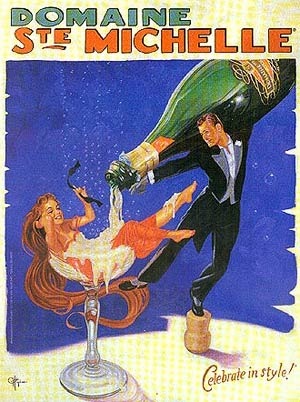 |
| Domaine Ste. Michelle Champage c 1930 |
 |
| Vlan du Berni Belgian Apertif poster c 1920 |
The woman in the glass theme has a long standing and robust place in popular culture - appearing in advertisements for alcoholic beverages from the early 20th century all the way to the current day, and appearing as a visual trope of licentious excess on both film and stage, as well as in burlesque.
 |
| Alberto Vargas pinup art - 1940s |
 |
Shirley Maclaine and Robert Mitchum in
What a Way to Go! (1964)
|
 |
| New Year's party dancers - 1960s |
 |
| "Rita"-1971 PR still. NY |
 |
Top American stripper Dita Von Teese's signature
burlesque act - in a coupe glass.
|
 |
| Von Teese's Cointreau ad - 2009 |
 |
| Rachel St James |
 The theme of the woman in the glass is a conflation of a sexualized female image with an icon of alcohol. This conflation has been used in other contexts than just the glass too. For example, check out the 2012 Budweiser ad, at right. The woman is one with the bottle in a direct visual conflation of her sexuality with the alcoholic product: objectification in purest sense.
A fall 2013 campaign for Veuve Clicquot Ponsardin champagne combines all the aspects of this conflation of sexualized woman with alcohol: the woman in the glass as well as the woman conflated with the bottle (this time the bottle also has connotations of the male sexual organ which we will see more of shortly). The ad campaign was a co-branding with a luxury brand of shoes and handbags: Charlottle Olympia, so the conflation was an attempted 3 way: booze, shoes, and female sexuality. This shows that these tropes and type of sexual objectification are completely mainstream even in the current day.

End of the Line? Conflating Alcohol with the Vagina
Given the trend in modern culture towards greater directness, explicitness, and the desire to shock, it is, perhaps, unsurprising that a visual trope has emerged that has taken the conflation of female sexuality and alcohol one step further. In these images, both in contemporary print advertising, fine art photography, and in various other forms of erotica, alcohol is conflated directly with the vagina itself. It appeared to start with an ad poster for French wine in the 60s, where the letter "V" in the word "Vin" was made to simultaneously represent the female organ. It's a little unclear to me which artist first put a glass of wine itself in that location - so I'm just going to show you a bunch of the more prominent examples and maybe someone can enlighten me further in the comments. |
| 1960s Promotional Poster |
 |
Chema Madoz fine art photograph - 2006
|
 |
| Julynacom print ad - 2012 Fundraising the the fight against cervical cancer |
 |
| Dominic Rouse - fine art photograph 2008 |


 |
| Biss V. by Alexandra Privitera |

This final example a 2008 cartoon posted to Toonpool - but apparently seen nowhere else ( http://www.toonpool.com/cartoons/Vine_14968) has the unusual attribute of taking the wine metaphor all the way with the bottle as male member, grapes as testes, and the wine filling up the woman's vagina. It's an oddly satisfying visual literal metaphor after all that innuendo.
 |
| "Vine" by Karry, June 19th 2008 |