Sunday, February 23, 2014

Glenmorangie Companta. The Master Comes Back To Red Wine.

Glenmorangie just came out with its fifth annual limited release.  This year it is titled "Companta" which means "Friendship", which Bill Lumsden, master blender at Glenmorangie, said refers to the ancient (1295-1560) Scottish historic alliance with France against England usually referred to as "The Auld Alliance".  The relationship with France is the central narrative with Companta as this is a red wine finishing barrel management story with wines from the Côtes du Rhône region.  Red wine finishes on single malt whiskies are tricky.  They can impart sour flavors, can overwhelm, and are hard to balance.  "I don't like red wine finishes" is an almost automatic response for some whisky enthusiasts.  But we should all keep an open mind.  This is a red wine finish with a twist - as executed by someone who really knows what they are doing.  I won't withhold the surprise, this one is yet another success.  It can't be as easy as it looks, but Lumsden's annual limited editions have all been interesting and worth drinking in one way or another and this is no exception.  I suspect this one will go over even better than last year's more purist Ealanta.

Lumsden introduces Companta
at The Brandy Library
Red wine finishes are familiar terrain for Lumsden and Glenmorangie.  In the mid-90s he started the mania for wine barrel finishing with Madeira, Port, and Sherry finished expressions. This led directly to the Sauternes finished Nectar D'Or and famous special wine finished editions from Chateaux Margeaux (a Bordeaux) and the legendary 1975 & 1978 vintage Tain L'Hermitage finished bottling made with casks from the Côtes du Rhône region. Later there was a regular OP Burgundy cask finished version and a more focused Burgundy edition that specified Côtes de Beaune cask finishing. That's a lot of history with using casks, or "Barriques", Lumsden specifies with characteristic precision and excellent brogue.

This fascination with red wine hasn't always been well received by everyone and, at a launch event for Companta at New York's Brandy Library, Lumsden alluded to the risks of tartness and possibility of the wine overpowering the delicate stone fruit and floral nature of Glenmorangie's distillate. With Companta, Lumsden has taken two dramatically contrasting wines from them same Côtes du Rhône Burgundy region.
60% of Companta is from a big tart pinot noir "Clos du Tart".  Lumsden took 1999 vinage ex-bourbon barrel aged Glenmo which was 9 years old in 2008 and then aged it for an addition 5 years in Clos du Tart for a total age of 14 years.

Clos du Tart 2004 Burgundy
Then he tempered it by using an older sweeter 1995 vintage Glenmo and finishing it in barriques that held a sweet fortified grenache graped Côtes du Rhône called "Rasteau" for an additional 8 years, totaling 18 years. At the Glenmorangie launch event we were poured each of these.  It was fascinating to taste the wine flavors that contributed to the cask finished flavors.  And the combination of these two contrasting flavors with mature Glenmorangie distillate has produced something greater than the sum of its parts.  It's hard to taste and discuss this without considering the larger issues swirling around lately: NAS bottings, and the use of fancy barrel finishes to hide younger whisky.  Obviously, in this case where the youngest whisky is 14 years old and the rest is 18 that isn't a pressing issue.  This one feels like a real exploration of the flavors for the flavor's own sake: an artisinal effort and not an exercise in covering things up.  I suspect people who don't like red wine finishes will find aspects to the tartness to the object to.  Others who decry the loss of hyper-mature extremely estery glut stock single casks might grouse about the wild showy flavors of Companta as wood management pyrotechnics in the place of the complexities of extremely mature whisky and maybe that's true.  But the wine finish game is Lumsden's innovation and it's a defining aspect of Glenmorangie so if anyone is going to be playing the wine cask finishing game it's going to be Lumsden - and he shows a deft touch here.  If anything he seems to be upping his game year over year.

Glenmorangie Companta 46% abv.


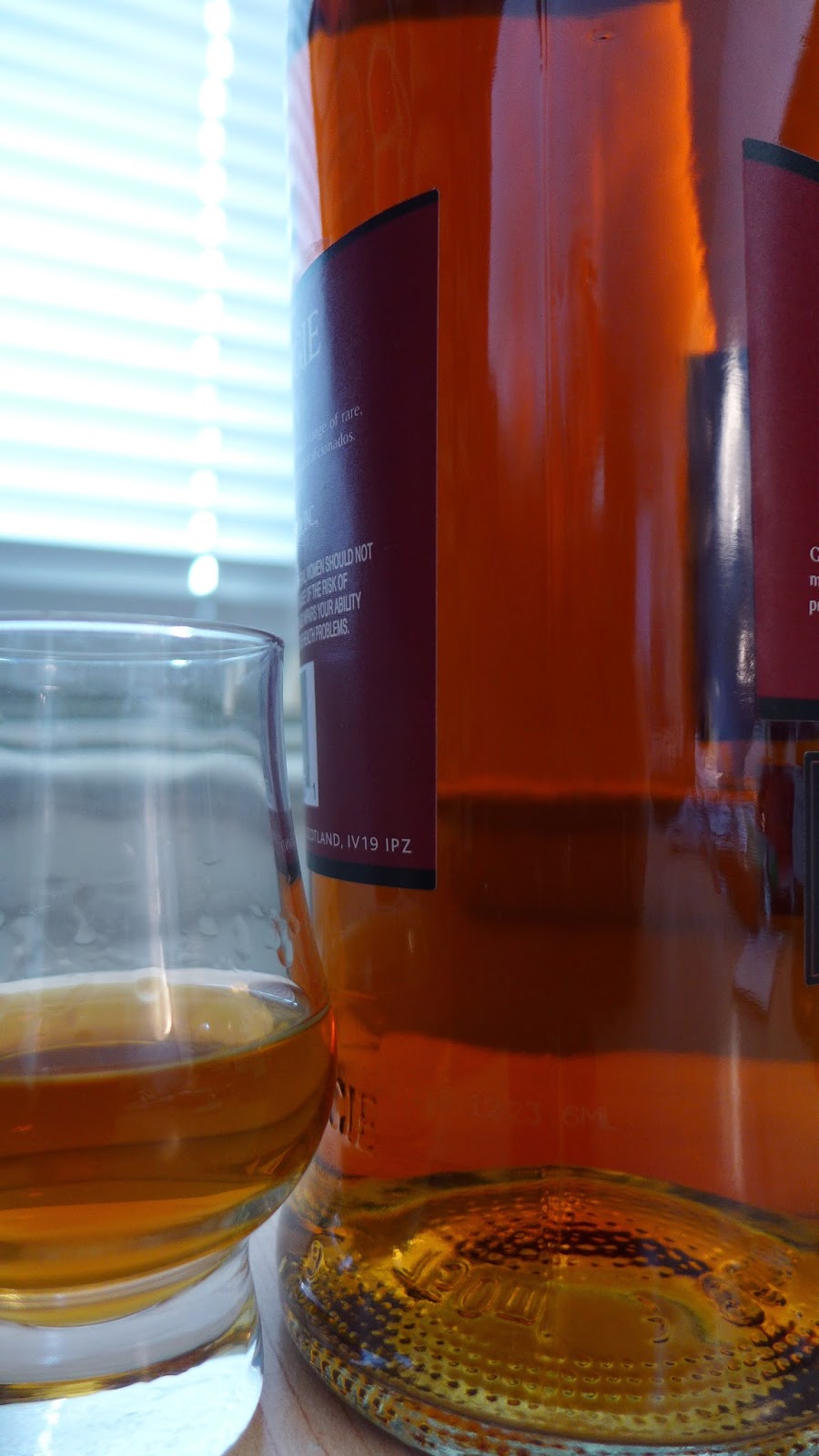
Color:  russet medium amber, with pink, copper, and gold tints.  It's brick red and pink and honey caramel color.  One of the more appetizing colors in the bottle and the glass that you'll ever see.
Companta's color is extraordinary

Nose: Creamy berry tart with darker notes of chocolate dipped raspberry on rich honey malt.  Undertones of forest floor loam, strawberry jam, and earthy sweet and elegant oak.  It's an interesting an involving nose.

Palate:  This isn't a whisky where the nose outshines the palate.  The opposite is true. At 46% there is enough intensity for sweetness and fruity acids to pop brightly on entry.  The entry is full of  milk chocolate, tart raspberry acid-sweet with notes of currant and malted milk with floral vanilla and creamy fudge.  The raspberry tartness deftly evokes the rich acid fruit of the Clos De Tart. There's a good balance between sweet and dry going on.  The creamy vanilla floral raspberry tart fruited entry opens into a taut and elegant mid palate expansion full of darker malt, dark chocolate, cocoa, and black currant fruit notes.  Thanks to the wine tasting portion of the launch event I can recognize the black currant herbal sweetness as coming from the rich port-like Rasteau (which really comes off as a Port that tastes more of currants than of grapes).  In the mid-palate expansion you can clearly taste the nectarine stone fruit flavors of the Glenmorange distillate itself.  Plus undefined additional notes of herbal brush and animal musk.  The finish is medium long with lingering fruit skin tartness, pepper heat, cocoa dust, and tannin that reads both of oak and wine.

Companta needs air to open, and takes water well.  Water increases the estery, sweet, and fruity aspects, and the milk chocolate covered raspberry note even while upping the spicy finish.

Companta is a Valentine.  A red fruit covered in chocolate - a kiss of sweet from a taut lithe body.  This might be the best one yet.  Bottom line - as soon as I saw a bottle I bought it and cracked it.

*****

(Sample provenance disclosure:  The bottle tasted for this review was purchased at Bottle King, Bloomfield, NJ with my own funds.  I had previously attended the launch event as the guest of the BA.)

FYI - the prior 4 limited Glenmorangie editions:
  • Sonnalta PX (Pedro Ximinez, 2009), 
  • Finealta (kiss of sherry and of peat 2010), 
  • Artein (Italian "Sassicaia" Super Tuscan cask finish, 15 years old, 2012), 
  • Ealanta (virgin toasted oak - 2013)


Sunday, February 9, 2014

Stitzel-Weller Old Fitzgerald Bonded Bourbons From Different Eras: Speaking Kindly of the Dead.

Old Fitz S-W BIBs. 1997 (left), 1959-1966 (right).
The story of Stitzel-Weller (S-W) is a story of something very beautiful that died.  It has become a symbol and a touchstone of something uniquely and particularly American which is seeming to pass away in a larger cultural sense too - which gives the story a lot of resonance.  What that thing is, exactly, is bigger than a single phrase and hard to pin down - but it's along the lines of  'a perfectionist vision of how Bourbon should be made', a Southern gentlemanly code, and a 19th century set of values that placed craftsmanship first and seemed to typify the United States of America in its period of expansion and glory.  This period, like the American obsession with craftsmanship itself, went through a nadir where it seemed to disappear, and is now being reborn.  Stitzel-Weller is a slice of a vanished America where we made the best cars, did business with a hand shake, and liked richly flavored Bourbon.

Stitzel-Weller, formed from the pre-Prohibition partnership of Pappy Julian Van Winkle's and Alex Farnsley's Weller (a wholesaler), and A. Ph.Stitzel's distillery, that was incorporated as "Stitzel-Weller in 1933.  In Prohibition, A. Ph. Stitzel was one of only six companies in the whole country with a license to distill medicinal whiskey.  It ended in 1972 when it was sold to Norton Simon Inc. in the midst of Bourbon's decline.  Norton Simon apparently purchased the great reputation of S-W for the expressed purpose of dumping a large quantity of inferior Bourbon that had been made at the Kentucky River Distillery in Jessamine County into a brand that had a market.  After the takeover they immediately began mixing this inferior whiskey with awesome S-W stocks in the base expression "Old Cabin Still" (a story with personal ramifications for me, dating back to the early 80s - but that's another post).  But even after Norton Simon's takover, the distillery continued to produce Old Fitz and the other brands at a high level of quality.   Then the distillery went though a parade of hands and ended up with United Distillers (which formed Diageo later) who finally closed it in 1992 and treated the facility as a semi abandoned asset of warehouses.  The whisky in those warehouses has continued to come out in the decades between then and now.  Older bottlings of Old Fitz (and other S-W brands) continued to be made with S-W juice for a number of years (until the late 1990s).
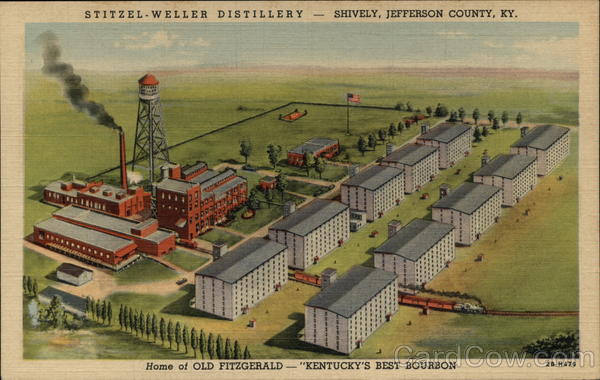
Postcard of a newly completed new post Repeal Stitzel-Weller distillery circa 1935.

But the story of Stitzel-Weller is far more than one of corporate takeovers.  It is the story of the personalities that built the business culture that ended up with a Bourbon that was reputed to be absolutely the best in the golden era of American whiskey distilling.  Chief among them is, of course, Julian P. "Pappy" Van Winkle. Pappy was the president, and while never the master distiller who actually made the whiskey, was the heart of the operation which he governed by an honest, forthright, and gentlemanly creed:

"We will sell fine Bourbon.  
At a profit if we can.  
At a loss if we must.  
But always fine Bourbon".  


After Stitzel-Weller was born as a corporation in 1933 with Repeal, they immediately began construction of a new much larger distillery in Shively, KY and it was completed in 1935.
They put Pappy's motto on a sign and posted it at the distillery's gates.  It was a clear commitment to a perfectionist level of craftsmanship.  And, as it happened, the moment passed.  Pappy died in 1965 and his son, Julian P. Van Winkle Jr. took over.  But the market was already heading South and with his sister and 49% of the board voting stock wanting to sell, he did in 1972 for the sake of family unity.  Then S-W went down the Norton-Simon rabbit hole on its path to closure.  But Julian Jr. wasn't done.  He subsequently created the "Old Rip Van Winkle" brand and contracted to buy Stitzel-Weller whisky and bottle it himself as a NDP.   His son, Julian III went into the same business and expanded it, and created the signature expressions of Pappy Van Winkle's Family Reserve 15, 20, and 23 that have become the vanguard of the tulip mania that is high-end Bourbon today.  Bottles of Pappy Family Reserve are effectively unobtainable these days and sell for many many multiples of the non-existent retail price.  Part of the mania for Pappy is its extremely high critical ratings - the buzz around which helped rekindle the widespread resurgence of ultra-high-end Bourbon in the mid-1990s.  Part of it is the tireless efforts of Julian P. Van Winkle III as a brand ambassador for his family's legacy.  Certainly part of it must be credited to the beautiful family history his sister Sally Van Winkle Campbell  wrote titled "But Always Fine Bourbon - Pappy Van Winkle and the Story of Old Fitzgerald".  In a brief but satisfyingly detailed book, Campbell tells the story of the distillery, Pappy, and the culture that thrived around a traditional and home-spun notion of a gentleman's honor code of whiskey.  It has the love and family focus of a book written by a doting granddaughter - but it also packs a good amount of detail about the business operations of Stitzel-Weller including an impressive tour of the distillery, illustrated by photographs from the United Distiller's collection (the company that ended up
The Key to Hospitality - reverse label of the 1959-1966 BIB.
with Stitzel-Weller in the end).  Many of the details in this post come from that book.  I highly recommend it.  This book certainly contributed mightily to the mystique of Pappy's whiskey.  But, honestly, the whiskey speaks for itself.  People tend to fall in love with it.  Wheated (with wheat in the mash bill instead of rye) - it's very sweet - but the sweetness is balanced by a big load of very mature quality old growth American white oak.  The wheated mash bill is a legacy of A. Ph Stitzel who made this mash bill in his old distillery before Prohibition.  It was the quality of this whiskey which had originally attracted Pappy and led him to the partnership.  It was as if Stitzel used oak spice in the place of rye spice to balance the extra load of candy apple sweetness.  That was accomplished with barrel management.  Pappy's barrels didn't look like regular barrels.  The staves were much thicker and thus the coopers had to use an extra pair of hoops so the barrels look enormously beefy and armored.  The whisky tastes enormously beefy from the oak perspective as a result.  This is a high amplitude balance; the bass of oak and the treble of sweet are turned way up high.  But more than this is the dark and rich tonal palette and thick mouth feel.  It's nutty and musky like an Olorosso sherry or a dark Cognac rancio  This bigness, balance, and heavy richness has made this Bourbon legendary.

Stitzel Weller made 4 brands:  Old Fitzgerald, Weller, Old Cabin Still and Rebel Yell.  They each had a niche.  Rebel Yell was the smoothie, with a marketing angle that targeted the South with its residual patriotism for The Confederacy.  Cabin Still was lighter and sweeter - "for sportsmen" according to Pappy.  Apparently because it didn't need as much air time to open up.  Weller was lighter as well, but also stronger.  Old Fitz was the unapologetically old fashioned full body and full flavor oak bomb at the top.  It was sold exclusively bottled in bond at 100 proof until Pappy's death when his son Julian immediately introduced an 86 proof version: Old Fitzgerald Prime.  It's significant that Sally Van Winkle Campbell chose to subtitle her history of Stitzel-Weller "The Story of Old Fitzgerald".  Old Fitzgerald wasn't just another brand in a portfolio: it's was Pappy's statement product.  Pappy had loved the brand and pursued it for years during Prohibition from its original owner S. Charles Herbst.  It had been named for a bondsman (a security guard at a bonded warehouse who enforced federal tax policy) who had such a good palate for picking good barrels to pilfer from that his name became a byword for a good barrel.  Herbst sold the brand after Prohibition shut him down.  In Campbell's book Herbst asks for $25,000 but ends up selling for $10,000.  On the Bourbon Enthusiast's excellent S-W timeline, the sale is listed as being for $4,000 in two payments in 1922 and 1925.  


(a faded date stamp is revealed to be Spring 1959 - Fall 1966 using high contrast photo filtering)

Like a lot of Bourbon enthusiasts I've encountered Sitzel-Weller's Bourbons in a variety of independent bottlings since the distillery's closure.  It has ended up in certain bottles from Willett's, Black Maple Hill, Michter's, Jefferson's Presidential Select 17 and 18, and, of course, Old Rip Van Winkle and Van Winkle Family Reserve.  Some of these bottlings are really stunning.  But the whiskey that Pappy himself considered the statement of his art was S-W's flagship brand:  Old Fitzgerald.

I've been assembling samples and bottles of Old Fitzgerald from three eras:
  1. 1950s and 60s - during the tenure of Pappy himself.  Represented here by a Very Old Fitz 1953-1961 (thanks, Mike Jasinski), and a 7 1/2 year old Old Fitz BIB 1959-1966 (full bottle found hunting)  
  2. 1965-1972 - the tenure of Julian Van Winkle Jr., represented by a 1966-1972 Old Fitz BIB "Fighting Irish" decanter (thanks, Mike Jasinski) and 
  3.  The time of closure represented by a 1997 dated Old Fitz BIB (courtesy of Joshua Scott).  
I'm also tasting a pair of Old Fitz Primes from the era of its introduction - the Julian Jr. period:  an Old Fitz Prime decanter from 1970 (Mike Jasinski) and a pair of Italian export market minis sourced from a German auction house.  Master dusty hunter Mike Jasinski was clearly a big part of this story, providing half the samples tasted.  Kudos to Mike for both being able to find these in the wild and for generously sharing them in the interest of science.


The idea is to get a sense of the flavor profile of this expression and how it evolved in the decades spanning the heyday to the final days.

Very Old Fitzgerald 8 year old 1953-1961 50% abv


Color:  Deep amber with reddish coppery tints.

Nose: Beautiful deep oak with tremendous fidelity.  Sticking your nose in a the drawer of a fine old oak desk.  Plummy round malted milk and dark chocolate, pecans, preserved cherry and dark bourbon vanilla beans.  Further back, earthy loam and char and mineral note that sometimes comes off as fresh cut grass.  This nose is heaven.  It smells of time,

Palate:  Sweet on entry with candy apple, musky malt, cherry, vanilla, and cognac rancio.  The  expansion is spicy and redolent of old dark oak.  Oak tannin bitterness rises to meet the rancio and malted milk chocolate cherry sweetness.  The turn to the finish is full of rich oak desk - fine polished furniture; herbal bitters, char and earth.  Delicious darkly oaked Bourbon.  With extra air it gets a little sour.

The extra age here takes the wood flavors to new heights, but the body isn't as malty-rich as the nearly equally aged 7 1/2 year old BIB.
(Thanks, Mike Jasinski for this sample)


Old Fitzgerald BIB, 7 year old age statement tax stamp dated Spring 1959-Fall 1966 50% abv

Color Deep amber with rich reddish coppery tints, almost like a glass of Cocoa Cola but more reddish and less brown.

Nose: Deep, plummy, round, and constantly evolving in the glass.  Malted milk balls made with dark chocolate, dark cooked toffee, well cooked citrus compote containing preserved cherry, ginger, and baking spice. Cinnamon red hots and candy apples and the dark nutty vinous quality you find in old sherry and Spanish brandy.  And, ultimately, oak: rich and deeply iterated oak.  But not the sawn oak note you get so often in Bourbon; a rich furniture oak with sandalwood perfume.  This whisky smells like time.   Over half a century in the glass, we can expect bottle maturation to have full play here.  Dark and tannic, this one took weeks to open up.  It was tight and astringent at first.  As it opens it becomes glorious.

Palate: Complex and evolving as well.  Sweet and candied and at turns honeyed, the classic wheater notes are present: candy apple, sweet corn, peach citrus, and charred oak.  But there is so much more - all in a dark palette.  Molasses, malt, chocolate, oak char, oak tannins.  This is full bore rich, dark whiskey.  The combination of sweet and dark gives this bourbon enormous flavor amplitude.   The progression of the palate works like this:  Floral treacle sweet cherry vanilla on the opening at the tip of the tongue.  A big spicy expansion full of mandarin orange, oak tannins, dark chocolate, malt, caramel, molasses and old brandy rancio take sway and never let go.  At the turn robust hyper-detailed oak with darker notes of char joins the endless and continuing rancio and big brown sweet flavors and fade off into the sunset together with the mass of the attack moving across the middle of the palate to the rear in a stately and fully mouth encompassing way.  The mouth feel is oily and thick.  This is a masterpiece.  It's a dark rich spicy pudding.  This is a Bourbon that completely embraces its brown and rich flavors.  Such Bourbon isn't made any more and it makes me want to cry.


Old Fitzgerald BIB 6 year old crockery decanter ("Irish Luck") Spring 1966- Spring 1972 50% abv.


Color: medium amber.  Just a shade lighter than the '59-'66 BIB.

Nose:  similar but a tad drier than the '59-66 BIB.  More citrus and cherry, and less vanilla floral sweetness, dark char and rancio.  It's a year and half younger and you can smell it.

Palate:  Glorious in the classic Old Fitz ways: candy apple sweet on opening with nutty rancio, malted milk, and old preserved cherry vanilla.  Darkly tannic at the turn, big oak dominates the turn and the finish.  The balance seems better here than with the 1959-66, even while the heavy malt and rancio flavors that are so distinctive are less fully emphasized.  Is this Julian's take?  The same instincts leading Julian Jr. to start making Old Fitz Prime leading him to make a slightly younger less malty-funky expression of Old Fitz?  It's clearly the same brand, same recipe and style - just turned a notch down in amplitude.  (Thanks, Mike Jasinski, for the sample).


By 1997, S-W isn't automatic.  The label here specifies that the distillery is DSP-KY-16.  That's S-W

Old Fitgerald BIB, NAS bottle date 1997 50% abv

While distilling ended for Old Fitz at S-W in 1991, Old Fitz continued being made with aging stocks of S-W juice for another half decade or so.  This NAS Old Fitz BIB appears bottled in 1997 or 98.  Given that the whisky in that bottle was laid down in 1992 at the latest, it must have been 5-6 years old, most likely.

Color: coppery medium amber

Nose: Candy apple, orange compote, orchid flowers, apricot nectar, floor varnish, and hints of pineapple and coconut.

Palate: Big and floral opening - almost perfumed.  Candy apple from the nose meets fruity cherry vanilla. Citrus and florals meet in the mid palate which brings a big dose of fragrant tannic oak.  Darker notes of char, caramel and leather rise up in concert with the oak.  There's a very nice balance to the three aspects - flowers, citrus, and dark oak and leather in the turn to the finish which isn't as long as you'd suspect, but full of the characteristic Stitzel-Weller Old Fitz rounded oaky bitters on the finish.  It's remarkable how it's the same flavor profile as the 1966 stuff, but younger, sweeter, and more dynamic.   It's pretty clear that the Old Fitz product was being bottled younger and maybe was being barreled at a higher proof - but the recipe was the same.  Tasted head to head with the 1966-1972 crock 6 year old version of Old Fitz it is a hair lighter and less malty-rancio rich, but only a hair.  Frankly, I was surprised how close they were.  I could never pick between them blind.

The 1997 date stamp.
Pappy resisted the market forces which led most whiskey makes to offer lower proof versions than Bottled In Bond 100 proof.  Here's a 1963 ad which expresses Pappy's creed on the topic:
But when Julian Van Winkle Jr. took over in 1966 the first thing that he did was introduce Old Fitz Prime:

1966 ad announcing the new Old Fitzgeral Prime expression 86.8 proof.

Old Fitz Prime (86 proof) mid 1960s mini (left) and 1970 duck decanter sample

Old Fitz Prime Duck Decanter 1970 43.4% abv.

Color: medium amber
Nose: dusky sandalwood oak, candy apple floral vanilla cherry compote.  Sweet, fruity, dusky, musky oaky, and intense.
Flavor: sweet with toffee, caramel, malted milk balls, a quality of Spanish dark brandy with dark sherry grape and rancio and a dose of floral vanilla on the opening.  Succulent dark cherry joins at the expansion, with notes of chocolate, and even light and sweet coffee.  Just beautiful.
The added bit of dilution in the Primes takes the oak tannin intensity down a notch and opens the palate with more sunny sweetness, but at the expense of a bit of richness of mouth feel.  This is an excellent and classic flavor profile.  Despite the lower proof, one of the tastiest pours of the evening.

Old Fitz Prime Italian Export market 6 year old Bonded 1/10th pint 43% abv - around 1965

For dating, note the two tone (white and gold) painted label and see #4 at:
http://www.ne.jp/asahi/miniature/smallworld/image/BourbonO.htm
The all gold color scheme of the late 50s turned into a gold and white two toned painted label mini like the ones here.  By 1968 a paper label had replaced the painted one.
Not technically a "Prime" at 43.4%, but an export version of the Bonded bottled at 43%.

Color: medium amber
Nose: very similar to the decanter: sandalwood oak, candy apple, black cherry fruit, floral vanilla.
The palate is also nearly identical: toffee sweet on opening with musky malted milk balls, dark cherry, floral vanilla, with a marked minty note as a distinguishing feature.  Lots of fragrant oak.  Really delicious.

The Primes succeed because the added water helps sweeten and mellow the dark tannin oak of the 100 proof BIB.  The trade off is the lighter mouth feel.

Old Fitz 1959-1966 BIB. Look at the color!
There is a remarkable unity in the flavors of the Old Fitzgeralds of the Sitzel-Weller distillery across the decades between the heyday and the end.  It's a heavy and old fashioned style of whisky.  Dark sweet and sherry-nutty were more common attributes among Bourbons of the early 20th century.  It was clearly inspiration for the  first year Eagle Rare 101 from Old Prentice (the malted milk and rancio).  For decades, S-W's whiskies were the only wheated mash bill whiskies around.  So the various wheaters you find now are all descendants of these S-W whiskies.  The crafting and attention to quality for which it is famed is immediately apparent.  S-W Old Fitz is a lush and heady beauty.  Candied, fruity, richly oaked.  (Some would say over oaked).

Old Fitz tastes old fashioned because that's the ideal of whiskey that Pappy had in his mind.  Pappy wasn't going to compromise on anything to do with the whisky - and that whiskey was all he was going to do.  In the end, Pappy stood for something.  He made his stand on the topic of quality Bourbon in the way he understood it - timelessly - to be.  Ultimately his fierce dedication to this inflexible definition of quality left his company too specialized on a type of whiskey that had become nonviable in the market to survive.  It's a shame.  Meanwhile, change is inevitable and isn't only about loss.  You can love a mid-century American car and note that "they don't make them like they used to" while still driving and enjoying a new car - which has certain benefits.  For example, compared to, say, Buffalo Trace's statement wheater - W.L. Weller from the Buffalo Trace Antique Collection, old Old Fitz is distinctive - but isn't unambiguously better.  This shows me that the state of the art isn't necessarily lost.  Although, clearly, something very special was indeed lost:  a culture of the grace of old time Southern gentlemen, the passion of craftsmen, and a sense of commitment to keeping a tradition of excellence - family owned.  Bottom line, Pappy's business was about family.  And that human dimension was the first thing that disappeared into the maw of the culture of corporate behemoths.

Pappy's name and the legend of his whiskey have become a mania in the Bourbon world at the current moment.  People are scrambling for the brands that have become associated with his legacy and don't seem to care when what they are actually buying is a cleverly made Buffalo Trace replica.  Old Fitz is now made by Heaven Hill and doesn't share S-W's lofty reputation among the hunters and the epicures.  (I need to taste the new Old Fitz.  It's not sold in my area - but I do get on the road from time to time.)  My purpose with this post isn't to stoke the mania for S-W further.  Auction prices are through the roof for Very Old Fitzgerald and vintage bottles of Old Fitz.  The hype ship has already fully sailed.  My purpose is to take a moment and remember Pappy's bourbon and try to understand what makes it great.  The distillery tour in "Always Fine Bourbon" tells the story:  Old Fitz was mashed a long time from carefully milled corn, barley, and wheat using a closely guarded old yeast and limestone aquifer well water (that is now no longer safe to use).  It was barreled at a low proof into high quality custom made bespoke cooperage and aged a long time for Bourbon.  It wasn't afraid of tasting rich 'n thick like "Old Man's" whiskey.  In In order to move on we have to know where we've been.  America isn't the same place it was in 1959 or 1965.  That moment in history has passed, but with some passion and some love our best days may still be in the future.

A year ago news came come out that Diageo is fitting Stitzel-Weller to restart Bourbon production there.
http://chuckcowdery.blogspot.com/2013/01/after-more-than-20-years-stitzel-weller.html 
The gist is that they are going to make Bulleit there:
http://whiskycast.com/decision-time-for-diageo-on-stitzel-weller/
BourbonTruth takes a deeper dive into the buzz of activity and the rumors and evidence for why:
http://thebourbontruth.tumblr.com/post/62732920744/whats-going-on-behind-the-gates-of-the-old

So, Stitzel-Weller will soon be making Bourbon again.  But, apparently, it won't be what we know of as Stitzel-Weller Bourbon.  It will be Diageo's replica of Four Roses' expression of Bulleit Bourbon.  And yet, Pappy's ideals are very much alive out there in the world of distilling.

Update:  As the story unfolded it became clear that production was not being restarted.  Rather, Diageo converted the old office house into the "Bulleit Frontier Whiskey Experience" - a tourist destination on the Bourbon Trail to be the spiritual home of their Bulleit whiskey expressions (Bourbon and Rye) - neither of which has any connection with the distillery in any way, as far as I know.  

Saturday, January 25, 2014

"Whiskey Women" - the untold story of how Fred Minnick became the new voice of whiskey for a generation.

"Whiskey Women: The Untold Story of How Women Saved Bourbon, Scotch, and Irish Whiskey" is so important that
I own(ed) 3 copies of it.  I have carried it around with me for months, inhabiting it.  I have consumed a pre-release publisher's timed self destructing electronic edition (based on my Amazon reviewer status), a signed hard cover (destroyed in an accident), and finished with a kindle edition.  I consider it an important book - the kind that can change your view of the world.  Or at least of the whisky world - and, in my view, that counts for a lot.  The particular view that "Whiskey Women" undoes is the notion that whiskey is a man's drink and that, after that fact, it's OK for women to like it too.  The "it's OK, honey, I'll scoot over for you and make room for you on this bench on the whiskey express" notion that is embodied in such facts as whiskey marketing people developing extremely light whiskies to be marketed to women and developing flavored whiskies specifically to appeal to the women's market.  For example:

"Though industry officials don’t like to talk about it, it’s no secret that one initial aim of the [flavored whiskey] bottlings was to bring women into the whiskey fold. “I do think it’s a major effort to go after female drinkers in an aggressive way,” Mr. [Dave] Pickerell said."

http://www.nytimes.com/2013/06/26/dining/flavored-whiskeys-expand-the-market.htm
This point of view is nothing new.  In fact it is very old and well nigh universal - but it doesn't square with a reality where women invented and were the ones to practice the art of brewing beer in the earliest eras of civilization and where women invented the art of distillation and where women were the first and traditional practitioners of the art.  Whiskey was born as a home made agricultural product as an outgrowth of the kitchen, and as a medicine that emerged as part of a woman-centered tradition of folk healing.  Fred Minnick documents all of this in Whiskey Women in a careful and authoritative way.  He does so in a way that isn't all that common in whiskey books.  Minnick takes us back to ancient source materials, Sumerian cuneiform tablets, medieval illuminated manuscripts, and a host of other source materials in a mature approach that melds scholarship with journalism.

But, as Minnick takes pains to show, this feminine locus of domestic whisky production was a dual edged sword in the culture wars that raged around whiskey in its initial rise from locally produced agricultural product to highly political source of tax revenue and then focus of industrial revolution mechanization and economies of scale.  In this era women distillers were demonized, hunted, exploited, and ultimately displaced.  Women making whiskey as part of traditional folk healing became connected with witchcraft and women distillers were burned at the stake as witches.  In the American culture that followed in the 19th century whiskey become intimately connected with prostitution and gambling and addiction.  It was a culture that produced strife and the women-led temperance movement which gave rise to Prohibition.  This movement portrayed whiskey as part of a complex of sinful anti-family activity on the part of men that included the image of whiskey bearing women as temptresses.  This created the great trope of women in bars as lures to a dissipated and destructive path.  This ultimately resulted in general banning of women from working in bars in many parts of the country for decades in the period from  Repeal to the 1950s and 60s.

Prohibition was a time of organized bootlegging and here women, once again, played a major role.  Minnick is on solid ground here with the fantastic stories of lady bootleggers, both high and low such as Gertrude, "Cleo" Lythgoe, "The Queen of the Bootleggers".   This stuff is fun.  The next historical moment is the movement for Repeal which was also led by a woman, Pauline Sabin.  And then the rise of single malt Scotch, greatly influenced by the woman who owned and ran Laphroaig, Bessie Williamson.  Bourbon's resurgence is connected with a number of fascinating women, as is the current global explosion of whiskey popularity.  We meet women master blenders, executives, brand creators, taste makers, and owners.  This cast of characters will be familiar to many whiskey enthusiasts.  There's plenty of #WhiskyFabric here.

And so we end up in the current day and into the ironic situation where women are becoming leaders of the whiskey world and the bar and cocktail scene and it's presented as though it is a "new thing".  Fred Minnick shows us this couldn't be further from the truth.  We have it backwards.  Women gave whiskey to the world and men took it from them, soiled it with big money, bloodshed, vice and greed and painted it as the very juice of the "Y" chromosome.  This is a fictional recasting of what whiskey actually is - something originally made in a kitchen that is part of the attributes of hospitality, medical and emotional care, and social interaction and there is nothing inherently male about any of it.  Get inside this idea and you'll understand why the Women In Academia Report listed this book on of the "Recent Books That May Be of Interest to Women Scholars" page.  "Whiskey Women" will change the nature of scholarship on the subject and I cannot see how it will not ultimately change the modern view of whisky's history and how it is told in the future.

(update...)  I recently wrote a post about how women are represented in American whiskey advertising and quoted heavily from "Whiskey Women".  You can see how Minnick's content inspired a whole thesis:
http://www.cooperedtot.com/2014/05/women-in-american-whiskey-advertising.html 

You have to understand that Fred Minnick wears an ascot, loves his bourbon, and has been to war. 

Fred Minnick isn't just a whiskey blogger, although he most definitely is one of those, and an important one - check out:
http://fredminnick.com/blog/
It's that Fred is also a professional journalist with a rapidly growing stature in the whiskey (and wider world).  He is a frequent contributor to Whiskey Advocate magazine:
http://whiskyadvocate.com/whisky/tag/fred-minnick/
He is the author of the Iraq war memoir Camera Boy.
http://www.amazon.com/Camera-Boy-Army-Journalists-Iraq/dp/1555716687
And, as a journalist, he writes regularly on a wide variety of topics for a wide variety of audiences.  But, significantly, he is commonly presenting aspect of the Bourbon world to the wider world, such as these articles in Scientific American:
http://www.scientificamerican.com/author/fred-minnick/
My point here is that Fred is more than just a guy who loves his bourbon, has been to war serving his country, and who wears an ascot.  He's also fast becoming one of the most important voices in America on the topic of America's whiskey.  I recommend you start keeping track of him, if you don't already.


FYI - if you want to read reviews of this book written by women whisky bloggers (and I recommend you do) check out the following:

Alwynn Gwilt's excellent review of this title:
http://misswhisky.com/2014/01/13/book-review-whiskey-women/

Johanne McInnis' interview with Fred - placing the book in a wider context:
http://whiskylassie.blogspot.com/2013/12/writer-circle-profile-fed-minnick-no.html

Susannah Skiver Barton's thoughtful and hard hitting review:
http://whattastesgood.net/2013/10/29/a-whisky-woman-on-whiskey-women/


Wednesday, January 15, 2014

Suntory becomes a caretaker of American Bourbon traditions. And that's OK.

High end Suntory whiskies glitter like the jewels they are.  Yamazaki 25 is the second from left.
Look at the color  of it:  all natural - and yet supernatural
The news that Suntory purchased Beam International for $13.6 billion has provoked a host of reactions - some of them racist and negative.  It's not surprising in a way.  There are few products more iconically American than Bourbon and the number one rye mash Bourbon is Jim Beam and the number one wheater is Maker's Mark.  And Japan bombed Pearl Harbor... as I remember every December 7th.  Here are a few of the thousands of comments floating around social media and the comments sections of the news articles all over the Internet to illustrate what I'm talking about:

"Another American iconic brand sold to a foreign company ... 
You will never get another cent from me .. 
Go count your yen and choke on it..."

"You sold heritage to a bunch of japanese businessmen. Sell outs! Sure, it might taste the same but it's not and ya know it. You just sold out a kentucky tradition to another country."

" I don't own a Japanese car I will not drink a Japanese bourbon. I would drink saki if I wanted a Japanese drink"

"SELL OUT... Continue to brew your whiskey, I for one will not buy 'Japanese Whiskey'"

Do all of these people understand that Bourbon, by law, must be made in the USA and thus every single drop of Bourbon is American?  Do they understand that Beam's management team, not to mention all the distillery jobs, aren't going anywhere?  That no one is changing the mash bills or recipes or the flavors of the iconic Beam Bourbon brands?  That other major Bourbon distilleries are already foreign owned?  Who knows?  It's an emotional "gut" sort of thing with some people.

But there is an irony here.  Japan is a major savior of Bourbon.  When Americans had forgotten it in the 1980s and Bourbon distilleries were going bust, Japan fell in love with mature Bourbons and began sucking out the aging glut stocks.  And that helped teach the world that Bourbon wasn't just an old American's uncreative fallback drink but was a legitimate epicurean product worthy of notice and demand.  Japanese whisky epicures became obsessed with Bourbon and it's a true love that helped resurrect a dying Bourbon industry.  To support that I'll quote Michael Veach, Bourbon historian for the Filson Historical Society who wrote, in his 2013 book "Kentucky Bourbon Whiskey: An American Heritage":

"The Japanese economy, which had grown at an outstanding rate in the 1960s and 1970s and continued to do so in the 1980s, also paved the way for bourbon’s comeback. Along with such best-selling brands as Early Times, Four Roses, Maker’s Mark , and Jim Beam, Blanton’s caught on in the Japanese market, selling for a very high price, and making Age International a nice profit. But the favorite was I. W. Harper. It sold so well that Schenley pulled it from the American market in order to circumvent its profits being funneled off by the gray market—"

Why?  Veach gives a very revealing and coherent explanation for that as well:

"Just as Scotch whiskey went global by following the armed forces of Britain to every corner of its empire, so too bourbon whiskey followed the U.S. military to its bases in South Korea , Japan, Germany, and Italy. Initially available only through base exchanges, bourbon was soon among the standard offerings of local bars catering to servicemen, giving the locals a chance to develop a taste for it as well."

Veach, Michael R. (2013-03-01). Kentucky Bourbon Whiskey: An American Heritage (Kindle Locations 1185-1188). The University Press of Kentucky. Kindle Edition.

To return to the irony of the "patriotic reaction", there is also the fact that Japanese whisky companies are already deeply involved in the Bourbon business - from Kirin's ownership of Four Roses to Age International being owned by Takara Shuzo Ltd.  (That's the company that flipped what became Buffalo Trace at the turn of the current century, but kept ownership of the Buffalo Trace Mashbill #2 brands like Rock Hill Farms).  Japan's involvement with Bourbon is nothing new - but somehow, with Jim Beam and in the current cultural mania over Bourbon it's different this time.

Or is it?  Of course Beam International isn't just Jim Beam Bourbon, it's a multinational conglomerate with distilleries and products around the world - and that's true for Suntory as well.  Suntory owns Morrison Bowmore and their moves there, such as making Rachel Barrie master blender and giving her tremendous freedom to be creative have resulted in some stunning whiskies and a some major turnarounds.  As far as patriotism goes, generally speaking, major multinational corporations are multi-national.  If you buy a Ford made in Mexico is it a more patriotic act than buying a Toyota made in Tennessee?  The idea that "the dollars stay here" is simply out of touch with the reality of the global economy.  The real issues are functional:  will it serve the whisky?

That's why, on Chuck Cowdery's excellent blog post about this sale, there is a comment that got to the root of it for me:

"Soonami said...
Will acquisition by a private company ultimately be beneficial to the brand from an enthusiast perspective? Will it be good for us like Kirin ownership of 4 Roses? Or will it be more like Campari, literally watering down Wild Turkey?"
http://chuckcowdery.blogspot.com/2014/01/its-suntory-time-for-beam-inc.html

I answered by equivocating - talking about how Suntory sticks to its guns and many of their expressions are just sold out a lot of the time and they aren't building new distilleries.  But I also noted that they are lowering the proof of Hakushu Heavily Peated for imports to the US (starting this year) to 43% abv. from the 46% abv. it's sold at in Europe.  But I had an experience in the Spring of this last year that really taught me something about Suntory.  It's something that gives me comfort and should give you some too if you have concerns about this deal.  What I saw was an obsession with quality and with the production of some of the worlds greatest whiskies.  The experience was an event: Suntory's 90th Anniversary celebration.  If you want to know about that astounding event, I'll refer you to the excellent work of several other whisky bloggers who were there and who all wrote up great posts about the event (links at bottom).  I wasn't blogging at the time, so I didn't.  There was something about that event that was really special.  Not just because it was the most astoundingly slick and beautiful whisky event I have ever attended or even ever heard of (because that is about the event - and not the whisky) - but because the whisky they were pouring was extraordinary and really astounded me.

Hiroyoshi (Mike) Miyamoto - former Master Distiller and General Manager of Suntory leads 
the first tasting.  His final selection, served to hundreds of people: the rare and 
stratospherically expensive Hakushu 25.
I'm not here to write up the event 6 months too late.  I'm here to tell the story of the whiskies they poured.  You see, I took samples - and I did follow up tastings (actually with a number of people including Peter Silver and Steven Zeller - The Smoky Beast.  And the whiskies that they served on the main bar (depicted in the photograph at the top of this post) rocked my world.  From left to right they were Yamazaki 18, Yamakai 25, Hakushu 18, Hakushu 25, Hibiki 17, and Hibiki 21.

I'm going to brief (ha ha).  Here are tasting notes for just a few of the highlights (Suntory's entire line of single malts was poured that night and I had them all - but will limit tasting notes to my top 3) and a a conclusion to wrap this all up.

In the glass.  Left to right: Hibiki 21, Hakushu 25, and Yamazaki 25. 

Hibiki 21 43% abv.

FYI - Hibiki is complex blend of Hakushu and Yamazaki malts and Chita grain (which is just wonderful - a butterscotch bomb).  As a blend there are a wide variety of malt, grain and wood influences which include American oak, Spanish oak, Japanese oak, and Japanese plum wine cask.

Color: rich gold

Nose: achingly lovely orchid florals, honey, bee's wax,

Palate opening is sweet and richly floral with plum blossom, and melon.  The mid palate is rich with honey, malt, bananas and butterscotch (which I recognize from the Chita grain).  The turn to the finish adds the complexities of mineral, forest, and a kiss of iodine and distant smoke.  A delicious whisky that takes sweetness close to the line, but stays dry enough and complex enough to be an absolute stunner.

*****

Hakushu 25 43% abv.


Neyah White, Suntory West Coast BA,
pours for grateful people including,  G-LO.  Center.
Color pale gold

Nose: big waxy estery fruity florals.  Orchids, magnolia, and ambergris.  Underneath there are complicating notes of mineral, forest oak leaves, and iodine.  There are distant notes of high grade leather and whiff of smoke.

Palate:  sweet, complexly floral in a tropical jasmine and magnolia vein, malty buttery, waxy and brilliant on the opening.  It just gets better on the mid palate as tropical fruits (quince, mangosteen, gogi, pineapple, and apple) emerge and dance with the complexity of mineral dust, oak tannins and smoke.  The turn to the finish is lovely as the elements turn toward oak and roasted seeds.  The finish is long, fruity, malty, oaken, and still, somehow, floral to the very end.

Complex, and richly intense, but what's special is how it melds light and dark aspects of the uniquely Japanese unsherried flavor profile.

*****

Would have been the dram of the night except for...

Yamazaki 25 43% abv.

Color: an astonishing scarlet dark reddish amber with mauve, almost purple glints.  I'm sorry to go on about the color but it is outstanding.

Nose: really big and involving evolving progression of dried roses, raisins, plum and berry jam, old oak, red fruits, rosemary herbals, and sandalwood incense.  

The palate, even at 43%, luxuriates in a syrupy thick mouth feel with mouth filling flavors of rose floral and chocolate covered raspberry sweetness expanding into elegant rancio, toffee, sherry, dried fruits (fig loaf, black raisins) and pipe tobacco. The finish is extremely long with dried figgy fruits, pannatone, and old money fancy oak furniture.
An incredible dram.  Truly memorable.  I wish I could even think about affording a bottle.  Definitely one of my fantasies.

*****

Conclusion:  Suntory is a company that is obsessed about quality whisky and has a deep and abiding love for whisky.  Having tasted their top expressions (which have won pretty much every award in sight, by the way) has convinced me that something special is in the DNA of that company.  A company that can make whiskies like this as OBs (Original Distillery Bottlings) is clearly deeply into the topic of what makes a whisky great.  All in all, I'm sure Beam International is in fine hands.  Here's to hoping that they consider bringing some of this magic to Beam's Bourbon line up.

Linked image of some whisky bloggers at the Suntory 90th in LIC
from The Whisky Woman Blog
Links to proper blog posts about the event:

G-LO and Limpd's write up on It's Just The Booze Dancing - with excellent photographs:
http://boozedancing.wordpress.com/2013/05/24/event-review-suntorys-the-art-of-japanese-whisky-long-island-city/

Stephen of the Malt Imposters uncharacteristically un-tongue-in-cheek and non-hallucinatory version - a very thorough and lucid bit of journalism:
http://www.maltimpostor.com/2013/05/suntory-art-of-japanese-whisky-event-in.html

Allison Patel's perceptive and beautiful post on The Whisky Woman blog: http://thewhiskywoman.wordpress.com/2013/06/13/suntorys-art-of-japanese-event-nyc/
Some weirdos from Malt Imposter and Booze Dancing... 
Update:  I just noticed that Sku said much of what I've said - but more succinctly and clearly written - on Sku's Recent Eats:  http://recenteats.blogspot.com/2014/01/bourbon-bigotry-suntorybeam-deal-brings.html

Saturday, December 28, 2013

Sorel and Brenne: an Odd and Compelling Synchronicity

Sorel & Brenne together.
Photo: courtesy of Jackie Summers
I'm not really a cocktail guy.  The concoctions I spend time and energy optimizing are pure whisky plays:  the Old Fashioned and the Manhattan.  I want to taste the whisky.  Indeed, the only cocktail I've ever blogged here was a banana infused bourbon Old Fashioned.  But there are plenty of other things to do with whisky. For me, it's often about pairing.  Sorel and Brenne is far simpler a drink than even the basic Old Fashioned.  It isn't really a cocktail at all.  It's a pairing.  2/3 Brenne to 1/3 Sorel.  And it's genius.  I first had it at a party celebrating Brenne's first anniversary as a brand last autumn at the West Village bar "Bell Book And Candle".  Allison Patel, Brenne's creator, had invited friends and people who helped get Brenne off the ground to have a birthday cake and some drinks.  I was honored to be on her list.  It was a stellar party.  There I met Jackie Summers, the creator of Sorel. I already had a bottle of Sorel and had been following @jackfrombkln on Twitter.  I was excited to meet him because I knew how much Allison liked him, but I wasn't prepared for how heartfelt, genuine, warm and sweet he is.   He's not just a nice guy, as it turns out, but someone aggresively on the path of wisdom about life (read on).  Someone mentioned the pairing of Brenne and Sorel and I tried it and played with it a bit and I really enjoyed it.  I had been looking for an application for that bottle of Sorel.

From Right: Sorel, Brenne, and the pairing, which is called "The Last Call".
Brenne: (I'm drinking the ethereal and apricot-banana floral cask 257 today - and it makes sense to pay attention to cask number as the variations are fascinating) is delicate, estery fruity floral pretty thing - soft and easy with silky mouth filling lignans from new French oak.  It comes off as sweet, but not from actual sugars, but solely the cues of esters and lignans.  It's so creamy.   Sorel (which Jackie Summers, it's creator, pronounces "sew-REHL" like it was a girl's name; instead of like the tart herb "sorrel" which most people tend to do while reading it) is a lightly alcoholic tincture of hibiscus flowers and a mess of baking spices (clove, nutmeg, and cinnamon).  I say "tincture" because it doesn't drink like a liqueur: it isn't too sweet and there's no syrupy sugar texture here.  Sorel is low proof (15%) but high flavor: bringing its fascinatingly intense, almost medicinal mix of lushly perfumed dark red fruit with aspects of tart sweet rubarb and red currants with those spices nutmeg, cinnamon and cloves to a light and smooth texture with a bit of ginger heat.   Over a few sips that hibiscus floral intensity spice combo builds up and become intense.  This is made to mix.

"Barrel No. 257" today.

The "Last Call"


But when these two mix at the magic proportion of 2 parts Brenne (or perhaps a smidgen more) to 1 part Sorel and allowed to rest and integrate for 15 minutes or so something magic happens.  The color is a russet scarlet mauve.  The nose becomes malt whisky loaded with cinnamon red hots, baskets of roses, and jammy red vinous scents, like a sherry bomb Scotch but with a fruity floral roobios zing while smoking a clove bidi.

The palate of the combo emphasizes the odd and unexpected planes of their union: floral and sweet without being sugared.  The sweetness is a mass of heavy massed tropical floral notes and tons of zing (stealth ginger).  The spices - the cloves, mace, and cinnamon - ride around in a big car made of malt whisky stone fruits made zingy - like raspberry.  Tasting it you'd never guess there were only two ingredients.  It likes some water - or even better - some ice.  This has joined my regular rotation.  It puts a vinous overlay over the whisky in a way that reminds me of a Manhattan, but with a totally new and very Caribbean flavor set.  This pairing has come to named "The Last Call".  It's a drink with a future.  It also likes a few drops of orange water or citrus bitters - but my favorite is neat, 2/3 plus a drop of Brenne and slightly less than 1/3 Sorel.  Just magic.

By the way, visually, something cloudy happens to the spirits in combination.  Although both are totally clear on their own, mottled flavor elements become visibly flocked out.  But adding water disperses them again.

The combination develops ephemeral clouds of
flocculating flavor compounds until water is added. 

The synergy here is pretty cool - but it's actually a much bigger coincidence than it appears.   These are both spirits whose story is hard to tell without telling the stories of their compelling creators.

Jackie Summers
Jackie Summers (Sorel) and Allison Patel (Brenne) are good friends.  They live in the same town and have become stars at the same time for being independent entrepreneurs introducing their own liquor brands.  Both are beautiful and charismatic people who light up a room.  Both are thinkers and independent bloggers before introducing their brands.  The fact that they are on this parallel course and are buddies is cool.  But it's no reason for their drinks to mix well together.  I mean, what are the odds?  Jackie was adapting a traditional Caribbean herbal cure into a liqueur.  Allison had discovered an indigenous French malt whisky in search of bottling strategy, a brand, market, and leader.  Nothing in these two histories suggests they should work (except the fact that they both seem to mix pretty well generally).

Allison Patel
Apparently the pairing came about organically the first time Allison Patel and Jackie Summers met - at a restaurant called Krescendo in Brooklyn.  The two spirits clicked together with such a clear and harmonious lock that it must have felt like fate. The spirits worked together and the creators became instant fast friends.  They are on parallel courses in life in a number of ways.  Allison has been a ballet and modern dancer professionally, a fitness consultant, a marketer of jewelry, a brand ambassador for whisky, a whisky blogger, an importer / exporter of American craft whisky, and now, finally, the creator of the Brenne brand.  Allison's whisky blog:
http://thewhiskywoman.wordpress.com/
Allison's whisky:
http://drinkbrenne.com/

Pic courtesy of Allison Patel
Jackie has been on a voyage of personal self examination and growth and civic philosophy.  He blogs with brutal and affecting honesty about becoming a man on the Tumblr F*CKING IN BROOKLYN He posts about race and philosophy on the fascinating and important web site The Good Men Project.  His body of work there is challenging, intelligent, bravely self reckoning, and generally really excellent.  I highly recommend you read it:  http://goodmenproject.com/author/jackiesummers/
As a great example, this recent piece is a searing memoir of social injustice, institutionalized racism in the judicial and penal system, and the feeling of gut check immediate danger at Riker's.  Just fantastic writing on every level:
http://goodmenproject.com/featured-content/slow-motion-skylarks-prison-and-social-progress/
And, of course, he does this little Sorel thing in his spare time - actually making the stuff and also making it rain.
Today, I asked Jackie if he had a picture of he and Allison for this post.  He produced the one below and then added:  "Allison is my sister in alcohol".  Try a Brenne and Sorel.  It's like having everything hip about New York in a glass.  While you're at it, think up a name for this simple pairing.

FYI - there is a similar, but more involved Manhattan version of Sorel with Brenne.  It's called The Brooklyn Blossom:
  • 2.5oz Brenne French Single Malt Whisky
  • 1.5oz Sorel
  • 1oz Dolin Dry Vermouth
  • 1 dash Angostura Bitters
  • 1 Hibuscus blossom
http://jackfrombrooklyn.com/recipe/brooklyn-blossom/

Good buddies that mix well together.
Picture courtesy of Jackie Summers
(All the liquors tasted in this piece are my own bottles.  Sorel purchased at Dry Dock in Red Hook from Brandy Rounds.  Brenne purchased at Park Avenue Liquors from Marlon Paltoo).